

248
particles were organized into superstructures similarly to those previously observed
with the Ru nanoparticles stabilized by free RaMe-β-cyclodextrin. The catalytic
activity of the Ru colloidal suspension stabilized by RaMe-β-cyclodextrin:HEA16Cl
mixture with a ratio of 1:1 was evaluated in the hydrogenation of several functionalized aromatic compounds (i.e., anisole, toluene, and styrene), and their performances were compared to the Ru nanoparticles prepared using only the ammonium
salt surfactant (Table 5.9).
Whatever the substrate, the RaMe-β-cyclodextrin/HEA16Cl-stabilized Ru
nanoparticle was the most active catalytic system, indicating a beneficial effect of
the inclusion complex as stabilizer. In the case of anisole, the catalytic activity of the
above nanoparticles was three times higher than the nanoparticles stabilized by the
ammonium surfactant. The same tendency was observed for toluene and styrene
hydrogenation. The difference of the activity was related to a different organization
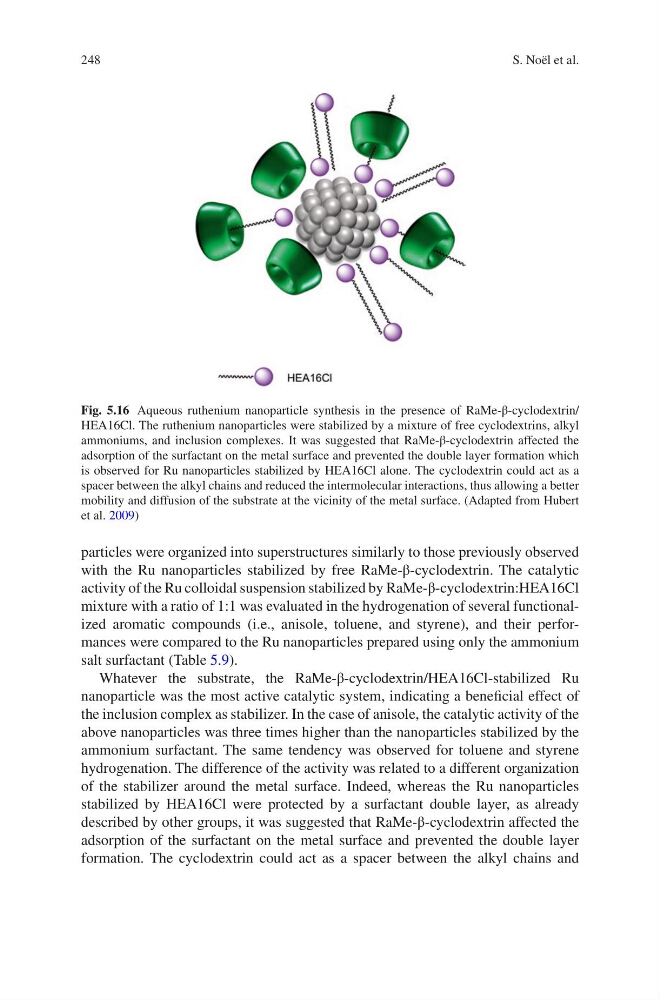
of the stabilizer around the metal surface. Indeed, whereas the Ru nanoparticles
stabilized by HEA16Cl were protected by a surfactant double layer, as already
described by other groups, it was suggested that RaMe-β-cyclodextrin affected the
adsorption of the surfactant on the metal surface and prevented the double layer
formation. The cyclodextrin could act as a spacer between the alkyl chains and
Fig. 5.16 Aqueous ruthenium nanoparticle synthesis in the presence of RaMe-β-cyclodextrin/
HEA16Cl. The ruthenium nanoparticles were stabilized by a mixture of free cyclodextrins, alkyl
ammoniums, and inclusion complexes. It was suggested that RaMe-β-cyclodextrin affected the
adsorption of the surfactant on the metal surface and prevented the double layer formation which
is observed for Ru nanoparticles stabilized by HEA16Cl alone. The cyclodextrin could act as a
spacer between the alkyl chains and reduced the intermolecular interactions, thus allowing a better
mobility and diffusion of the substrate at the vicinity of the metal surface. (Adapted from Hubert
et al. 2009)
S. Noël et al.
particles were organized into superstructures similarly to those previously observed
with the Ru nanoparticles stabilized by free RaMe-β-cyclodextrin. The catalytic
activity of the Ru colloidal suspension stabilized by RaMe-β-cyclodextrin:HEA16Cl
mixture with a ratio of 1:1 was evaluated in the hydrogenation of several functionalized aromatic compounds (i.e., anisole, toluene, and styrene), and their performances were compared to the Ru nanoparticles prepared using only the ammonium
salt surfactant (Table 5.9).
Whatever the substrate, the RaMe-β-cyclodextrin/HEA16Cl-stabilized Ru
nanoparticle was the most active catalytic system, indicating a beneficial effect of
the inclusion complex as stabilizer. In the case of anisole, the catalytic activity of the
above nanoparticles was three times higher than the nanoparticles stabilized by the
ammonium surfactant. The same tendency was observed for toluene and styrene
hydrogenation. The difference of the activity was related to a different organization
of the stabilizer around the metal surface. Indeed, whereas the Ru nanoparticles
stabilized by HEA16Cl were protected by a surfactant double layer, as already
described by other groups, it was suggested that RaMe-β-cyclodextrin affected the
adsorption of the surfactant on the metal surface and prevented the double layer
formation. The cyclodextrin could act as a spacer between the alkyl chains and
Fig. 5.16 Aqueous ruthenium nanoparticle synthesis in the presence of RaMe-β-cyclodextrin/
HEA16Cl. The ruthenium nanoparticles were stabilized by a mixture of free cyclodextrins, alkyl
ammoniums, and inclusion complexes. It was suggested that RaMe-β-cyclodextrin affected the
adsorption of the surfactant on the metal surface and prevented the double layer formation which
is observed for Ru nanoparticles stabilized by HEA16Cl alone. The cyclodextrin could act as a
spacer between the alkyl chains and reduced the intermolecular interactions, thus allowing a better
mobility and diffusion of the substrate at the vicinity of the metal surface. (Adapted from Hubert
et al. 2009)
S. Noël et al.