

240
5.2.3 Nanoparticles Stabilized by Polymers in the Presence
of Cyclodextrin
Nanoparticles Stabilized by a Physical Mixture of Polymer
and Cyclodextrin
Another way to stabilize aqueous dispersed metal nanoparticles is the possibility of
using water-soluble polymer in the presence of cyclodextrins. The use of cyclodextrins as additives in the synthesis of poly(N-vinyl-2-pyrrolidone)-stabilized metal
nanoparticles was studied (Herbois et al. 2012). For this purpose, Ru nanoparticles
were synthesized in the presence of poly(N-vinyl-2-pyrrolidone)/cyclodextrin mixture with a controlled ratio, and the transmission electron microscopy images of the
corresponding particles were carefully compared. For the standard Ru nanoparticles, i.e., Ru nanoparticles stabilized by poly(N-vinyl-2-pyrrolidone) alone, the particles were entrapped in string-like assemblies by the effect of
poly(N-vinyl-2-pyrrolidone) chains. The morphology did not seem to be altered by
the presence of cyclodextrin. However, a slight decrease in the mean particle size
was noticed when cyclodextrins were added to the poly(N-vinyl-2-pyrrolidone) (2.5
and 2.3 nm, respectively, for β-cyclodextrin and RaMe-β-cyclodextrin against
3.0 nm without cyclodextrin). The well-known aggregation of cyclodextrins in
aqueous solutions, which can give rise to large agglomerates in the 200–300 nm
range, was deeply disturbed by the presence of poly(N-vinyl-2-pyrrolidone).
According to the dynamic light scattering experiments, it was observed that these
cyclodextrin aggregates had the tendency to significantly disappear in the presence
of poly(N-vinyl-2-pyrrolidone) in favor of small-sized assemblies of only two or
three cyclodextrin units as evidenced by the presence of a population centered on a
mean diameter about 2–3 nm. The disaggregated cyclodextrins were assumed to
interact easier with the soluble Ru(III) precursor than poly(N-vinyl-2-pyrrolidone),
thus increasing the efficiency in controlling the growth of the Ru nanoparticles after
the reduction step (Fig. 5.13).
To confirm this hypothesis, an additional experiment was realized, in which
cyclodextrins were added to a preformed poly(N-vinyl-2-pyrrolidone)-stabilized Ru
colloidal suspension and kept under stirring during 24 supplementary hours.
Notably, the size range of the particles was the same to that of the control
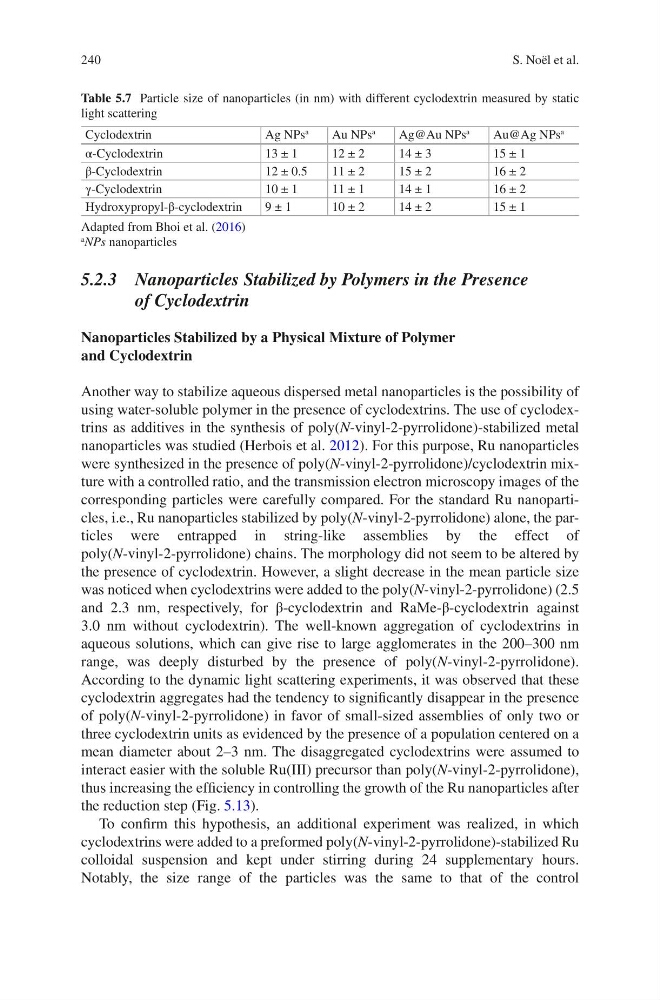
Table 5.7 Particle size of nanoparticles (in nm) with different cyclodextrin measured by static
light scattering
Cyclodextrin
Ag NPs
a
Au NPs
a
Ag@Au NPs
a
Au@Ag NPs
a
α-Cyclodextrin
13 ± 1
12 ± 2
14 ± 3
15 ± 1
β-Cyclodextrin
12 ± 0.5
11 ± 2
15 ± 2
16 ± 2
γ-Cyclodextrin
10 ± 1
11 ± 1
14 ± 1
16 ± 2
Hydroxypropyl-β-cyclodextrin
9 ± 1
10 ± 2
14 ± 2
15 ± 1
Adapted from Bhoi et al. (2016)
a
NPs nanoparticles
S. Noël et al.
5.2.3 Nanoparticles Stabilized by Polymers in the Presence
of Cyclodextrin
Nanoparticles Stabilized by a Physical Mixture of Polymer
and Cyclodextrin
Another way to stabilize aqueous dispersed metal nanoparticles is the possibility of
using water-soluble polymer in the presence of cyclodextrins. The use of cyclodextrins as additives in the synthesis of poly(N-vinyl-2-pyrrolidone)-stabilized metal
nanoparticles was studied (Herbois et al. 2012). For this purpose, Ru nanoparticles
were synthesized in the presence of poly(N-vinyl-2-pyrrolidone)/cyclodextrin mixture with a controlled ratio, and the transmission electron microscopy images of the
corresponding particles were carefully compared. For the standard Ru nanoparticles, i.e., Ru nanoparticles stabilized by poly(N-vinyl-2-pyrrolidone) alone, the particles were entrapped in string-like assemblies by the effect of
poly(N-vinyl-2-pyrrolidone) chains. The morphology did not seem to be altered by
the presence of cyclodextrin. However, a slight decrease in the mean particle size
was noticed when cyclodextrins were added to the poly(N-vinyl-2-pyrrolidone) (2.5
and 2.3 nm, respectively, for β-cyclodextrin and RaMe-β-cyclodextrin against
3.0 nm without cyclodextrin). The well-known aggregation of cyclodextrins in
aqueous solutions, which can give rise to large agglomerates in the 200–300 nm
range, was deeply disturbed by the presence of poly(N-vinyl-2-pyrrolidone).
According to the dynamic light scattering experiments, it was observed that these
cyclodextrin aggregates had the tendency to significantly disappear in the presence
of poly(N-vinyl-2-pyrrolidone) in favor of small-sized assemblies of only two or
three cyclodextrin units as evidenced by the presence of a population centered on a
mean diameter about 2–3 nm. The disaggregated cyclodextrins were assumed to
interact easier with the soluble Ru(III) precursor than poly(N-vinyl-2-pyrrolidone),
thus increasing the efficiency in controlling the growth of the Ru nanoparticles after
the reduction step (Fig. 5.13).
To confirm this hypothesis, an additional experiment was realized, in which
cyclodextrins were added to a preformed poly(N-vinyl-2-pyrrolidone)-stabilized Ru
colloidal suspension and kept under stirring during 24 supplementary hours.
Notably, the size range of the particles was the same to that of the control
Table 5.7 Particle size of nanoparticles (in nm) with different cyclodextrin measured by static
light scattering
Cyclodextrin
Ag NPs
a
Au NPs
a
Ag@Au NPs
a
Au@Ag NPs
a
α-Cyclodextrin
13 ± 1
12 ± 2
14 ± 3
15 ± 1
β-Cyclodextrin
12 ± 0.5
11 ± 2
15 ± 2
16 ± 2
γ-Cyclodextrin
10 ± 1
11 ± 1
14 ± 1
16 ± 2
Hydroxypropyl-β-cyclodextrin
9 ± 1
10 ± 2
14 ± 2
15 ± 1
Adapted from Bhoi et al. (2016)
a
NPs nanoparticles
S. Noël et al.