

239
avoid too toxic compounds such as NaBH 4 or hydrazine. The silver nanoparticles
were tested in the catalytic degradation of methyl orange, rhodamine, and
4- nitrophenol. 4-nitrophenol was completely converted into 4-aminophenol within
25 min when rhodamine and methyl orange were completely converted within 22 min.
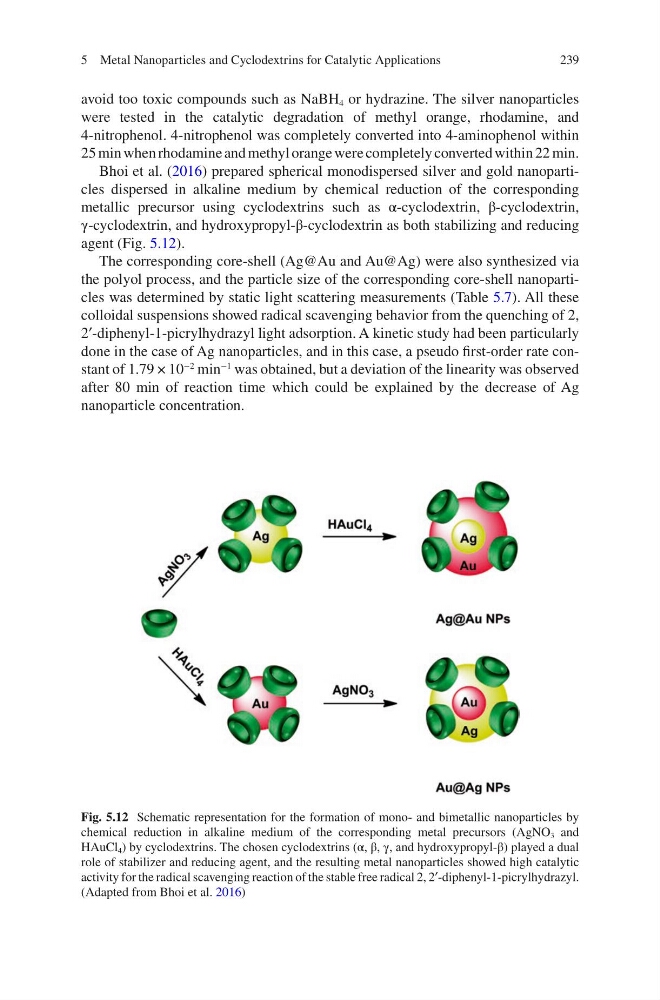
Bhoi et al. (2016) prepared spherical monodispersed silver and gold nanoparticles dispersed in alkaline medium by chemical reduction of the corresponding
metallic precursor using cyclodextrins such as α-cyclodextrin, β-cyclodextrin,
γ-cyclodextrin, and hydroxypropyl-β-cyclodextrin as both stabilizing and reducing
agent (Fig. 5.12).
The corresponding core-shell (Ag@Au and Au@Ag) were also synthesized via
the polyol process, and the particle size of the corresponding core-shell nanoparticles was determined by static light scattering measurements (Table 5.7). All these
colloidal suspensions showed radical scavenging behavior from the quenching of 2,
2′-diphenyl-1-picrylhydrazyl light adsorption. A kinetic study had been particularly
done in the case of Ag nanoparticles, and in this case, a pseudo first-order rate constant of 1.79 × 10
−2
min
−1
was obtained, but a deviation of the linearity was observed
after 80 min of reaction time which could be explained by the decrease of Ag
nanoparticle concentration.
Fig. 5.12 Schematic representation for the formation of mono- and bimetallic nanoparticles by
chemical reduction in alkaline medium of the corresponding metal precursors (AgNO 3 and
HAuCl 4 ) by cyclodextrins. The chosen cyclodextrins (α, β, γ, and hydroxypropyl-β) played a dual
role of stabilizer and reducing agent, and the resulting metal nanoparticles showed high catalytic
activity for the radical scavenging reaction of the stable free radical 2, 2′-diphenyl-1- picrylhydrazyl.
(Adapted from Bhoi et al. 2016)
5 Metal Nanoparticles and Cyclodextrins for Catalytic Applications
avoid too toxic compounds such as NaBH 4 or hydrazine. The silver nanoparticles
were tested in the catalytic degradation of methyl orange, rhodamine, and
4- nitrophenol. 4-nitrophenol was completely converted into 4-aminophenol within
25 min when rhodamine and methyl orange were completely converted within 22 min.
Bhoi et al. (2016) prepared spherical monodispersed silver and gold nanoparticles dispersed in alkaline medium by chemical reduction of the corresponding
metallic precursor using cyclodextrins such as α-cyclodextrin, β-cyclodextrin,
γ-cyclodextrin, and hydroxypropyl-β-cyclodextrin as both stabilizing and reducing
agent (Fig. 5.12).
The corresponding core-shell (Ag@Au and Au@Ag) were also synthesized via
the polyol process, and the particle size of the corresponding core-shell nanoparticles was determined by static light scattering measurements (Table 5.7). All these
colloidal suspensions showed radical scavenging behavior from the quenching of 2,
2′-diphenyl-1-picrylhydrazyl light adsorption. A kinetic study had been particularly
done in the case of Ag nanoparticles, and in this case, a pseudo first-order rate constant of 1.79 × 10
−2
min
−1
was obtained, but a deviation of the linearity was observed
after 80 min of reaction time which could be explained by the decrease of Ag
nanoparticle concentration.
Fig. 5.12 Schematic representation for the formation of mono- and bimetallic nanoparticles by
chemical reduction in alkaline medium of the corresponding metal precursors (AgNO 3 and
HAuCl 4 ) by cyclodextrins. The chosen cyclodextrins (α, β, γ, and hydroxypropyl-β) played a dual
role of stabilizer and reducing agent, and the resulting metal nanoparticles showed high catalytic
activity for the radical scavenging reaction of the stable free radical 2, 2′-diphenyl-1- picrylhydrazyl.
(Adapted from Bhoi et al. 2016)
5 Metal Nanoparticles and Cyclodextrins for Catalytic Applications