

236
Very interestingly, the hydrogenation of aromatic rings depended both on the
type of methylated cyclodextrin (α, β, γ) and on the substitution degree. Indeed,
when RaMe-α-cyclodextrin was used as the stabilizer, the aromatic rings were not
hydrogenated. In contrast, their total hydrogenation was observed with RaMe-γcyclodextrin-stabilized Ru nanoparticles. These results can be explained by the cavity size of the different cyclodextrins which leads to more or less important
interactions with the substrates. In the case of the RaMe-β-cyclodextrin, the selectivities were related to the substitution degree. These catalytic results can be correlated to the deeper hydrophobic host cavity of the RaMe-β-cyclodextrin with the
highest degree of substitution which can wrap more efficiently the aromatic rings of
the substrate avoiding their hydrogenation. The turnover frequency values are modest compared to other catalytic systems, but the reactions were carried out at room
temperature under atmospheric hydrogen pressure.
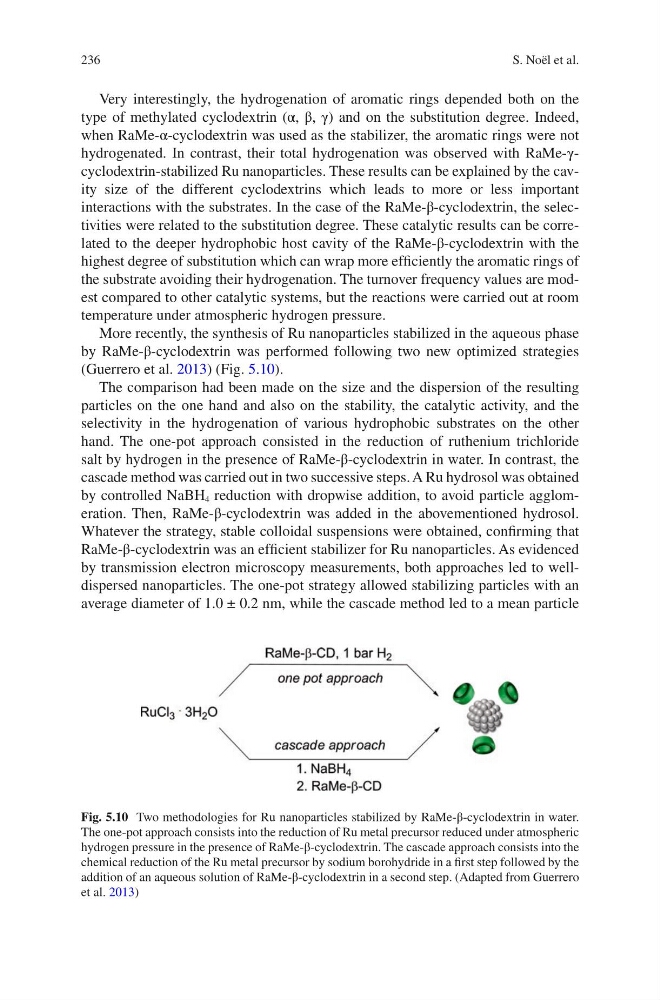
More recently, the synthesis of Ru nanoparticles stabilized in the aqueous phase
by RaMe-β-cyclodextrin was performed following two new optimized strategies
(Guerrero et al. 2013) (Fig. 5.10).
The comparison had been made on the size and the dispersion of the resulting
particles on the one hand and also on the stability, the catalytic activity, and the
selectivity in the hydrogenation of various hydrophobic substrates on the other
hand. The one-pot approach consisted in the reduction of ruthenium trichloride
salt by hydrogen in the presence of RaMe-β-cyclodextrin in water. In contrast, the
cascade method was carried out in two successive steps. A Ru hydrosol was obtained
by controlled NaBH 4 reduction with dropwise addition, to avoid particle agglomeration. Then, RaMe-β-cyclodextrin was added in the abovementioned hydrosol.
Whatever the strategy, stable colloidal suspensions were obtained, confirming that
RaMe-β-cyclodextrin was an efficient stabilizer for Ru nanoparticles. As evidenced
by transmission electron microscopy measurements, both approaches led to welldispersed nanoparticles. The one-pot strategy allowed stabilizing particles with an
average diameter of 1.0 ± 0.2 nm, while the cascade method led to a mean particle
Fig. 5.10 Two methodologies for Ru nanoparticles stabilized by RaMe-β-cyclodextrin in water.
The one-pot approach consists into the reduction of Ru metal precursor reduced under atmospheric
hydrogen pressure in the presence of RaMe-β-cyclodextrin. The cascade approach consists into the
chemical reduction of the Ru metal precursor by sodium borohydride in a first step followed by the
addition of an aqueous solution of RaMe-β-cyclodextrin in a second step. (Adapted from Guerrero
et al. 2013)
S. Noël et al.
Very interestingly, the hydrogenation of aromatic rings depended both on the
type of methylated cyclodextrin (α, β, γ) and on the substitution degree. Indeed,
when RaMe-α-cyclodextrin was used as the stabilizer, the aromatic rings were not
hydrogenated. In contrast, their total hydrogenation was observed with RaMe-γcyclodextrin-stabilized Ru nanoparticles. These results can be explained by the cavity size of the different cyclodextrins which leads to more or less important
interactions with the substrates. In the case of the RaMe-β-cyclodextrin, the selectivities were related to the substitution degree. These catalytic results can be correlated to the deeper hydrophobic host cavity of the RaMe-β-cyclodextrin with the
highest degree of substitution which can wrap more efficiently the aromatic rings of
the substrate avoiding their hydrogenation. The turnover frequency values are modest compared to other catalytic systems, but the reactions were carried out at room
temperature under atmospheric hydrogen pressure.
More recently, the synthesis of Ru nanoparticles stabilized in the aqueous phase
by RaMe-β-cyclodextrin was performed following two new optimized strategies
(Guerrero et al. 2013) (Fig. 5.10).
The comparison had been made on the size and the dispersion of the resulting
particles on the one hand and also on the stability, the catalytic activity, and the
selectivity in the hydrogenation of various hydrophobic substrates on the other
hand. The one-pot approach consisted in the reduction of ruthenium trichloride
salt by hydrogen in the presence of RaMe-β-cyclodextrin in water. In contrast, the
cascade method was carried out in two successive steps. A Ru hydrosol was obtained
by controlled NaBH 4 reduction with dropwise addition, to avoid particle agglomeration. Then, RaMe-β-cyclodextrin was added in the abovementioned hydrosol.
Whatever the strategy, stable colloidal suspensions were obtained, confirming that
RaMe-β-cyclodextrin was an efficient stabilizer for Ru nanoparticles. As evidenced
by transmission electron microscopy measurements, both approaches led to welldispersed nanoparticles. The one-pot strategy allowed stabilizing particles with an
average diameter of 1.0 ± 0.2 nm, while the cascade method led to a mean particle
Fig. 5.10 Two methodologies for Ru nanoparticles stabilized by RaMe-β-cyclodextrin in water.
The one-pot approach consists into the reduction of Ru metal precursor reduced under atmospheric
hydrogen pressure in the presence of RaMe-β-cyclodextrin. The cascade approach consists into the
chemical reduction of the Ru metal precursor by sodium borohydride in a first step followed by the
addition of an aqueous solution of RaMe-β-cyclodextrin in a second step. (Adapted from Guerrero
et al. 2013)
S. Noël et al.