

237
size of 1.4 ± 0.2 nm. To have a deeper insight into the interactions between the randomly methylated cyclodextrins and metal surface in both methods, diffusion
ordered spectroscopy experiments had been carried out in D 2 O solution. Whatever
the synthesis strategy, similar values of diffusion coefficients and hydrodynamic
radius were obtained. Contrary to what is usually observed with strongly interacting
ligands, such as phosphines, the
1
H NMR experiments exhibited no significant difference in the chemical shifts of the cyclodextrins, indicating weak interactions
between RaMe-β-cyclodextrin and the surface of the metal nanoparticles.
Consequently, the authors gave a dispersive agent behavior to the cyclodextrin
instead of a stabilizing effect of a classical ligand. The catalytic activity of the Ru
nanoparticles prepared by each strategy was evaluated in the hydrogenation of several model substrates, including 3-methylanisole, methyl-2-acetamidoacrylate, and
ethyl pyruvate, under 20 bar of hydrogen. For ethyl pyruvate and methyl-2acetamidoacrylate, the catalytic activities related to the nanoparticles prepared by
the cascade method were slightly higher. The possibility of recycling these catalytic
systems was investigated on the hydrogenation of ethyl pyruvate, and whatever the
strategy, it showed that four successive runs were achieved without any significant
loss of stability and activity.
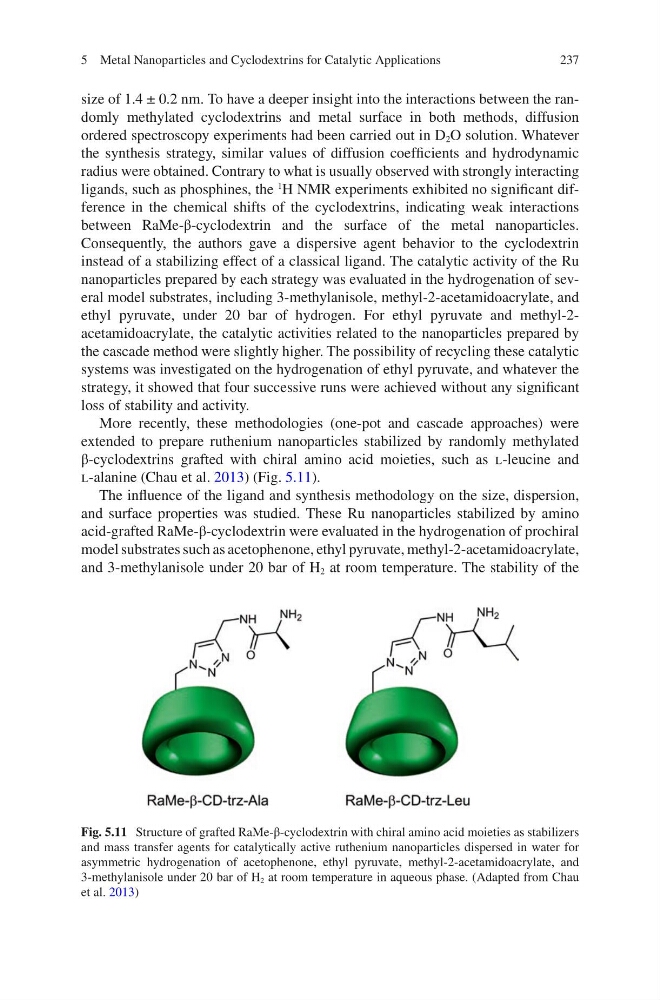
More recently, these methodologies (one-pot and cascade approaches) were
extended to prepare ruthenium nanoparticles stabilized by randomly methylated
β-cyclodextrins grafted with chiral amino acid moieties, such as l-leucine and
l-alanine (Chau et al. 2013) (Fig. 5.11).
The influence of the ligand and synthesis methodology on the size, dispersion,
and surface properties was studied. These Ru nanoparticles stabilized by amino
acid-grafted RaMe-β-cyclodextrin were evaluated in the hydrogenation of prochiral
model substrates such as acetophenone, ethyl pyruvate, methyl-2- acetamidoacrylate,
and 3-methylanisole under 20 bar of H 2 at room temperature. The stability of the
Fig. 5.11 Structure of grafted RaMe-β-cyclodextrin with chiral amino acid moieties as stabilizers
and mass transfer agents for catalytically active ruthenium nanoparticles dispersed in water for
asymmetric hydrogenation of acetophenone, ethyl pyruvate, methyl-2-acetamidoacrylate, and
3-methylanisole under 20 bar of H 2 at room temperature in aqueous phase. (Adapted from Chau
et al. 2013)
5 Metal Nanoparticles and Cyclodextrins for Catalytic Applications
size of 1.4 ± 0.2 nm. To have a deeper insight into the interactions between the randomly methylated cyclodextrins and metal surface in both methods, diffusion
ordered spectroscopy experiments had been carried out in D 2 O solution. Whatever
the synthesis strategy, similar values of diffusion coefficients and hydrodynamic
radius were obtained. Contrary to what is usually observed with strongly interacting
ligands, such as phosphines, the
1
H NMR experiments exhibited no significant difference in the chemical shifts of the cyclodextrins, indicating weak interactions
between RaMe-β-cyclodextrin and the surface of the metal nanoparticles.
Consequently, the authors gave a dispersive agent behavior to the cyclodextrin
instead of a stabilizing effect of a classical ligand. The catalytic activity of the Ru
nanoparticles prepared by each strategy was evaluated in the hydrogenation of several model substrates, including 3-methylanisole, methyl-2-acetamidoacrylate, and
ethyl pyruvate, under 20 bar of hydrogen. For ethyl pyruvate and methyl-2acetamidoacrylate, the catalytic activities related to the nanoparticles prepared by
the cascade method were slightly higher. The possibility of recycling these catalytic
systems was investigated on the hydrogenation of ethyl pyruvate, and whatever the
strategy, it showed that four successive runs were achieved without any significant
loss of stability and activity.
More recently, these methodologies (one-pot and cascade approaches) were
extended to prepare ruthenium nanoparticles stabilized by randomly methylated
β-cyclodextrins grafted with chiral amino acid moieties, such as l-leucine and
l-alanine (Chau et al. 2013) (Fig. 5.11).
The influence of the ligand and synthesis methodology on the size, dispersion,
and surface properties was studied. These Ru nanoparticles stabilized by amino
acid-grafted RaMe-β-cyclodextrin were evaluated in the hydrogenation of prochiral
model substrates such as acetophenone, ethyl pyruvate, methyl-2- acetamidoacrylate,
and 3-methylanisole under 20 bar of H 2 at room temperature. The stability of the
Fig. 5.11 Structure of grafted RaMe-β-cyclodextrin with chiral amino acid moieties as stabilizers
and mass transfer agents for catalytically active ruthenium nanoparticles dispersed in water for
asymmetric hydrogenation of acetophenone, ethyl pyruvate, methyl-2-acetamidoacrylate, and
3-methylanisole under 20 bar of H 2 at room temperature in aqueous phase. (Adapted from Chau
et al. 2013)
5 Metal Nanoparticles and Cyclodextrins for Catalytic Applications