

235
These alkenes were totally hydrogenated to their saturated analogues with turnover frequencies (TOFs) ranging from 12 to 22 h
−1
. These TOFs are modest in
comparison to other aqueous nanocatalytic systems, but the experimental conditions are less harsh. It is worth noting that the catalytic activity decreased with
increasing the chain length (C 10 > C 12 > C 14 ). This phenomenon could be attributed
to a lower solubility of the resulting inclusion complex in water. These colloids
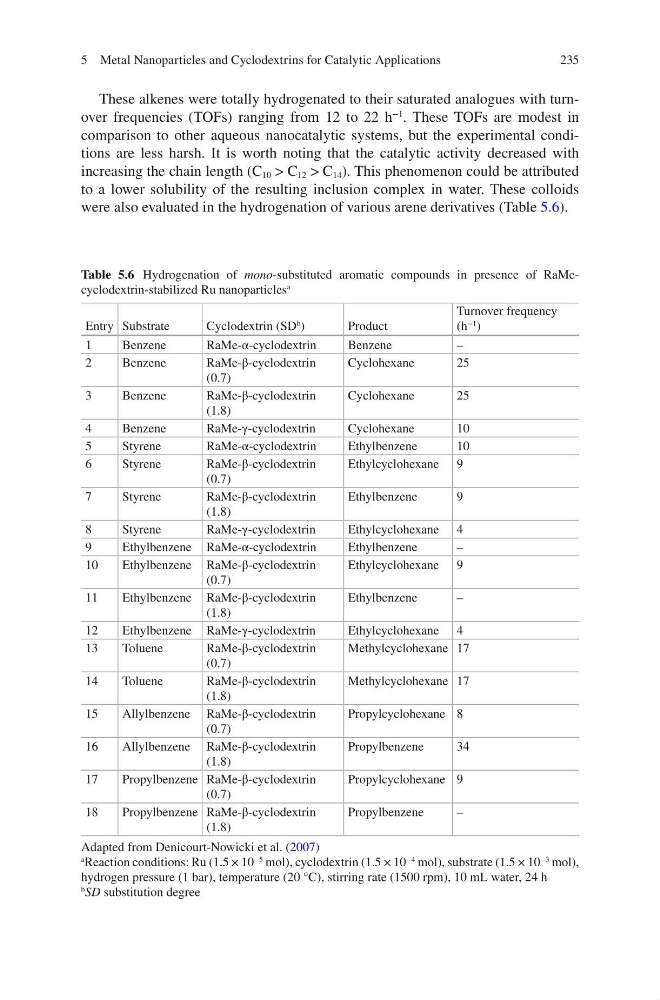
were also evaluated in the hydrogenation of various arene derivatives (Table 5.6).
Table 5.6 Hydrogenation of mono-substituted aromatic compounds in presence of RaMecyclodextrin- stabilized Ru nanoparticles
a
Entry Substrate
Cyclodextrin (SD
b
)
Product
Turnover frequency
(h
−1 )
1
Benzene
RaMe-α-cyclodextrin
Benzene
–
2
Benzene
RaMe-β-cyclodextrin
(0.7)
Cyclohexane
25
3
Benzene
RaMe-β-cyclodextrin
(1.8)
Cyclohexane
25
4
Benzene
RaMe-γ-cyclodextrin
Cyclohexane
10
5
Styrene
RaMe-α-cyclodextrin
Ethylbenzene
10
6
Styrene
RaMe-β-cyclodextrin
(0.7)
Ethylcyclohexane 9
7
Styrene
RaMe-β-cyclodextrin
(1.8)
Ethylbenzene
9
8
Styrene
RaMe-γ-cyclodextrin
Ethylcyclohexane 4
9
Ethylbenzene RaMe-α-cyclodextrin
Ethylbenzene
–
10
Ethylbenzene RaMe-β-cyclodextrin
(0.7)
Ethylcyclohexane 9
11
Ethylbenzene RaMe-β-cyclodextrin
(1.8)
Ethylbenzene
–
12
Ethylbenzene RaMe-γ-cyclodextrin
Ethylcyclohexane 4
13
Toluene
RaMe-β-cyclodextrin
(0.7)
Methylcyclohexane 17
14
Toluene
RaMe-β-cyclodextrin
(1.8)
Methylcyclohexane 17
15
Allylbenzene RaMe-β-cyclodextrin
(0.7)
Propylcyclohexane 8
16
Allylbenzene RaMe-β-cyclodextrin
(1.8)
Propylbenzene
34
17
Propylbenzene RaMe-β-cyclodextrin
(0.7)
Propylcyclohexane 9
18
Propylbenzene RaMe-β-cyclodextrin
(1.8)
Propylbenzene
–
Adapted from Denicourt-Nowicki et al. (2007)
a Reaction conditions: Ru (1.5 × 10
−5
mol), cyclodextrin (1.5 × 10
−4 mol), substrate (1.5 × 10
−3
mol),
hydrogen pressure (1 bar), temperature (20 °C), stirring rate (1500 rpm), 10 mL water, 24 h
b
SD substitution degree
5 Metal Nanoparticles and Cyclodextrins for Catalytic Applications
These alkenes were totally hydrogenated to their saturated analogues with turnover frequencies (TOFs) ranging from 12 to 22 h
−1
. These TOFs are modest in
comparison to other aqueous nanocatalytic systems, but the experimental conditions are less harsh. It is worth noting that the catalytic activity decreased with
increasing the chain length (C 10 > C 12 > C 14 ). This phenomenon could be attributed
to a lower solubility of the resulting inclusion complex in water. These colloids
were also evaluated in the hydrogenation of various arene derivatives (Table 5.6).
Table 5.6 Hydrogenation of mono-substituted aromatic compounds in presence of RaMecyclodextrin- stabilized Ru nanoparticles
a
Entry Substrate
Cyclodextrin (SD
b
)
Product
Turnover frequency
(h
−1 )
1
Benzene
RaMe-α-cyclodextrin
Benzene
–
2
Benzene
RaMe-β-cyclodextrin
(0.7)
Cyclohexane
25
3
Benzene
RaMe-β-cyclodextrin
(1.8)
Cyclohexane
25
4
Benzene
RaMe-γ-cyclodextrin
Cyclohexane
10
5
Styrene
RaMe-α-cyclodextrin
Ethylbenzene
10
6
Styrene
RaMe-β-cyclodextrin
(0.7)
Ethylcyclohexane 9
7
Styrene
RaMe-β-cyclodextrin
(1.8)
Ethylbenzene
9
8
Styrene
RaMe-γ-cyclodextrin
Ethylcyclohexane 4
9
Ethylbenzene RaMe-α-cyclodextrin
Ethylbenzene
–
10
Ethylbenzene RaMe-β-cyclodextrin
(0.7)
Ethylcyclohexane 9
11
Ethylbenzene RaMe-β-cyclodextrin
(1.8)
Ethylbenzene
–
12
Ethylbenzene RaMe-γ-cyclodextrin
Ethylcyclohexane 4
13
Toluene
RaMe-β-cyclodextrin
(0.7)
Methylcyclohexane 17
14
Toluene
RaMe-β-cyclodextrin
(1.8)
Methylcyclohexane 17
15
Allylbenzene RaMe-β-cyclodextrin
(0.7)
Propylcyclohexane 8
16
Allylbenzene RaMe-β-cyclodextrin
(1.8)
Propylbenzene
34
17
Propylbenzene RaMe-β-cyclodextrin
(0.7)
Propylcyclohexane 9
18
Propylbenzene RaMe-β-cyclodextrin
(1.8)
Propylbenzene
–
Adapted from Denicourt-Nowicki et al. (2007)
a Reaction conditions: Ru (1.5 × 10
−5
mol), cyclodextrin (1.5 × 10
−4 mol), substrate (1.5 × 10
−3
mol),
hydrogen pressure (1 bar), temperature (20 °C), stirring rate (1500 rpm), 10 mL water, 24 h
b
SD substitution degree
5 Metal Nanoparticles and Cyclodextrins for Catalytic Applications