

232
indicating the interactions between the thiolated cyclodextrin and the surface of the
nanoparticles (3356 and 1415 cm
−1
vs. 3375 and 1371 cm
−1
for the hydroxyl bands).
These copper nanoparticles were tested as enzyme mimic, and the cyclodextrin had
a strong effect on the reaction rate. The peroxidase-like catalysis of Cu nanoclusters
showed the Michaelis-Menten kinetics, which was similar to that of horseradish
peroxidase. On the basis of its unique and attractive catalytic activity, a simple and
selective colorimetric assay for H 2 O 2 and glucose has been developed. Compared
with the natural enzymes, Cu nanoclusters as a mimic peroxidase showed several
advantages such as the ease of preparation, the low cost, as well as the high stability
and activity under harsh conditions, which made it a promising candidate as enzyme
mimics in biotechnology and clinical diagnosis applications.
Nanoparticles Stabilized by Alkylated Cyclodextrins
Alkylated cyclodextrins such as randomly methylated β-cyclodextrin (RaMe-βcyclodextrin) and hydroxypropylated β-cyclodextrin (HP-β-cyclodextrin) (Fig. 5.9)
have also been used for the stabilization of metal nanoparticles.
The synthesis of ruthenium nanoparticles in water using randomly methylated
cyclodextrins as protective agents was reported for the first time by Monflier and
Roucoux (Nowicki et al. 2006; Denicourt-Nowicki et al. 2007). These cyclodextrins
had some advantages such as high solubility in water, low cost, non-toxicity, and
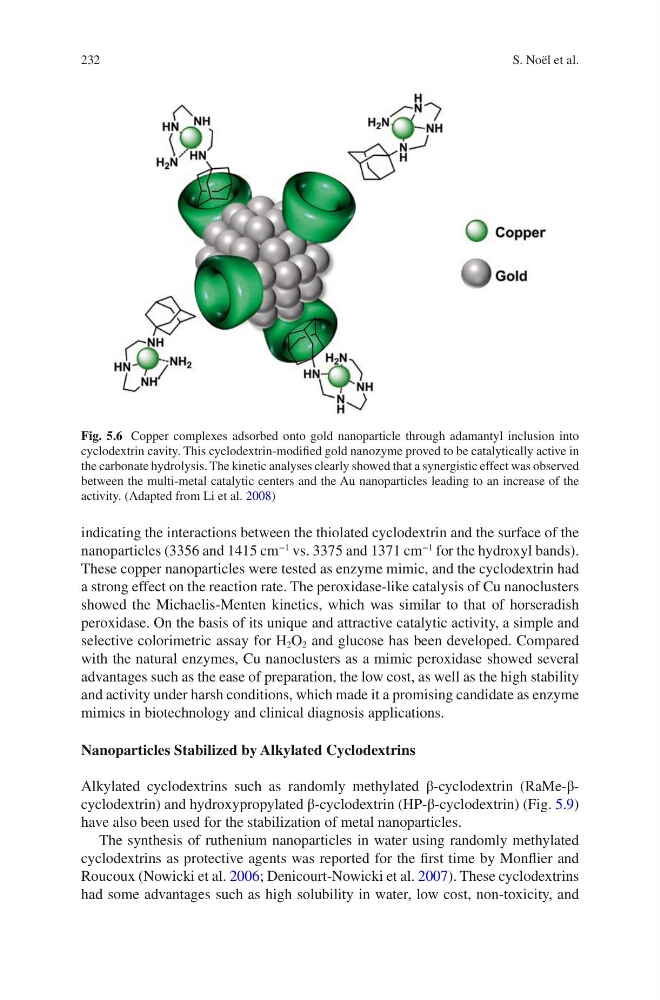
Fig. 5.6 Copper complexes adsorbed onto gold nanoparticle through adamantyl inclusion into
cyclodextrin cavity. This cyclodextrin-modified gold nanozyme proved to be catalytically active in
the carbonate hydrolysis. The kinetic analyses clearly showed that a synergistic effect was observed
between the multi-metal catalytic centers and the Au nanoparticles leading to an increase of the
activity. (Adapted from Li et al. 2008)
S. Noël et al.
indicating the interactions between the thiolated cyclodextrin and the surface of the
nanoparticles (3356 and 1415 cm
−1
vs. 3375 and 1371 cm
−1
for the hydroxyl bands).
These copper nanoparticles were tested as enzyme mimic, and the cyclodextrin had
a strong effect on the reaction rate. The peroxidase-like catalysis of Cu nanoclusters
showed the Michaelis-Menten kinetics, which was similar to that of horseradish
peroxidase. On the basis of its unique and attractive catalytic activity, a simple and
selective colorimetric assay for H 2 O 2 and glucose has been developed. Compared
with the natural enzymes, Cu nanoclusters as a mimic peroxidase showed several
advantages such as the ease of preparation, the low cost, as well as the high stability
and activity under harsh conditions, which made it a promising candidate as enzyme
mimics in biotechnology and clinical diagnosis applications.
Nanoparticles Stabilized by Alkylated Cyclodextrins
Alkylated cyclodextrins such as randomly methylated β-cyclodextrin (RaMe-βcyclodextrin) and hydroxypropylated β-cyclodextrin (HP-β-cyclodextrin) (Fig. 5.9)
have also been used for the stabilization of metal nanoparticles.
The synthesis of ruthenium nanoparticles in water using randomly methylated
cyclodextrins as protective agents was reported for the first time by Monflier and
Roucoux (Nowicki et al. 2006; Denicourt-Nowicki et al. 2007). These cyclodextrins
had some advantages such as high solubility in water, low cost, non-toxicity, and
Fig. 5.6 Copper complexes adsorbed onto gold nanoparticle through adamantyl inclusion into
cyclodextrin cavity. This cyclodextrin-modified gold nanozyme proved to be catalytically active in
the carbonate hydrolysis. The kinetic analyses clearly showed that a synergistic effect was observed
between the multi-metal catalytic centers and the Au nanoparticles leading to an increase of the
activity. (Adapted from Li et al. 2008)
S. Noël et al.