

231
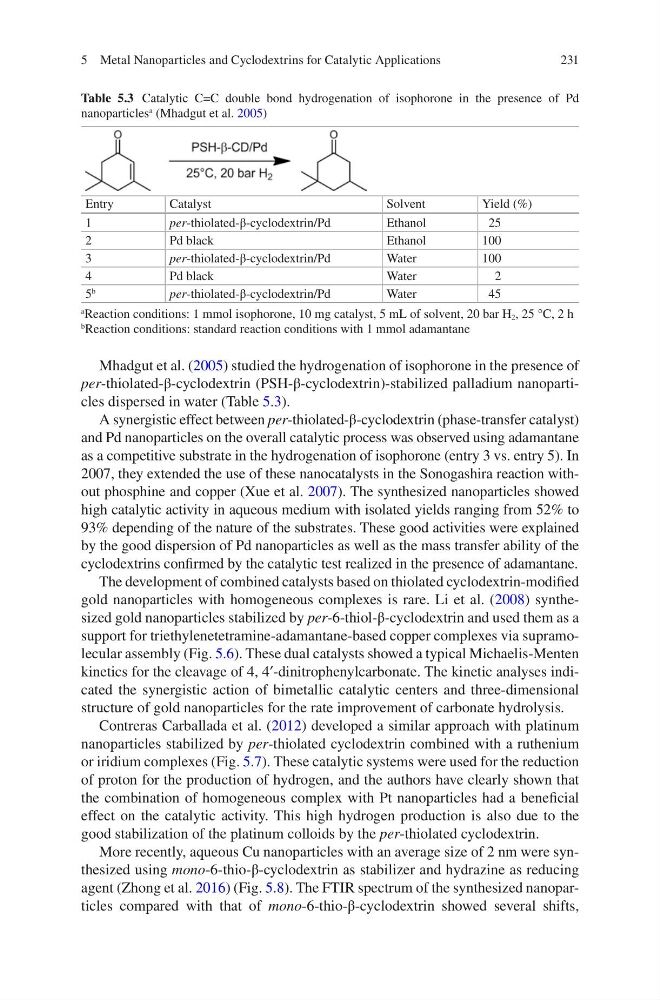
Mhadgut et al. (2005) studied the hydrogenation of isophorone in the presence of
per-thiolated-β-cyclodextrin (PSH-β-cyclodextrin)-stabilized palladium nanoparticles dispersed in water (Table 5.3).
A synergistic effect between per-thiolated-β-cyclodextrin (phase-transfer catalyst)
and Pd nanoparticles on the overall catalytic process was observed using adamantane
as a competitive substrate in the hydrogenation of isophorone (entry 3 vs. entry 5). In
2007, they extended the use of these nanocatalysts in the Sonogashira reaction without phosphine and copper (Xue et al. 2007). The synthesized nanoparticles showed
high catalytic activity in aqueous medium with isolated yields ranging from 52% to
93% depending of the nature of the substrates. These good activities were explained
by the good dispersion of Pd nanoparticles as well as the mass transfer ability of the
cyclodextrins confirmed by the catalytic test realized in the presence of adamantane.
The development of combined catalysts based on thiolated cyclodextrin- modified
gold nanoparticles with homogeneous complexes is rare. Li et al. (2008) synthesized gold nanoparticles stabilized by per-6-thiol-β-cyclodextrin and used them as a
support for triethylenetetramine-adamantane-based copper complexes via supramolecular assembly (Fig. 5.6). These dual catalysts showed a typical Michaelis- Menten
kinetics for the cleavage of 4, 4′-dinitrophenylcarbonate. The kinetic analyses indicated the synergistic action of bimetallic catalytic centers and three- dimensional
structure of gold nanoparticles for the rate improvement of carbonate hydrolysis.
Contreras Carballada et al. (2012) developed a similar approach with platinum
nanoparticles stabilized by per-thiolated cyclodextrin combined with a ruthenium
or iridium complexes (Fig. 5.7). These catalytic systems were used for the reduction
of proton for the production of hydrogen, and the authors have clearly shown that
the combination of homogeneous complex with Pt nanoparticles had a beneficial
effect on the catalytic activity. This high hydrogen production is also due to the
good stabilization of the platinum colloids by the per-thiolated cyclodextrin.
More recently, aqueous Cu nanoparticles with an average size of 2 nm were synthesized using mono-6-thio-β-cyclodextrin as stabilizer and hydrazine as reducing
agent (Zhong et al. 2016) (Fig. 5.8). The FTIR spectrum of the synthesized nanoparticles compared with that of mono-6-thio-β-cyclodextrin showed several shifts,
Table 5.3 Catalytic C=C double bond hydrogenation of isophorone in the presence of Pd
nanoparticles
a (Mhadgut et al. 2005)
Entry
Catalyst
Solvent
Yield (%)
1
per-thiolated-β-cyclodextrin/Pd
Ethanol
25
2
Pd black
Ethanol
100
3
per-thiolated-β-cyclodextrin/Pd
Water
100
4
Pd black
Water
2
5
b
per-thiolated-β-cyclodextrin/Pd
Water
45
a
Reaction conditions: 1 mmol isophorone, 10 mg catalyst, 5 mL of solvent, 20 bar H 2 , 25 °C, 2 h
b
Reaction conditions: standard reaction conditions with 1 mmol adamantane
5 Metal Nanoparticles and Cyclodextrins for Catalytic Applications
Mhadgut et al. (2005) studied the hydrogenation of isophorone in the presence of
per-thiolated-β-cyclodextrin (PSH-β-cyclodextrin)-stabilized palladium nanoparticles dispersed in water (Table 5.3).
A synergistic effect between per-thiolated-β-cyclodextrin (phase-transfer catalyst)
and Pd nanoparticles on the overall catalytic process was observed using adamantane
as a competitive substrate in the hydrogenation of isophorone (entry 3 vs. entry 5). In
2007, they extended the use of these nanocatalysts in the Sonogashira reaction without phosphine and copper (Xue et al. 2007). The synthesized nanoparticles showed
high catalytic activity in aqueous medium with isolated yields ranging from 52% to
93% depending of the nature of the substrates. These good activities were explained
by the good dispersion of Pd nanoparticles as well as the mass transfer ability of the
cyclodextrins confirmed by the catalytic test realized in the presence of adamantane.
The development of combined catalysts based on thiolated cyclodextrin- modified
gold nanoparticles with homogeneous complexes is rare. Li et al. (2008) synthesized gold nanoparticles stabilized by per-6-thiol-β-cyclodextrin and used them as a
support for triethylenetetramine-adamantane-based copper complexes via supramolecular assembly (Fig. 5.6). These dual catalysts showed a typical Michaelis- Menten
kinetics for the cleavage of 4, 4′-dinitrophenylcarbonate. The kinetic analyses indicated the synergistic action of bimetallic catalytic centers and three- dimensional
structure of gold nanoparticles for the rate improvement of carbonate hydrolysis.
Contreras Carballada et al. (2012) developed a similar approach with platinum
nanoparticles stabilized by per-thiolated cyclodextrin combined with a ruthenium
or iridium complexes (Fig. 5.7). These catalytic systems were used for the reduction
of proton for the production of hydrogen, and the authors have clearly shown that
the combination of homogeneous complex with Pt nanoparticles had a beneficial
effect on the catalytic activity. This high hydrogen production is also due to the
good stabilization of the platinum colloids by the per-thiolated cyclodextrin.
More recently, aqueous Cu nanoparticles with an average size of 2 nm were synthesized using mono-6-thio-β-cyclodextrin as stabilizer and hydrazine as reducing
agent (Zhong et al. 2016) (Fig. 5.8). The FTIR spectrum of the synthesized nanoparticles compared with that of mono-6-thio-β-cyclodextrin showed several shifts,
Table 5.3 Catalytic C=C double bond hydrogenation of isophorone in the presence of Pd
nanoparticles
a (Mhadgut et al. 2005)
Entry
Catalyst
Solvent
Yield (%)
1
per-thiolated-β-cyclodextrin/Pd
Ethanol
25
2
Pd black
Ethanol
100
3
per-thiolated-β-cyclodextrin/Pd
Water
100
4
Pd black
Water
2
5
b
per-thiolated-β-cyclodextrin/Pd
Water
45
a
Reaction conditions: 1 mmol isophorone, 10 mg catalyst, 5 mL of solvent, 20 bar H 2 , 25 °C, 2 h
b
Reaction conditions: standard reaction conditions with 1 mmol adamantane
5 Metal Nanoparticles and Cyclodextrins for Catalytic Applications