

230
of iodo derivatives in comparison to bromo derivatives (respectively, turnover frequency from 41 to 48 h
−1
and from 7.8 to 13 h
−1
) which is generally observed in C-C
coupling reactions. Interestingly, the authors compared their values to poly(Nvinyl- 2-pyrrolidone)-stabilized Pd nanoparticles (Li et al. 2002). These lower values can be explained by too strong interactions between the thiolated cyclodextrin
with the palladium nanoparticles. In the case of iodoferrocene, substrate which can
form an inclusion complex with the thiolated cyclodextrin, the catalytic activity of
the corresponding palladium nanoparticles was improved in the presence of the
cyclodextrin. It is important to note that the authors awarded the opposing solubility
requirements which constitute the use of cyclodextrin-capped metal nanoparticles.
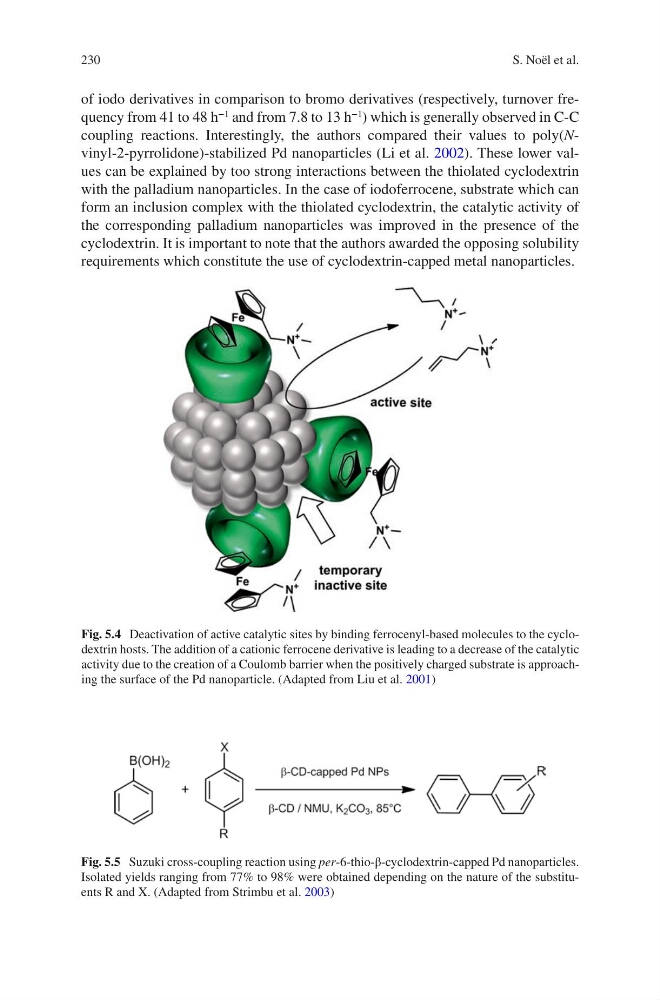
Fig. 5.4 Deactivation of active catalytic sites by binding ferrocenyl-based molecules to the cyclodextrin hosts. The addition of a cationic ferrocene derivative is leading to a decrease of the catalytic
activity due to the creation of a Coulomb barrier when the positively charged substrate is approaching the surface of the Pd nanoparticle. (Adapted from Liu et al. 2001)
Fig. 5.5 Suzuki cross-coupling reaction using per-6-thio-β-cyclodextrin-capped Pd nanoparticles.
Isolated yields ranging from 77% to 98% were obtained depending on the nature of the substituents R and X. (Adapted from Strimbu et al. 2003)
S. Noël et al.
of iodo derivatives in comparison to bromo derivatives (respectively, turnover frequency from 41 to 48 h
−1
and from 7.8 to 13 h
−1
) which is generally observed in C-C
coupling reactions. Interestingly, the authors compared their values to poly(Nvinyl- 2-pyrrolidone)-stabilized Pd nanoparticles (Li et al. 2002). These lower values can be explained by too strong interactions between the thiolated cyclodextrin
with the palladium nanoparticles. In the case of iodoferrocene, substrate which can
form an inclusion complex with the thiolated cyclodextrin, the catalytic activity of
the corresponding palladium nanoparticles was improved in the presence of the
cyclodextrin. It is important to note that the authors awarded the opposing solubility
requirements which constitute the use of cyclodextrin-capped metal nanoparticles.
Fig. 5.4 Deactivation of active catalytic sites by binding ferrocenyl-based molecules to the cyclodextrin hosts. The addition of a cationic ferrocene derivative is leading to a decrease of the catalytic
activity due to the creation of a Coulomb barrier when the positively charged substrate is approaching the surface of the Pd nanoparticle. (Adapted from Liu et al. 2001)
Fig. 5.5 Suzuki cross-coupling reaction using per-6-thio-β-cyclodextrin-capped Pd nanoparticles.
Isolated yields ranging from 77% to 98% were obtained depending on the nature of the substituents R and X. (Adapted from Strimbu et al. 2003)
S. Noël et al.