

229
DMSO:H 2 O mixture were reduced with sodium borohydride in the presence of
per-6-thio-β-cyclodextrin (Fig. 5.3) leading to a dark precipitate.
The interaction of the thiolated cyclodextrin with the metal nanoparticles was
justified by the disappearance of the S–H stretching peak at 2560 cm
−1
in the FTIR
spectra of the resulting materials. Transmission electron microscopy measurements
showed spherical metal nanoparticles with an average diameter of 14.1 ± 2.2 and
15.6 ± 1.3 nm, respectively, for Pt and Pd particles. The catalytic activity of these
nanoparticles was evaluated in the hydrogenation of allylamine under 1 atmosphere
of hydrogen, at room temperature in D 2 O solution in order to follow the reaction by
1
H NMR. Full conversions were obtained for both catalytic systems after 6 h of
reaction with a selectivity of 100% toward propylamine. The same authors also
optimized the synthesis of the palladium nanoparticles with an average particle size
decrease (from 15.6 nm to 3.5 nm) by increasing the thiolated cyclodextrin amount,
which is generally observed in the synthesis of solvent-dispersed nanoparticles.
These new aqueous dispersed nanoparticles were tested in hydrogenation (Liu et al.
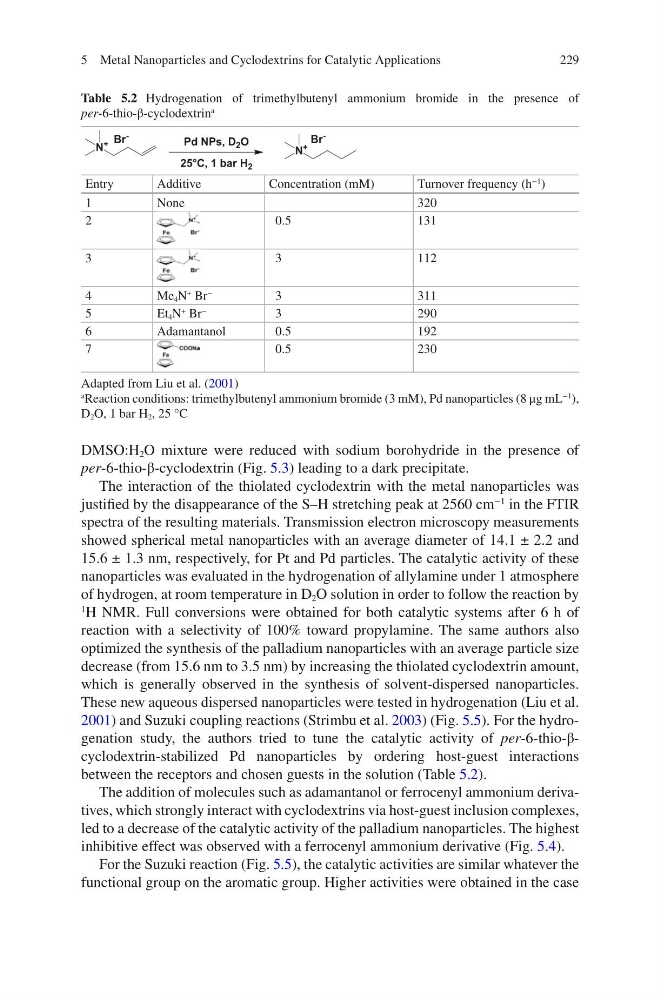
2001) and Suzuki coupling reactions (Strimbu et al. 2003) (Fig. 5.5). For the hydrogenation study, the authors tried to tune the catalytic activity of per-6-thio-βcyclodextrin- stabilized Pd nanoparticles by ordering host-guest interactions
between the receptors and chosen guests in the solution (Table 5.2).
The addition of molecules such as adamantanol or ferrocenyl ammonium derivatives, which strongly interact with cyclodextrins via host-guest inclusion complexes,
led to a decrease of the catalytic activity of the palladium nanoparticles. The highest
inhibitive effect was observed with a ferrocenyl ammonium derivative (Fig. 5.4).
For the Suzuki reaction (Fig. 5.5), the catalytic activities are similar whatever the
functional group on the aromatic group. Higher activities were obtained in the case
Table 5.2 Hydrogenation of trimethylbutenyl ammonium bromide in the presence of
per-6-thio-β-cyclodextrin
a
Entry
Additive
Concentration (mM)
Turnover frequency (h
−1 )
1
None
320
2
0.5
131
3
3
112
4
Me 4 N
+ Br
−
3
311
5
Et 4 N
+ Br
−
3
290
6
Adamantanol
0.5
192
7
0.5
230
Adapted from Liu et al. (2001)
a Reaction conditions: trimethylbutenyl ammonium bromide (3 mM), Pd nanoparticles (8 μg mL
−1 ),
D 2 O, 1 bar H 2 , 25 °C
5 Metal Nanoparticles and Cyclodextrins for Catalytic Applications
DMSO:H 2 O mixture were reduced with sodium borohydride in the presence of
per-6-thio-β-cyclodextrin (Fig. 5.3) leading to a dark precipitate.
The interaction of the thiolated cyclodextrin with the metal nanoparticles was
justified by the disappearance of the S–H stretching peak at 2560 cm
−1
in the FTIR
spectra of the resulting materials. Transmission electron microscopy measurements
showed spherical metal nanoparticles with an average diameter of 14.1 ± 2.2 and
15.6 ± 1.3 nm, respectively, for Pt and Pd particles. The catalytic activity of these
nanoparticles was evaluated in the hydrogenation of allylamine under 1 atmosphere
of hydrogen, at room temperature in D 2 O solution in order to follow the reaction by
1
H NMR. Full conversions were obtained for both catalytic systems after 6 h of
reaction with a selectivity of 100% toward propylamine. The same authors also
optimized the synthesis of the palladium nanoparticles with an average particle size
decrease (from 15.6 nm to 3.5 nm) by increasing the thiolated cyclodextrin amount,
which is generally observed in the synthesis of solvent-dispersed nanoparticles.
These new aqueous dispersed nanoparticles were tested in hydrogenation (Liu et al.
2001) and Suzuki coupling reactions (Strimbu et al. 2003) (Fig. 5.5). For the hydrogenation study, the authors tried to tune the catalytic activity of per-6-thio-βcyclodextrin- stabilized Pd nanoparticles by ordering host-guest interactions
between the receptors and chosen guests in the solution (Table 5.2).
The addition of molecules such as adamantanol or ferrocenyl ammonium derivatives, which strongly interact with cyclodextrins via host-guest inclusion complexes,
led to a decrease of the catalytic activity of the palladium nanoparticles. The highest
inhibitive effect was observed with a ferrocenyl ammonium derivative (Fig. 5.4).
For the Suzuki reaction (Fig. 5.5), the catalytic activities are similar whatever the
functional group on the aromatic group. Higher activities were obtained in the case
Table 5.2 Hydrogenation of trimethylbutenyl ammonium bromide in the presence of
per-6-thio-β-cyclodextrin
a
Entry
Additive
Concentration (mM)
Turnover frequency (h
−1 )
1
None
320
2
0.5
131
3
3
112
4
Me 4 N
+ Br
−
3
311
5
Et 4 N
+ Br
−
3
290
6
Adamantanol
0.5
192
7
0.5
230
Adapted from Liu et al. (2001)
a Reaction conditions: trimethylbutenyl ammonium bromide (3 mM), Pd nanoparticles (8 μg mL
−1 ),
D 2 O, 1 bar H 2 , 25 °C
5 Metal Nanoparticles and Cyclodextrins for Catalytic Applications