

185
multistep processes including precipitation, adsorption on starch, and gel filtration
were developed (Okada and Kitahata 1975). Later, an alkalophilic and thermostable
cyclodextrin glucosyltransferase derived from Klebsiella pneumoniae with a considerably high initial cyclization rate especially on long-chain maltodextrin was
reported (Bender 1977).
The first Japanese patents described processes using trichloroethylene, chloroform, and bromobenzene as appropriate beta-cyclodextrin precipitation agents in
potato starch conversion (Okada and Tsujama 1974; Horikoshi 1975; Horikoshi and
Nakamura 1979). The other Japanese technologies applied strict control on maltose
and glucose concentration (Suzuki et al. 1975) and used ion-exchange resin for
separation of cyclodextrins from glucose and other linear dextrins with reducing
end groups in conversion mixture (Suzuki et al. 1975; Yoritomi and Yoshida 1976).
At the beginning of the 1980s, the latter technologies led to the early approval of
cyclodextrins as enzymatically modified starch for food and pharmaceutical use by
the Japanese Food and Drug Administration Agency (Nagai 1982). Szejtli (1988,
1990) reviewed the various cyclodextrin-producing technologies.
4.2 History of Hungarian Cyclodextrin Production
The cyclodextrin research at Chinoin Pharmaceutical and Chemical Works Co. Ltd.
started in 1975. As a world-known outstanding expert of carbohydrate chemistry,
Professor Szejtli received the background including a new laboratory and annual
budget for this research. The management of the factory supported his initiative for
the cyclodextrin production. According to Chinoin marketing experts, it seemed to
be a massive beta-cyclodextrin demand in world market, in not too distant future.
Cooperation agreement between the Biochemical Research Laboratory (this was
the name of the cyclodextrin research laboratory headed by Professor Szejtli) and
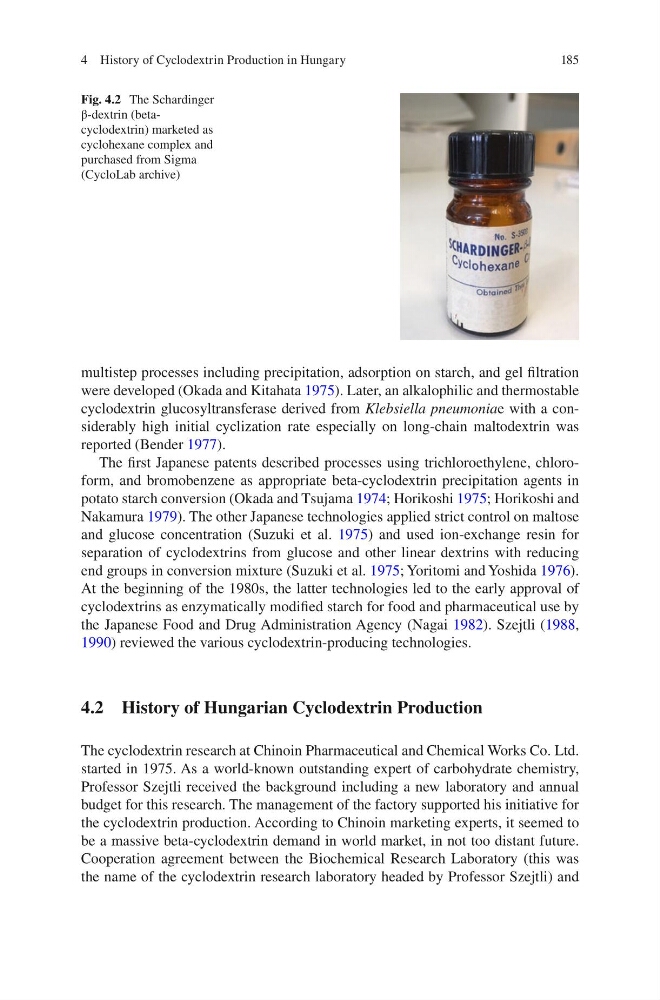
Fig. 4.2 The Schardinger
β-dextrin (betacyclodextrin) marketed as
cyclohexane complex and
purchased from Sigma
(CycloLab archive)
4 History of Cyclodextrin Production in Hungary
multistep processes including precipitation, adsorption on starch, and gel filtration
were developed (Okada and Kitahata 1975). Later, an alkalophilic and thermostable
cyclodextrin glucosyltransferase derived from Klebsiella pneumoniae with a considerably high initial cyclization rate especially on long-chain maltodextrin was
reported (Bender 1977).
The first Japanese patents described processes using trichloroethylene, chloroform, and bromobenzene as appropriate beta-cyclodextrin precipitation agents in
potato starch conversion (Okada and Tsujama 1974; Horikoshi 1975; Horikoshi and
Nakamura 1979). The other Japanese technologies applied strict control on maltose
and glucose concentration (Suzuki et al. 1975) and used ion-exchange resin for
separation of cyclodextrins from glucose and other linear dextrins with reducing
end groups in conversion mixture (Suzuki et al. 1975; Yoritomi and Yoshida 1976).
At the beginning of the 1980s, the latter technologies led to the early approval of
cyclodextrins as enzymatically modified starch for food and pharmaceutical use by
the Japanese Food and Drug Administration Agency (Nagai 1982). Szejtli (1988,
1990) reviewed the various cyclodextrin-producing technologies.
4.2 History of Hungarian Cyclodextrin Production
The cyclodextrin research at Chinoin Pharmaceutical and Chemical Works Co. Ltd.
started in 1975. As a world-known outstanding expert of carbohydrate chemistry,
Professor Szejtli received the background including a new laboratory and annual
budget for this research. The management of the factory supported his initiative for
the cyclodextrin production. According to Chinoin marketing experts, it seemed to
be a massive beta-cyclodextrin demand in world market, in not too distant future.
Cooperation agreement between the Biochemical Research Laboratory (this was
the name of the cyclodextrin research laboratory headed by Professor Szejtli) and
Fig. 4.2 The Schardinger
β-dextrin (betacyclodextrin) marketed as
cyclohexane complex and
purchased from Sigma
(CycloLab archive)
4 History of Cyclodextrin Production in Hungary