

184
yields of cyclodextrin were obtained within 2–7 days at 50 °C and a pH of about 7
when the enzyme dosage ranged between 100 and 1000 Tilden-Hudson units per
100 grams of starch.
A few other cyclodextrin-producing bacterium strains were reported later, e.g.,
B. megaterium and B. stearothermophilus were recognized as good enzyme producers (Shiosaka 1973; Okada and Kitahata 1975). For purification of enzyme, various
Table 4.1 Effect of precipitating agents present during enzymolysis on the conversion yield
(potato starch concentration, 33.3 g/100 mL; pre-hydrolyzed until 1.9 dextrose equivalent)
(Armbruster and Kool 1969; Armbruster and Jacaway 1969)
Precipitant
Cyclodextrin yield
Percent of cyclodextrin type within the cyclodextrin
mixture
after 4 days
Alpha-cyclodextrin
Beta-cyclodextrin
None (control)
10
No data
No data
p-Cymene
50
0
100
Tetrachloroethane 47
38
62
Benzene
47
0
100
Toluene
45
0
100
Cyclohexane
41
0
100
1-Butanol
24
0
100
1-Octanol
58
53
47
1-Octadecanol
a
79
82
18
a
After 7 days of conversion
Prehydrolized
starch
Conversion mixture
(CMx)
Cyclodextrins
Acyclic dextrins
Cyclodextrin glucosyl
transferase
a-Cyclodextrin
b-Cyclodextrin
g-Cyclodextrin
Complexing agent
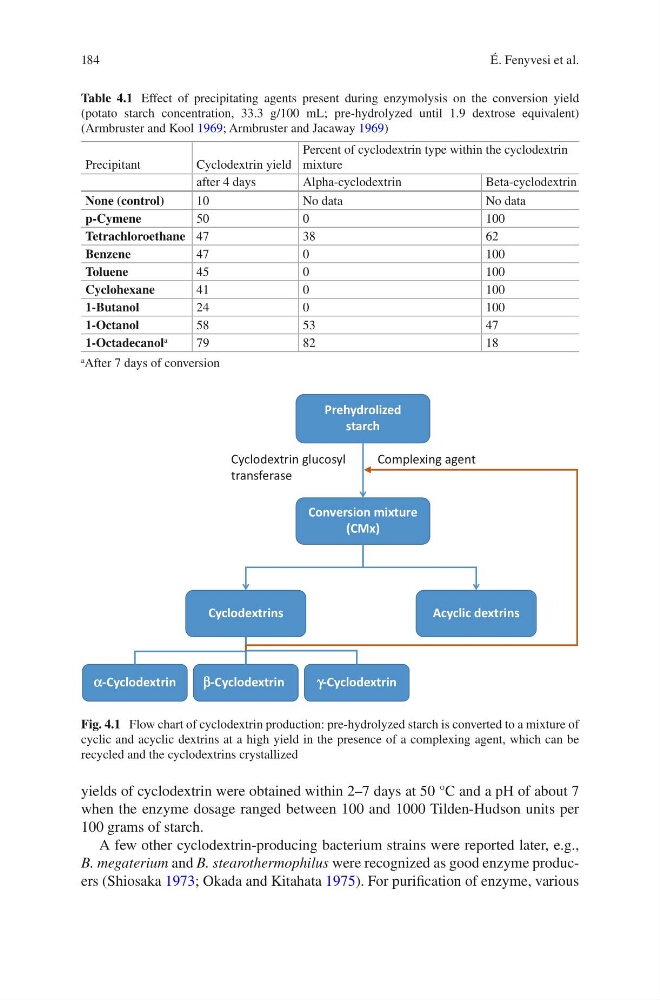
Fig. 4.1 Flow chart of cyclodextrin production: pre-hydrolyzed starch is converted to a mixture of
cyclic and acyclic dextrins at a high yield in the presence of a complexing agent, which can be
recycled and the cyclodextrins crystallized
É. Fenyvesi et al.
yields of cyclodextrin were obtained within 2–7 days at 50 °C and a pH of about 7
when the enzyme dosage ranged between 100 and 1000 Tilden-Hudson units per
100 grams of starch.
A few other cyclodextrin-producing bacterium strains were reported later, e.g.,
B. megaterium and B. stearothermophilus were recognized as good enzyme producers (Shiosaka 1973; Okada and Kitahata 1975). For purification of enzyme, various
Table 4.1 Effect of precipitating agents present during enzymolysis on the conversion yield
(potato starch concentration, 33.3 g/100 mL; pre-hydrolyzed until 1.9 dextrose equivalent)
(Armbruster and Kool 1969; Armbruster and Jacaway 1969)
Precipitant
Cyclodextrin yield
Percent of cyclodextrin type within the cyclodextrin
mixture
after 4 days
Alpha-cyclodextrin
Beta-cyclodextrin
None (control)
10
No data
No data
p-Cymene
50
0
100
Tetrachloroethane 47
38
62
Benzene
47
0
100
Toluene
45
0
100
Cyclohexane
41
0
100
1-Butanol
24
0
100
1-Octanol
58
53
47
1-Octadecanol
a
79
82
18
a
After 7 days of conversion
Prehydrolized
starch
Conversion mixture
(CMx)
Cyclodextrins
Acyclic dextrins
Cyclodextrin glucosyl
transferase
a-Cyclodextrin
b-Cyclodextrin
g-Cyclodextrin
Complexing agent
Fig. 4.1 Flow chart of cyclodextrin production: pre-hydrolyzed starch is converted to a mixture of
cyclic and acyclic dextrins at a high yield in the presence of a complexing agent, which can be
recycled and the cyclodextrins crystallized
É. Fenyvesi et al.