

175
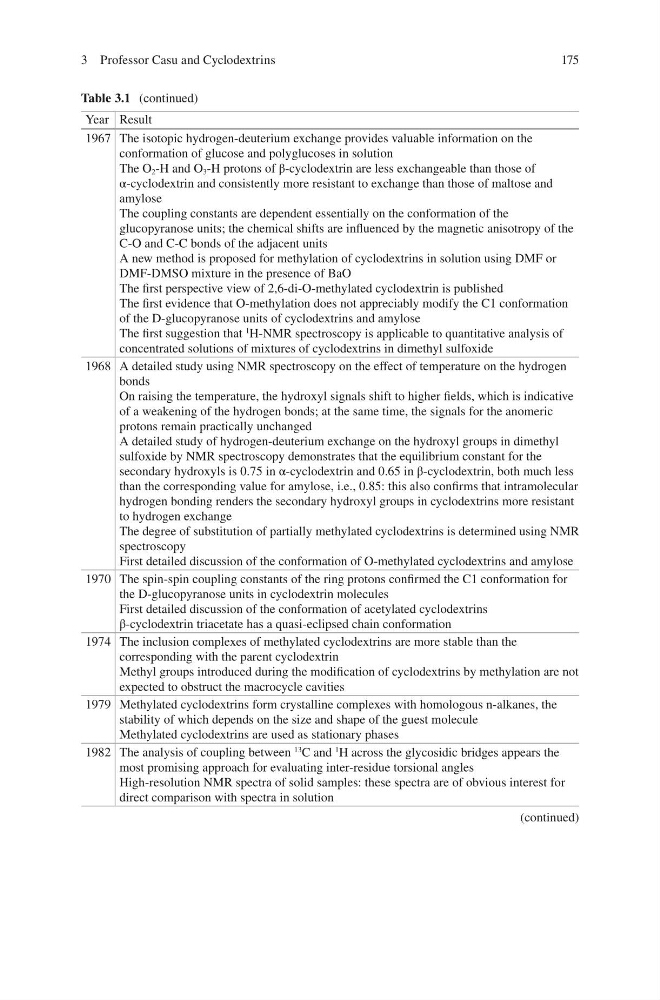
Table 3.1 (continued)
Year Result
1967 The isotopic hydrogen-deuterium exchange provides valuable information on the
conformation of glucose and polyglucoses in solution
The O 2 -H and O 3 -H protons of β-cyclodextrin are less exchangeable than those of
α-cyclodextrin and consistently more resistant to exchange than those of maltose and
amylose
The coupling constants are dependent essentially on the conformation of the
glucopyranose units; the chemical shifts are influenced by the magnetic anisotropy of the
C-O and C-C bonds of the adjacent units
A new method is proposed for methylation of cyclodextrins in solution using DMF or
DMF-DMSO mixture in the presence of BaO
The first perspective view of 2,6-di-O-methylated cyclodextrin is published
The first evidence that O-methylation does not appreciably modify the C1 conformation
of the D-glucopyranose units of cyclodextrins and amylose
The first suggestion that
1 H-NMR spectroscopy is applicable to quantitative analysis of
concentrated solutions of mixtures of cyclodextrins in dimethyl sulfoxide
1968 A detailed study using NMR spectroscopy on the effect of temperature on the hydrogen
bonds
On raising the temperature, the hydroxyl signals shift to higher fields, which is indicative
of a weakening of the hydrogen bonds; at the same time, the signals for the anomeric
protons remain practically unchanged
A detailed study of hydrogen-deuterium exchange on the hydroxyl groups in dimethyl
sulfoxide by NMR spectroscopy demonstrates that the equilibrium constant for the
secondary hydroxyls is 0.75 in α-cyclodextrin and 0.65 in β-cyclodextrin, both much less
than the corresponding value for amylose, i.e., 0.85: this also confirms that intramolecular
hydrogen bonding renders the secondary hydroxyl groups in cyclodextrins more resistant
to hydrogen exchange
The degree of substitution of partially methylated cyclodextrins is determined using NMR
spectroscopy
First detailed discussion of the conformation of O-methylated cyclodextrins and amylose
1970 The spin-spin coupling constants of the ring protons confirmed the C1 conformation for
the D-glucopyranose units in cyclodextrin molecules
First detailed discussion of the conformation of acetylated cyclodextrins
β-cyclodextrin triacetate has a quasi-eclipsed chain conformation
1974 The inclusion complexes of methylated cyclodextrins are more stable than the
corresponding with the parent cyclodextrin
Methyl groups introduced during the modification of cyclodextrins by methylation are not
expected to obstruct the macrocycle cavities
1979 Methylated cyclodextrins form crystalline complexes with homologous n-alkanes, the
stability of which depends on the size and shape of the guest molecule
Methylated cyclodextrins are used as stationary phases
1982 The analysis of coupling between
13 C and
1 H across the glycosidic bridges appears the
most promising approach for evaluating inter-residue torsional angles
High-resolution NMR spectra of solid samples: these spectra are of obvious interest for
direct comparison with spectra in solution
(continued)
3 Professor Casu and Cyclodextrins
Table 3.1 (continued)
Year Result
1967 The isotopic hydrogen-deuterium exchange provides valuable information on the
conformation of glucose and polyglucoses in solution
The O 2 -H and O 3 -H protons of β-cyclodextrin are less exchangeable than those of
α-cyclodextrin and consistently more resistant to exchange than those of maltose and
amylose
The coupling constants are dependent essentially on the conformation of the
glucopyranose units; the chemical shifts are influenced by the magnetic anisotropy of the
C-O and C-C bonds of the adjacent units
A new method is proposed for methylation of cyclodextrins in solution using DMF or
DMF-DMSO mixture in the presence of BaO
The first perspective view of 2,6-di-O-methylated cyclodextrin is published
The first evidence that O-methylation does not appreciably modify the C1 conformation
of the D-glucopyranose units of cyclodextrins and amylose
The first suggestion that
1 H-NMR spectroscopy is applicable to quantitative analysis of
concentrated solutions of mixtures of cyclodextrins in dimethyl sulfoxide
1968 A detailed study using NMR spectroscopy on the effect of temperature on the hydrogen
bonds
On raising the temperature, the hydroxyl signals shift to higher fields, which is indicative
of a weakening of the hydrogen bonds; at the same time, the signals for the anomeric
protons remain practically unchanged
A detailed study of hydrogen-deuterium exchange on the hydroxyl groups in dimethyl
sulfoxide by NMR spectroscopy demonstrates that the equilibrium constant for the
secondary hydroxyls is 0.75 in α-cyclodextrin and 0.65 in β-cyclodextrin, both much less
than the corresponding value for amylose, i.e., 0.85: this also confirms that intramolecular
hydrogen bonding renders the secondary hydroxyl groups in cyclodextrins more resistant
to hydrogen exchange
The degree of substitution of partially methylated cyclodextrins is determined using NMR
spectroscopy
First detailed discussion of the conformation of O-methylated cyclodextrins and amylose
1970 The spin-spin coupling constants of the ring protons confirmed the C1 conformation for
the D-glucopyranose units in cyclodextrin molecules
First detailed discussion of the conformation of acetylated cyclodextrins
β-cyclodextrin triacetate has a quasi-eclipsed chain conformation
1974 The inclusion complexes of methylated cyclodextrins are more stable than the
corresponding with the parent cyclodextrin
Methyl groups introduced during the modification of cyclodextrins by methylation are not
expected to obstruct the macrocycle cavities
1979 Methylated cyclodextrins form crystalline complexes with homologous n-alkanes, the
stability of which depends on the size and shape of the guest molecule
Methylated cyclodextrins are used as stationary phases
1982 The analysis of coupling between
13 C and
1 H across the glycosidic bridges appears the
most promising approach for evaluating inter-residue torsional angles
High-resolution NMR spectra of solid samples: these spectra are of obvious interest for
direct comparison with spectra in solution
(continued)
3 Professor Casu and Cyclodextrins