

174
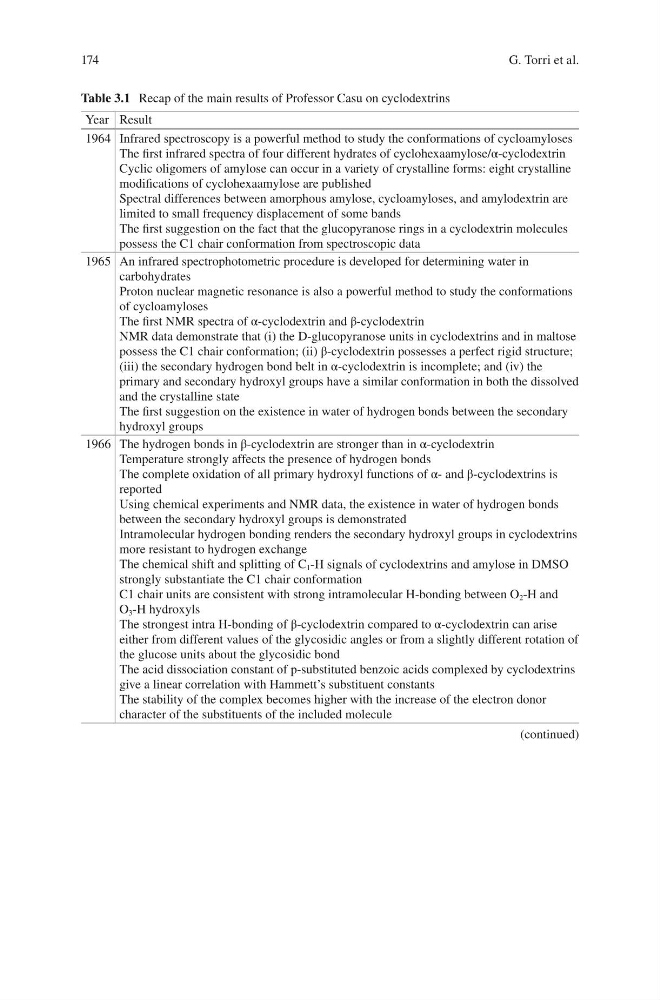
Table 3.1 Recap of the main results of Professor Casu on cyclodextrins
Year Result
1964 Infrared spectroscopy is a powerful method to study the conformations of cycloamyloses
The first infrared spectra of four different hydrates of cyclohexaamylose/α-cyclodextrin
Cyclic oligomers of amylose can occur in a variety of crystalline forms: eight crystalline
modifications of cyclohexaamylose are published
Spectral differences between amorphous amylose, cycloamyloses, and amylodextrin are
limited to small frequency displacement of some bands
The first suggestion on the fact that the glucopyranose rings in a cyclodextrin molecules
possess the C1 chair conformation from spectroscopic data
1965 An infrared spectrophotometric procedure is developed for determining water in
carbohydrates
Proton nuclear magnetic resonance is also a powerful method to study the conformations
of cycloamyloses
The first NMR spectra of α-cyclodextrin and β-cyclodextrin
NMR data demonstrate that (i) the D-glucopyranose units in cyclodextrins and in maltose
possess the C1 chair conformation; (ii) β-cyclodextrin possesses a perfect rigid structure;
(iii) the secondary hydrogen bond belt in α-cyclodextrin is incomplete; and (iv) the
primary and secondary hydroxyl groups have a similar conformation in both the dissolved
and the crystalline state
The first suggestion on the existence in water of hydrogen bonds between the secondary
hydroxyl groups
1966 The hydrogen bonds in β-cyclodextrin are stronger than in α-cyclodextrin
Temperature strongly affects the presence of hydrogen bonds
The complete oxidation of all primary hydroxyl functions of α- and β-cyclodextrins is
reported
Using chemical experiments and NMR data, the existence in water of hydrogen bonds
between the secondary hydroxyl groups is demonstrated
Intramolecular hydrogen bonding renders the secondary hydroxyl groups in cyclodextrins
more resistant to hydrogen exchange
The chemical shift and splitting of C 1 -H signals of cyclodextrins and amylose in DMSO
strongly substantiate the C1 chair conformation
C1 chair units are consistent with strong intramolecular H-bonding between O 2 -H and
O 3 -H hydroxyls
The strongest intra H-bonding of β-cyclodextrin compared to α-cyclodextrin can arise
either from different values of the glycosidic angles or from a slightly different rotation of
the glucose units about the glycosidic bond
The acid dissociation constant of p-substituted benzoic acids complexed by cyclodextrins
give a linear correlation with Hammett’s substituent constants
The stability of the complex becomes higher with the increase of the electron donor
character of the substituents of the included molecule
(continued)
G. Torri et al.
Table 3.1 Recap of the main results of Professor Casu on cyclodextrins
Year Result
1964 Infrared spectroscopy is a powerful method to study the conformations of cycloamyloses
The first infrared spectra of four different hydrates of cyclohexaamylose/α-cyclodextrin
Cyclic oligomers of amylose can occur in a variety of crystalline forms: eight crystalline
modifications of cyclohexaamylose are published
Spectral differences between amorphous amylose, cycloamyloses, and amylodextrin are
limited to small frequency displacement of some bands
The first suggestion on the fact that the glucopyranose rings in a cyclodextrin molecules
possess the C1 chair conformation from spectroscopic data
1965 An infrared spectrophotometric procedure is developed for determining water in
carbohydrates
Proton nuclear magnetic resonance is also a powerful method to study the conformations
of cycloamyloses
The first NMR spectra of α-cyclodextrin and β-cyclodextrin
NMR data demonstrate that (i) the D-glucopyranose units in cyclodextrins and in maltose
possess the C1 chair conformation; (ii) β-cyclodextrin possesses a perfect rigid structure;
(iii) the secondary hydrogen bond belt in α-cyclodextrin is incomplete; and (iv) the
primary and secondary hydroxyl groups have a similar conformation in both the dissolved
and the crystalline state
The first suggestion on the existence in water of hydrogen bonds between the secondary
hydroxyl groups
1966 The hydrogen bonds in β-cyclodextrin are stronger than in α-cyclodextrin
Temperature strongly affects the presence of hydrogen bonds
The complete oxidation of all primary hydroxyl functions of α- and β-cyclodextrins is
reported
Using chemical experiments and NMR data, the existence in water of hydrogen bonds
between the secondary hydroxyl groups is demonstrated
Intramolecular hydrogen bonding renders the secondary hydroxyl groups in cyclodextrins
more resistant to hydrogen exchange
The chemical shift and splitting of C 1 -H signals of cyclodextrins and amylose in DMSO
strongly substantiate the C1 chair conformation
C1 chair units are consistent with strong intramolecular H-bonding between O 2 -H and
O 3 -H hydroxyls
The strongest intra H-bonding of β-cyclodextrin compared to α-cyclodextrin can arise
either from different values of the glycosidic angles or from a slightly different rotation of
the glucose units about the glycosidic bond
The acid dissociation constant of p-substituted benzoic acids complexed by cyclodextrins
give a linear correlation with Hammett’s substituent constants
The stability of the complex becomes higher with the increase of the electron donor
character of the substituents of the included molecule
(continued)
G. Torri et al.