

136
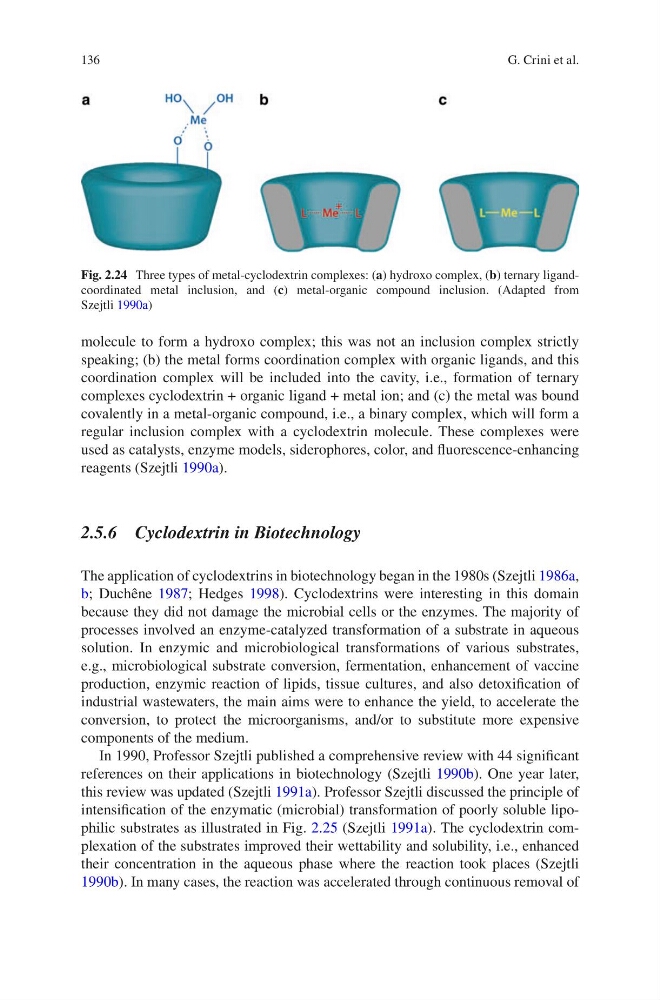
molecule to form a hydroxo complex; this was not an inclusion complex strictly
speaking; (b) the metal forms coordination complex with organic ligands, and this
coordination complex will be included into the cavity, i.e., formation of ternary
complexes cyclodextrin + organic ligand + metal ion; and (c) the metal was bound
covalently in a metal-organic compound, i.e., a binary complex, which will form a
regular inclusion complex with a cyclodextrin molecule. These complexes were
used as catalysts, enzyme models, siderophores, color, and fluorescence-enhancing
reagents (Szejtli 1990a).
2.5.6 Cyclodextrin in Biotechnology
The application of cyclodextrins in biotechnology began in the 1980s (Szejtli 1986a,
b; Duchêne 1987; Hedges 1998). Cyclodextrins were interesting in this domain
because they did not damage the microbial cells or the enzymes. The majority of
processes involved an enzyme-catalyzed transformation of a substrate in aqueous
solution. In enzymic and microbiological transformations of various substrates,
e.g., microbiological substrate conversion, fermentation, enhancement of vaccine
production, enzymic reaction of lipids, tissue cultures, and also detoxification of
industrial wastewaters, the main aims were to enhance the yield, to accelerate the
conversion, to protect the microorganisms, and/or to substitute more expensive
components of the medium.
In 1990, Professor Szejtli published a comprehensive review with 44 significant
references on their applications in biotechnology (Szejtli 1990b). One year later,
this review was updated (Szejtli 1991a). Professor Szejtli discussed the principle of
intensification of the enzymatic (microbial) transformation of poorly soluble lipophilic substrates as illustrated in Fig. 2.25 (Szejtli 1991a). The cyclodextrin complexation of the substrates improved their wettability and solubility, i.e., enhanced
their concentration in the aqueous phase where the reaction took places (Szejtli
1990b). In many cases, the reaction was accelerated through continuous removal of
Fig. 2.24 Three types of metal-cyclodextrin complexes: (a) hydroxo complex, (b) ternary ligandcoordinated metal inclusion, and (c) metal-organic compound inclusion. (Adapted from
Szejtli 1990a)
G. Crini et al.
molecule to form a hydroxo complex; this was not an inclusion complex strictly
speaking; (b) the metal forms coordination complex with organic ligands, and this
coordination complex will be included into the cavity, i.e., formation of ternary
complexes cyclodextrin + organic ligand + metal ion; and (c) the metal was bound
covalently in a metal-organic compound, i.e., a binary complex, which will form a
regular inclusion complex with a cyclodextrin molecule. These complexes were
used as catalysts, enzyme models, siderophores, color, and fluorescence-enhancing
reagents (Szejtli 1990a).
2.5.6 Cyclodextrin in Biotechnology
The application of cyclodextrins in biotechnology began in the 1980s (Szejtli 1986a,
b; Duchêne 1987; Hedges 1998). Cyclodextrins were interesting in this domain
because they did not damage the microbial cells or the enzymes. The majority of
processes involved an enzyme-catalyzed transformation of a substrate in aqueous
solution. In enzymic and microbiological transformations of various substrates,
e.g., microbiological substrate conversion, fermentation, enhancement of vaccine
production, enzymic reaction of lipids, tissue cultures, and also detoxification of
industrial wastewaters, the main aims were to enhance the yield, to accelerate the
conversion, to protect the microorganisms, and/or to substitute more expensive
components of the medium.
In 1990, Professor Szejtli published a comprehensive review with 44 significant
references on their applications in biotechnology (Szejtli 1990b). One year later,
this review was updated (Szejtli 1991a). Professor Szejtli discussed the principle of
intensification of the enzymatic (microbial) transformation of poorly soluble lipophilic substrates as illustrated in Fig. 2.25 (Szejtli 1991a). The cyclodextrin complexation of the substrates improved their wettability and solubility, i.e., enhanced
their concentration in the aqueous phase where the reaction took places (Szejtli
1990b). In many cases, the reaction was accelerated through continuous removal of
Fig. 2.24 Three types of metal-cyclodextrin complexes: (a) hydroxo complex, (b) ternary ligandcoordinated metal inclusion, and (c) metal-organic compound inclusion. (Adapted from
Szejtli 1990a)
G. Crini et al.