

125
showed that the complexation reaction involved a gain in enthalpy and a loss of
entropy (Bender and Komiyama 1978).
In 1982, Professor Szejtli published a thorough state of the art of inclusion complexes (Szejtli 1982a), which was updated 2 years later by Saenger (1984). Professor
Szejtli summarized and reformulated all the interpretations made on the mechanism
of formation of inclusion complexes.
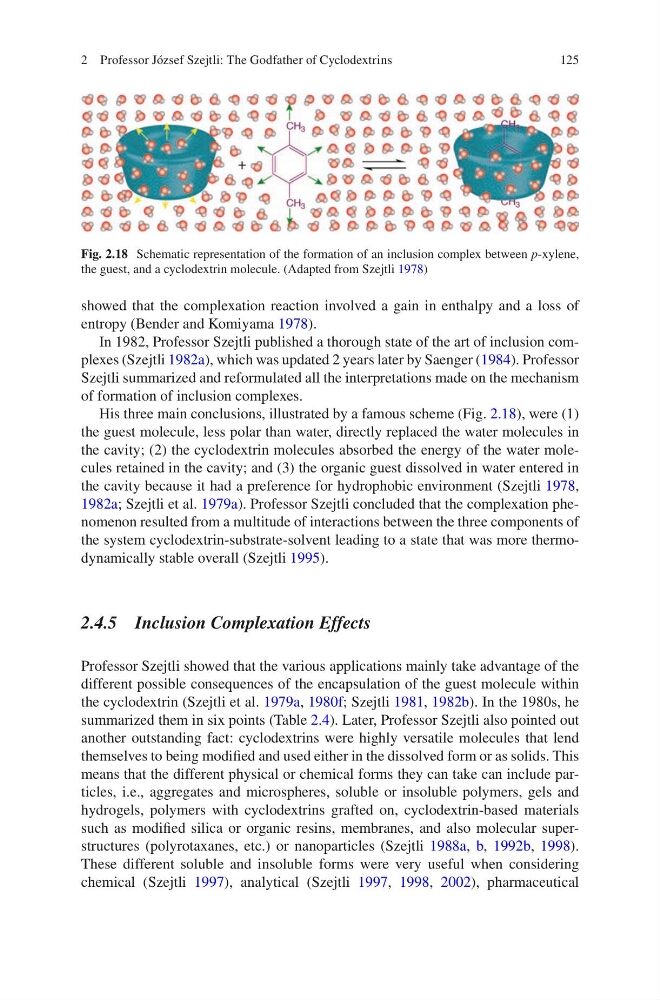
His three main conclusions, illustrated by a famous scheme (Fig. 2.18), were (1)
the guest molecule, less polar than water, directly replaced the water molecules in
the cavity; (2) the cyclodextrin molecules absorbed the energy of the water molecules retained in the cavity; and (3) the organic guest dissolved in water entered in
the cavity because it had a preference for hydrophobic environment (Szejtli 1978,
1982a; Szejtli et al. 1979a). Professor Szejtli concluded that the complexation phenomenon resulted from a multitude of interactions between the three components of
the system cyclodextrin-substrate-solvent leading to a state that was more thermodynamically stable overall (Szejtli 1995).
2.4.5 Inclusion Complexation Effects
Professor Szejtli showed that the various applications mainly take advantage of the
different possible consequences of the encapsulation of the guest molecule within
the cyclodextrin (Szejtli et al. 1979a, 1980f; Szejtli 1981, 1982b). In the 1980s, he
summarized them in six points (Table 2.4). Later, Professor Szejtli also pointed out
another outstanding fact: cyclodextrins were highly versatile molecules that lend
themselves to being modified and used either in the dissolved form or as solids. This
means that the different physical or chemical forms they can take can include particles, i.e., aggregates and microspheres, soluble or insoluble polymers, gels and
hydrogels, polymers with cyclodextrins grafted on, cyclodextrin-based materials
such as modified silica or organic resins, membranes, and also molecular superstructures (polyrotaxanes, etc.) or nanoparticles (Szejtli 1988a, b, 1992b, 1998).
These different soluble and insoluble forms were very useful when considering
chemical (Szejtli 1997), analytical (Szejtli 1997, 1998, 2002), pharmaceutical
Fig. 2.18 Schematic representation of the formation of an inclusion complex between p-xylene,
the guest, and a cyclodextrin molecule. (Adapted from Szejtli 1978)
2 Professor József Szejtli: The Godfather of Cyclodextrins
showed that the complexation reaction involved a gain in enthalpy and a loss of
entropy (Bender and Komiyama 1978).
In 1982, Professor Szejtli published a thorough state of the art of inclusion complexes (Szejtli 1982a), which was updated 2 years later by Saenger (1984). Professor
Szejtli summarized and reformulated all the interpretations made on the mechanism
of formation of inclusion complexes.
His three main conclusions, illustrated by a famous scheme (Fig. 2.18), were (1)
the guest molecule, less polar than water, directly replaced the water molecules in
the cavity; (2) the cyclodextrin molecules absorbed the energy of the water molecules retained in the cavity; and (3) the organic guest dissolved in water entered in
the cavity because it had a preference for hydrophobic environment (Szejtli 1978,
1982a; Szejtli et al. 1979a). Professor Szejtli concluded that the complexation phenomenon resulted from a multitude of interactions between the three components of
the system cyclodextrin-substrate-solvent leading to a state that was more thermodynamically stable overall (Szejtli 1995).
2.4.5 Inclusion Complexation Effects
Professor Szejtli showed that the various applications mainly take advantage of the
different possible consequences of the encapsulation of the guest molecule within
the cyclodextrin (Szejtli et al. 1979a, 1980f; Szejtli 1981, 1982b). In the 1980s, he
summarized them in six points (Table 2.4). Later, Professor Szejtli also pointed out
another outstanding fact: cyclodextrins were highly versatile molecules that lend
themselves to being modified and used either in the dissolved form or as solids. This
means that the different physical or chemical forms they can take can include particles, i.e., aggregates and microspheres, soluble or insoluble polymers, gels and
hydrogels, polymers with cyclodextrins grafted on, cyclodextrin-based materials
such as modified silica or organic resins, membranes, and also molecular superstructures (polyrotaxanes, etc.) or nanoparticles (Szejtli 1988a, b, 1992b, 1998).
These different soluble and insoluble forms were very useful when considering
chemical (Szejtli 1997), analytical (Szejtli 1997, 1998, 2002), pharmaceutical
Fig. 2.18 Schematic representation of the formation of an inclusion complex between p-xylene,
the guest, and a cyclodextrin molecule. (Adapted from Szejtli 1978)
2 Professor József Szejtli: The Godfather of Cyclodextrins