

119
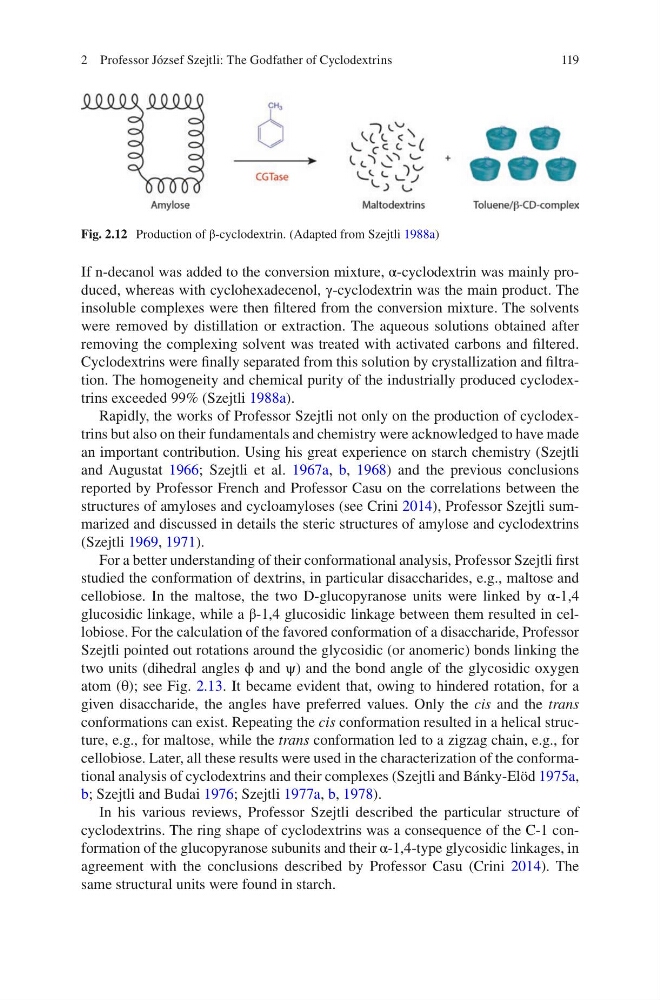
If n-decanol was added to the conversion mixture, α-cyclodextrin was mainly produced, whereas with cyclohexadecenol, γ-cyclodextrin was the main product. The
insoluble complexes were then filtered from the conversion mixture. The solvents
were removed by distillation or extraction. The aqueous solutions obtained after
removing the complexing solvent was treated with activated carbons and filtered.
Cyclodextrins were finally separated from this solution by crystallization and filtration. The homogeneity and chemical purity of the industrially produced cyclodextrins exceeded 99% (Szejtli 1988a).
Rapidly, the works of Professor Szejtli not only on the production of cyclodextrins but also on their fundamentals and chemistry were acknowledged to have made
an important contribution. Using his great experience on starch chemistry (Szejtli
and Augustat 1966; Szejtli et al. 1967a, b, 1968) and the previous conclusions
reported by Professor French and Professor Casu on the correlations between the
structures of amyloses and cycloamyloses (see Crini 2014), Professor Szejtli summarized and discussed in details the steric structures of amylose and cyclodextrins
(Szejtli 1969, 1971).
For a better understanding of their conformational analysis, Professor Szejtli first
studied the conformation of dextrins, in particular disaccharides, e.g., maltose and
cellobiose. In the maltose, the two D-glucopyranose units were linked by α-1,4
glucosidic linkage, while a β-1,4 glucosidic linkage between them resulted in cellobiose. For the calculation of the favored conformation of a disaccharide, Professor
Szejtli pointed out rotations around the glycosidic (or anomeric) bonds linking the
two units (dihedral angles ϕ and ψ) and the bond angle of the glycosidic oxygen
atom (θ); see Fig. 2.13. It became evident that, owing to hindered rotation, for a
given disaccharide, the angles have preferred values. Only the cis and the trans
conformations can exist. Repeating the cis conformation resulted in a helical structure, e.g., for maltose, while the trans conformation led to a zigzag chain, e.g., for
cellobiose. Later, all these results were used in the characterization of the conformational analysis of cyclodextrins and their complexes (Szejtli and Bánky-Elöd 1975a,
b; Szejtli and Budai 1976; Szejtli 1977a, b, 1978).
In his various reviews, Professor Szejtli described the particular structure of
cyclodextrins. The ring shape of cyclodextrins was a consequence of the C-1 conformation of the glucopyranose subunits and their α-1,4-type glycosidic linkages, in
agreement with the conclusions described by Professor Casu (Crini 2014). The
same structural units were found in starch.
Fig. 2.12 Production of β-cyclodextrin. (Adapted from Szejtli 1988a)
2 Professor József Szejtli: The Godfather of Cyclodextrins
If n-decanol was added to the conversion mixture, α-cyclodextrin was mainly produced, whereas with cyclohexadecenol, γ-cyclodextrin was the main product. The
insoluble complexes were then filtered from the conversion mixture. The solvents
were removed by distillation or extraction. The aqueous solutions obtained after
removing the complexing solvent was treated with activated carbons and filtered.
Cyclodextrins were finally separated from this solution by crystallization and filtration. The homogeneity and chemical purity of the industrially produced cyclodextrins exceeded 99% (Szejtli 1988a).
Rapidly, the works of Professor Szejtli not only on the production of cyclodextrins but also on their fundamentals and chemistry were acknowledged to have made
an important contribution. Using his great experience on starch chemistry (Szejtli
and Augustat 1966; Szejtli et al. 1967a, b, 1968) and the previous conclusions
reported by Professor French and Professor Casu on the correlations between the
structures of amyloses and cycloamyloses (see Crini 2014), Professor Szejtli summarized and discussed in details the steric structures of amylose and cyclodextrins
(Szejtli 1969, 1971).
For a better understanding of their conformational analysis, Professor Szejtli first
studied the conformation of dextrins, in particular disaccharides, e.g., maltose and
cellobiose. In the maltose, the two D-glucopyranose units were linked by α-1,4
glucosidic linkage, while a β-1,4 glucosidic linkage between them resulted in cellobiose. For the calculation of the favored conformation of a disaccharide, Professor
Szejtli pointed out rotations around the glycosidic (or anomeric) bonds linking the
two units (dihedral angles ϕ and ψ) and the bond angle of the glycosidic oxygen
atom (θ); see Fig. 2.13. It became evident that, owing to hindered rotation, for a
given disaccharide, the angles have preferred values. Only the cis and the trans
conformations can exist. Repeating the cis conformation resulted in a helical structure, e.g., for maltose, while the trans conformation led to a zigzag chain, e.g., for
cellobiose. Later, all these results were used in the characterization of the conformational analysis of cyclodextrins and their complexes (Szejtli and Bánky-Elöd 1975a,
b; Szejtli and Budai 1976; Szejtli 1977a, b, 1978).
In his various reviews, Professor Szejtli described the particular structure of
cyclodextrins. The ring shape of cyclodextrins was a consequence of the C-1 conformation of the glucopyranose subunits and their α-1,4-type glycosidic linkages, in
agreement with the conclusions described by Professor Casu (Crini 2014). The
same structural units were found in starch.
Fig. 2.12 Production of β-cyclodextrin. (Adapted from Szejtli 1988a)
2 Professor József Szejtli: The Godfather of Cyclodextrins