

118
wrote: “Cyclodextrins can be consumed by humans as ingredients of drugs, foods,
or cosmetics.”
2.4.2 Preparation and Chemistry of Cyclodextrins
In the mid-1970s, Professor Szejtli showed that cyclodextrins can be produced at
industrial scale by a relatively simple technology by fermentation of starch (Szejtli
1982a, 1988a), in agreement with the previous results published in the laboratory
scale by Professors Freudenberg, Cramer, and French (Crini 2014). This was interesting because, at that time, cyclodextrins still remained as laboratory curiosities
and were extremely expensive.
The method of preparation of β-cyclodextrin, illustrated in Fig. 2.12, was detailed
in his second book (Szejtli 1988a). In the first step of cyclodextrin production,
starch was liquefied at elevated temperatures. It was hydrolyzed to an optimum
degree in order to reduce the viscosity of such fairly concentrated (around 30% dry
weight) starch solution. After cooling the solution to optimum temperature, the
cyclodextrin-glucosyl-transferase enzyme was added. The purification of the
enzyme was made by affinity chromatography. In the solvent technology (Fig. 2.12),
an appropriate complex-forming agent was added to the conversion mixture. If toluene was added to this system, the toluene/β-cyclodextrin complex formed was separated immediately, and the conversion was shifted toward β-cyclodextrin formation.
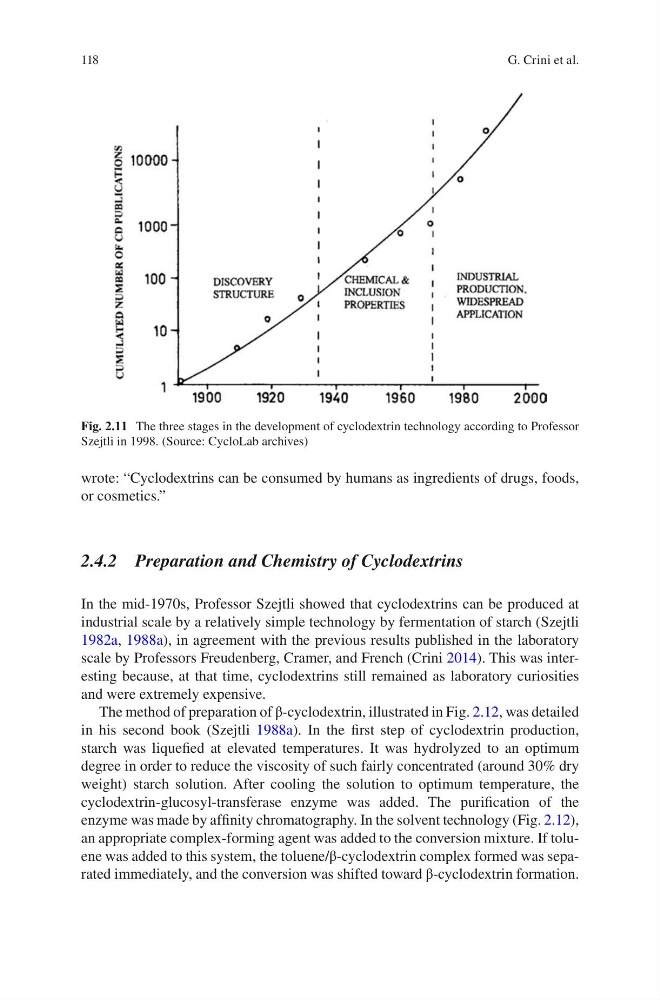
Fig. 2.11 The three stages in the development of cyclodextrin technology according to Professor
Szejtli in 1998. (Source: CycloLab archives)
G. Crini et al.
wrote: “Cyclodextrins can be consumed by humans as ingredients of drugs, foods,
or cosmetics.”
2.4.2 Preparation and Chemistry of Cyclodextrins
In the mid-1970s, Professor Szejtli showed that cyclodextrins can be produced at
industrial scale by a relatively simple technology by fermentation of starch (Szejtli
1982a, 1988a), in agreement with the previous results published in the laboratory
scale by Professors Freudenberg, Cramer, and French (Crini 2014). This was interesting because, at that time, cyclodextrins still remained as laboratory curiosities
and were extremely expensive.
The method of preparation of β-cyclodextrin, illustrated in Fig. 2.12, was detailed
in his second book (Szejtli 1988a). In the first step of cyclodextrin production,
starch was liquefied at elevated temperatures. It was hydrolyzed to an optimum
degree in order to reduce the viscosity of such fairly concentrated (around 30% dry
weight) starch solution. After cooling the solution to optimum temperature, the
cyclodextrin-glucosyl-transferase enzyme was added. The purification of the
enzyme was made by affinity chromatography. In the solvent technology (Fig. 2.12),
an appropriate complex-forming agent was added to the conversion mixture. If toluene was added to this system, the toluene/β-cyclodextrin complex formed was separated immediately, and the conversion was shifted toward β-cyclodextrin formation.
Fig. 2.11 The three stages in the development of cyclodextrin technology according to Professor
Szejtli in 1998. (Source: CycloLab archives)
G. Crini et al.