

108
With the ceremony at the International Cyclodextrin Symposia, the CycloLab’s
team hopes to keep Professor Szejtli in memory for long.
2.3 Szejtli’s Scientific Achievements
2.3.1 Early Work in Starch
The young student Szejtli first concentrated on the field of starch chemistry at the
University of Technical Sciences, Budapest, between 1957 and 1963, working
under the supervision of Professor János Holló. Szejtli studied the structure and
conformation of the two components of starch, i.e., amylopectin and amylose. With
Professor Holló, Szejtli proposed a new “helical-segment theory” to characterize
the possible conformations of amylose in aqueous solution.
The most characteristic feature of starch known for long was its blue color on
contacting with iodine. It was well-known that amylopectin was of highly branched
structure and gave a violet-red (or brown-red) color with iodine, while blue coloring
with iodine occurred only in amylose which consisted of glucose with bonds α-1,4,
a linear polymer without branched structure. However, there was a debate on the
mechanism of the reaction, i.e., a phenomenon due to adsorption and aggregation or
due to the formation of complexes. In addition, at that time, the studies on the conformation of amylose were even marred by hot debate between the different laboratories (Szejtli 1969).
Three “schools of thought” were established (Fig. 2.7): that describing the conformation using a rigid, rod-like helical form, that describing the conformation
using a segmented flexible coil-like helical structure, and that describing a random
coil (Szejtli 1969). Many studies were also conducted on the retrogradation of amylose from different origins, and this has also remained a subject of debate
(Kainuma 1984).
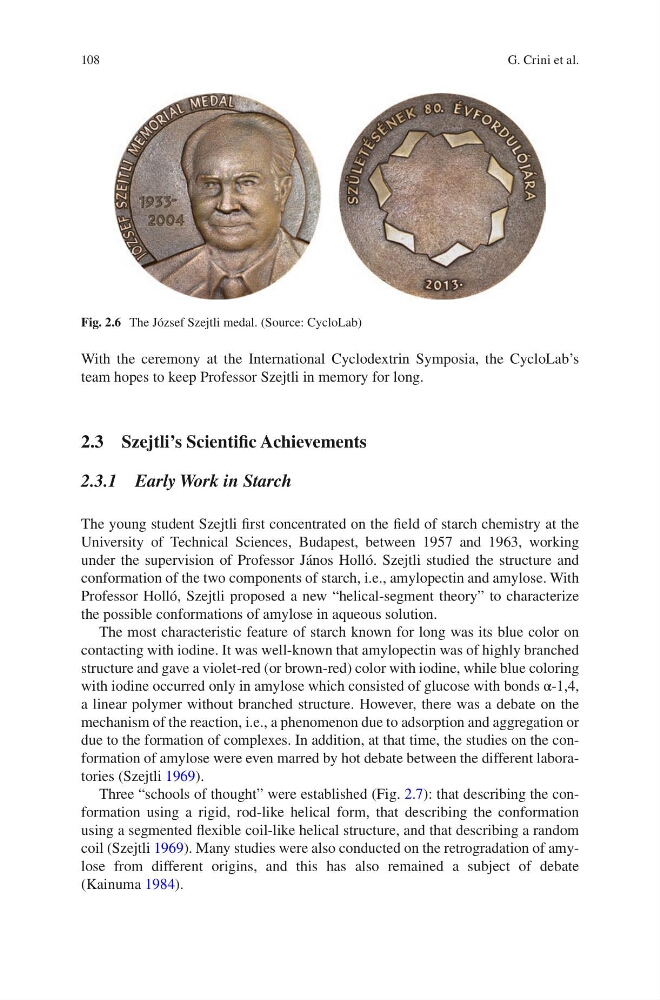
Fig. 2.6 The József Szejtli medal. (Source: CycloLab)
G. Crini et al.
With the ceremony at the International Cyclodextrin Symposia, the CycloLab’s
team hopes to keep Professor Szejtli in memory for long.
2.3 Szejtli’s Scientific Achievements
2.3.1 Early Work in Starch
The young student Szejtli first concentrated on the field of starch chemistry at the
University of Technical Sciences, Budapest, between 1957 and 1963, working
under the supervision of Professor János Holló. Szejtli studied the structure and
conformation of the two components of starch, i.e., amylopectin and amylose. With
Professor Holló, Szejtli proposed a new “helical-segment theory” to characterize
the possible conformations of amylose in aqueous solution.
The most characteristic feature of starch known for long was its blue color on
contacting with iodine. It was well-known that amylopectin was of highly branched
structure and gave a violet-red (or brown-red) color with iodine, while blue coloring
with iodine occurred only in amylose which consisted of glucose with bonds α-1,4,
a linear polymer without branched structure. However, there was a debate on the
mechanism of the reaction, i.e., a phenomenon due to adsorption and aggregation or
due to the formation of complexes. In addition, at that time, the studies on the conformation of amylose were even marred by hot debate between the different laboratories (Szejtli 1969).
Three “schools of thought” were established (Fig. 2.7): that describing the conformation using a rigid, rod-like helical form, that describing the conformation
using a segmented flexible coil-like helical structure, and that describing a random
coil (Szejtli 1969). Many studies were also conducted on the retrogradation of amylose from different origins, and this has also remained a subject of debate
(Kainuma 1984).
Fig. 2.6 The József Szejtli medal. (Source: CycloLab)
G. Crini et al.