

109
Holló and Szejtli (1957a, b, c, 1958), studying the mechanism of starch-iodine
reaction, were among the first to propose that amylose existed as a helix in aqueous
solutions. Their conclusions were based on amperometric titration (an innovative
method at that time), streaming dichroism (amylose-iodine complex in solution
caused dichroism), and on the viscosity studies of amylose. Holló and Szejtli
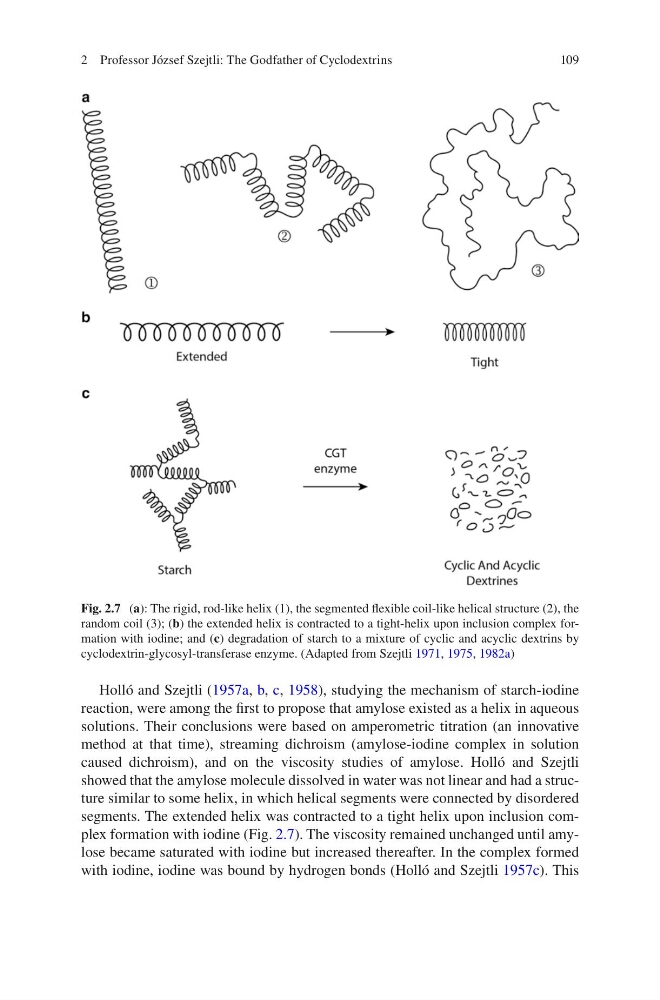
showed that the amylose molecule dissolved in water was not linear and had a structure similar to some helix, in which helical segments were connected by disordered
segments. The extended helix was contracted to a tight helix upon inclusion complex formation with iodine (Fig. 2.7). The viscosity remained unchanged until amylose became saturated with iodine but increased thereafter. In the complex formed
with iodine, iodine was bound by hydrogen bonds (Holló and Szejtli 1957c). This
Fig. 2.7 (a): The rigid, rod-like helix (1), the segmented flexible coil-like helical structure (2), the
random coil (3); (b) the extended helix is contracted to a tight-helix upon inclusion complex formation with iodine; and (c) degradation of starch to a mixture of cyclic and acyclic dextrins by
cyclodextrin-glycosyl-transferase enzyme. (Adapted from Szejtli 1971, 1975, 1982a)
2 Professor József Szejtli: The Godfather of Cyclodextrins
Holló and Szejtli (1957a, b, c, 1958), studying the mechanism of starch-iodine
reaction, were among the first to propose that amylose existed as a helix in aqueous
solutions. Their conclusions were based on amperometric titration (an innovative
method at that time), streaming dichroism (amylose-iodine complex in solution
caused dichroism), and on the viscosity studies of amylose. Holló and Szejtli
showed that the amylose molecule dissolved in water was not linear and had a structure similar to some helix, in which helical segments were connected by disordered
segments. The extended helix was contracted to a tight helix upon inclusion complex formation with iodine (Fig. 2.7). The viscosity remained unchanged until amylose became saturated with iodine but increased thereafter. In the complex formed
with iodine, iodine was bound by hydrogen bonds (Holló and Szejtli 1957c). This
Fig. 2.7 (a): The rigid, rod-like helix (1), the segmented flexible coil-like helical structure (2), the
random coil (3); (b) the extended helix is contracted to a tight-helix upon inclusion complex formation with iodine; and (c) degradation of starch to a mixture of cyclic and acyclic dextrins by
cyclodextrin-glycosyl-transferase enzyme. (Adapted from Szejtli 1971, 1975, 1982a)
2 Professor József Szejtli: The Godfather of Cyclodextrins