

47
What Makes a Task Safety Critical?
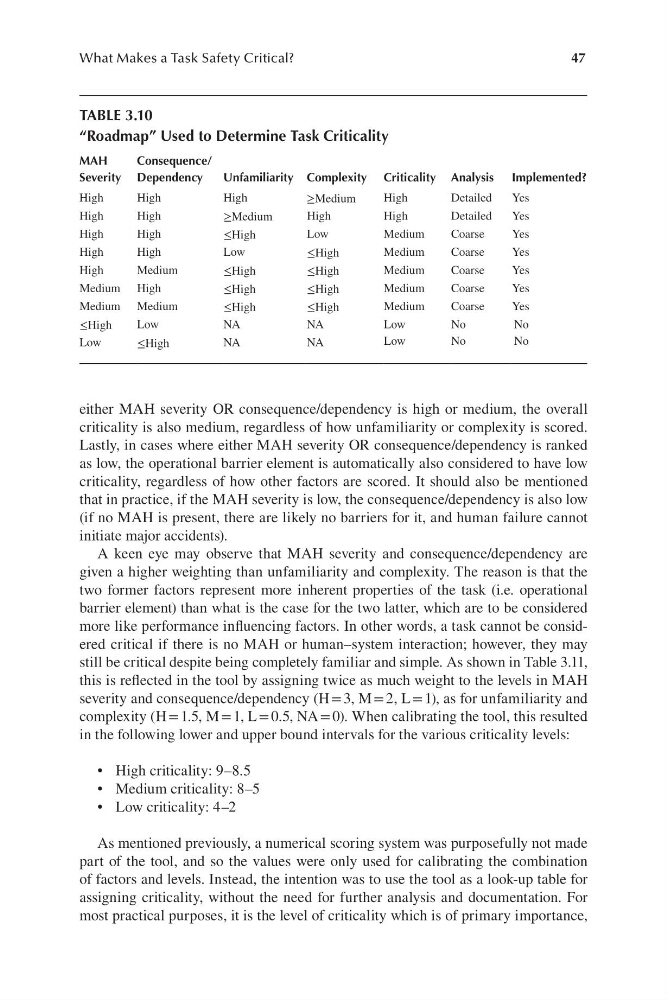
either MAH severity OR consequence/ dependency is high or medium, the overall
criticality is also medium, regardless of how unfamiliarity or complexity is scored.
Lastly, in cases where either MAH severity OR consequence/ dependency is ranked
as low, the operational barrier element is automatically also considered to have low
criticality, regardless of how other factors are scored. It should also be mentioned
that in practice, if the MAH severity is low, the consequence/ dependency is also low
( if no MAH is present, there are likely no barriers for it, and human failure cannot
initiate major accidents).
A keen eye may observe that MAH severity and consequence/ dependency are
given a higher weighting than unfamiliarity and complexity. The reason is that the
two former factors represent more inherent properties of the task ( i.e. operational
barrier element) than what is the case for the two latter, which are to be considered
more like performance influencing factors. In other words, a task cannot be considered critical if there is no MAH or human–system interaction; however, they may
still be critical despite being completely familiar and simple. As shown in Table 3.11,
this is reflected in the tool by assigning twice as much weight to the levels in MAH
severity and consequence/ dependency ( H = 3, M = 2, L = 1), as for unfamiliarity and
complexity (H = 1.5, M = 1, L = 0.5, NA = 0). When calibrating the tool, this resulted
in the following lower and upper bound intervals for the various criticality levels:
• High criticality: 9–8.5
• Medium criticality: 8–5
• Low criticality: 4–2
As mentioned previously, a numerical scoring system was purposefully not made
part of the tool, and so the values were only used for calibrating the combination
of factors and levels. Instead, the intention was to use the tool as a look-up table for
assigning criticality, without the need for further analysis and documentation. For
most practical purposes, it is the level of criticality which is of primary importance,
TABLE 3.10
“ Roadmap” Used to Determine Task Criticality
MAH
Consequence/
Severity Dependency
Unfamiliarity Complexity Criticality Analysis Implemented?
High
High
High
≥Medium
High
Detailed
Yes
High
High
≥Medium
High
High
Detailed
Yes
High
High
≤High
Low
Medium
Coarse
Yes
High
High
Low
≤High
Medium
Coarse
Yes
High
Medium
≤High
≤High
Medium
Coarse
Yes
Medium High
≤High
≤High
Medium
Coarse
Yes
Medium Medium
≤High
≤High
Medium
Coarse
Yes
≤High
Low
NA
NA
Low
No
No
Low
≤High
NA
NA
Low
No
No
What Makes a Task Safety Critical?
either MAH severity OR consequence/ dependency is high or medium, the overall
criticality is also medium, regardless of how unfamiliarity or complexity is scored.
Lastly, in cases where either MAH severity OR consequence/ dependency is ranked
as low, the operational barrier element is automatically also considered to have low
criticality, regardless of how other factors are scored. It should also be mentioned
that in practice, if the MAH severity is low, the consequence/ dependency is also low
( if no MAH is present, there are likely no barriers for it, and human failure cannot
initiate major accidents).
A keen eye may observe that MAH severity and consequence/ dependency are
given a higher weighting than unfamiliarity and complexity. The reason is that the
two former factors represent more inherent properties of the task ( i.e. operational
barrier element) than what is the case for the two latter, which are to be considered
more like performance influencing factors. In other words, a task cannot be considered critical if there is no MAH or human–system interaction; however, they may
still be critical despite being completely familiar and simple. As shown in Table 3.11,
this is reflected in the tool by assigning twice as much weight to the levels in MAH
severity and consequence/ dependency ( H = 3, M = 2, L = 1), as for unfamiliarity and
complexity (H = 1.5, M = 1, L = 0.5, NA = 0). When calibrating the tool, this resulted
in the following lower and upper bound intervals for the various criticality levels:
• High criticality: 9–8.5
• Medium criticality: 8–5
• Low criticality: 4–2
As mentioned previously, a numerical scoring system was purposefully not made
part of the tool, and so the values were only used for calibrating the combination
of factors and levels. Instead, the intention was to use the tool as a look-up table for
assigning criticality, without the need for further analysis and documentation. For
most practical purposes, it is the level of criticality which is of primary importance,
TABLE 3.10
“ Roadmap” Used to Determine Task Criticality
MAH
Consequence/
Severity Dependency
Unfamiliarity Complexity Criticality Analysis Implemented?
High
High
High
≥Medium
High
Detailed
Yes
High
High
≥Medium
High
High
Detailed
Yes
High
High
≤High
Low
Medium
Coarse
Yes
High
High
Low
≤High
Medium
Coarse
Yes
High
Medium
≤High
≤High
Medium
Coarse
Yes
Medium High
≤High
≤High
Medium
Coarse
Yes
Medium Medium
≤High
≤High
Medium
Coarse
Yes
≤High
Low
NA
NA
Low
No
No
Low
≤High
NA
NA
Low
No
No