

46
Sensemaking in Safety Critical and Complex Situations
may have multiple goals. Trouble shooting may require knowledge beyond what can
be proceduralized, and extensive coordination and communication between several
people is part of the task. A medium complex operational barrier element has many
of the same characteristics as those with high complexity but to a lesser degree,
most often due to a lower number of actions. Operational barrier elements with low
complexity are tasks which are highly obvious, e.g. due to a combination of few steps
and being supported by w ell-designed human–machine interfaces, alarm systems
and automation.
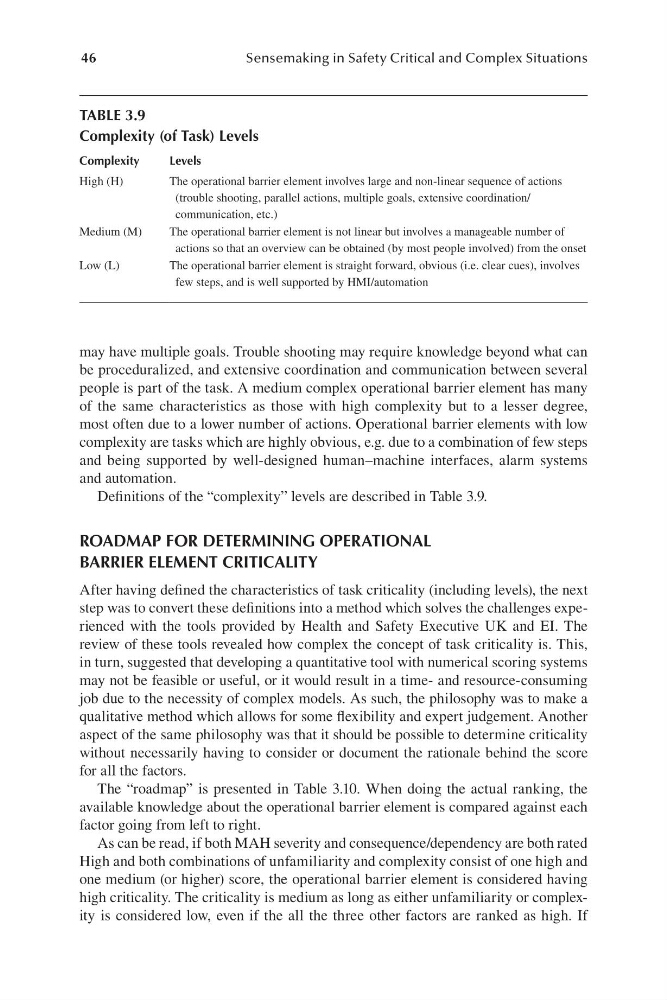
Definitions of the “ complexity” levels are described in Table 3.9.
ROADMAP FOR DETERMINING OPERATIONAL
BARRIER ELEMENT CRITICALITY
After having defined the characteristics of task criticality ( including levels), the next
step was to convert these definitions into a method which solves the challenges experienced with the tools provided by Health and Safety Executive UK and EI. The
review of these tools revealed how complex the concept of task criticality is. This,
in turn, suggested that developing a quantitative tool with numerical scoring systems
may not be feasible or useful, or it would result in a t ime- and resource-consuming
job due to the necessity of complex models. As such, the philosophy was to make a
qualitative method which allows for some flexibility and expert judgement. Another
aspect of the same philosophy was that it should be possible to determine criticality
without necessarily having to consider or document the rationale behind the score
for all the factors.
The “ roadmap” is presented in T able 3.10. When doing the actual ranking, the
available knowledge about the operational barrier element is compared against each
factor going from left to right.
As can be read, if both MAH severity and consequence/ dependency are both rated
High and both combinations of unfamiliarity and complexity consist of one high and
one medium ( or higher) score, the operational barrier element is considered having
high criticality. The criticality is medium as long as either unfamiliarity or complexity is considered low, even if the all the three other factors are ranked as high. If
TABLE 3.9
Complexity ( of Task) Levels
Complexity
Levels
High (H)
The operational barrier element involves large and non-linear sequence of actions
( trouble shooting, parallel actions, multiple goals, extensive coordination/
communication, etc.)
Medium (M)
The operational barrier element is not linear but involves a manageable number of
actions so that an overview can be obtained ( by most people involved) from the onset
Low (L)
The operational barrier element is straight forward, obvious ( i.e. clear cues), involves
few steps, and is well supported by HMI/ automation
Sensemaking in Safety Critical and Complex Situations
may have multiple goals. Trouble shooting may require knowledge beyond what can
be proceduralized, and extensive coordination and communication between several
people is part of the task. A medium complex operational barrier element has many
of the same characteristics as those with high complexity but to a lesser degree,
most often due to a lower number of actions. Operational barrier elements with low
complexity are tasks which are highly obvious, e.g. due to a combination of few steps
and being supported by w ell-designed human–machine interfaces, alarm systems
and automation.
Definitions of the “ complexity” levels are described in Table 3.9.
ROADMAP FOR DETERMINING OPERATIONAL
BARRIER ELEMENT CRITICALITY
After having defined the characteristics of task criticality ( including levels), the next
step was to convert these definitions into a method which solves the challenges experienced with the tools provided by Health and Safety Executive UK and EI. The
review of these tools revealed how complex the concept of task criticality is. This,
in turn, suggested that developing a quantitative tool with numerical scoring systems
may not be feasible or useful, or it would result in a t ime- and resource-consuming
job due to the necessity of complex models. As such, the philosophy was to make a
qualitative method which allows for some flexibility and expert judgement. Another
aspect of the same philosophy was that it should be possible to determine criticality
without necessarily having to consider or document the rationale behind the score
for all the factors.
The “ roadmap” is presented in T able 3.10. When doing the actual ranking, the
available knowledge about the operational barrier element is compared against each
factor going from left to right.
As can be read, if both MAH severity and consequence/ dependency are both rated
High and both combinations of unfamiliarity and complexity consist of one high and
one medium ( or higher) score, the operational barrier element is considered having
high criticality. The criticality is medium as long as either unfamiliarity or complexity is considered low, even if the all the three other factors are ranked as high. If
TABLE 3.9
Complexity ( of Task) Levels
Complexity
Levels
High (H)
The operational barrier element involves large and non-linear sequence of actions
( trouble shooting, parallel actions, multiple goals, extensive coordination/
communication, etc.)
Medium (M)
The operational barrier element is not linear but involves a manageable number of
actions so that an overview can be obtained ( by most people involved) from the onset
Low (L)
The operational barrier element is straight forward, obvious ( i.e. clear cues), involves
few steps, and is well supported by HMI/ automation