

45
What Makes a Task Safety Critical?
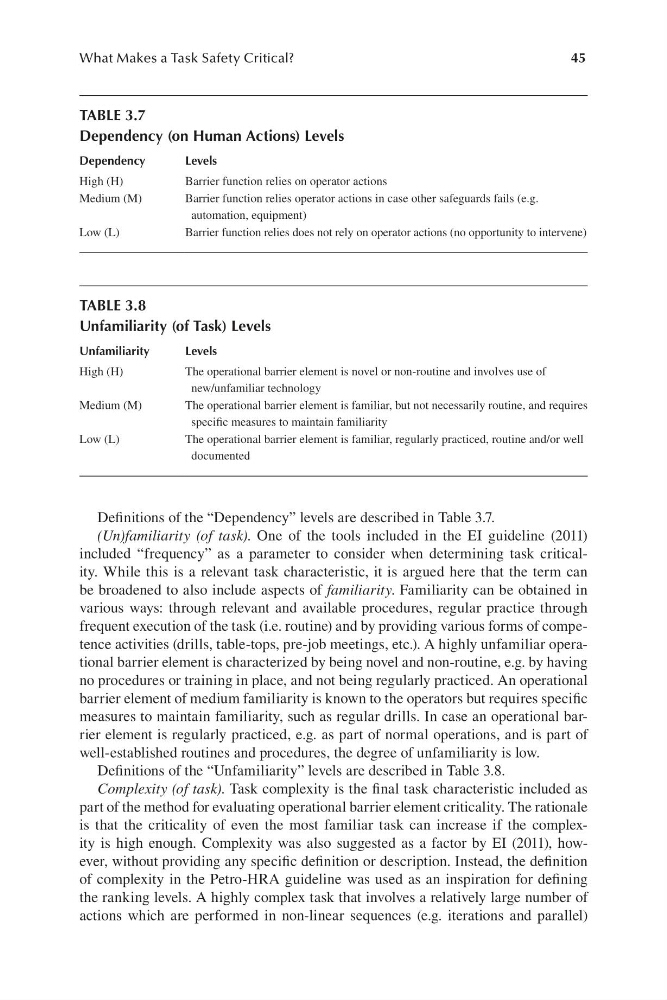
Definitions of the “ Dependency” levels are described in T able 3.7.
(Un)familiarity (of task). One of the tools included in the EI guideline ( 2011)
included “ frequency” as a parameter to consider when determining task criticality. While this is a relevant task characteristic, it is argued here that the term can
be broadened to also include aspects of familiarity. Familiarity can be obtained in
various ways: through relevant and available procedures, regular practice through
frequent execution of the task ( i.e. routine) and by providing various forms of competence activities ( drills, table-tops, pre-job meetings, etc.). A highly unfamiliar operational barrier element is characterized by being novel and non-routine, e.g. by having
no procedures or training in place, and not being regularly practiced. An operational
barrier element of medium familiarity is known to the operators but requires specific
measures to maintain familiarity, such as regular drills. In case an operational barrier element is regularly practiced, e.g. as part of normal operations, and is part of
well-established routines and procedures, the degree of unfamiliarity is low.
Definitions of the “ Unfamiliarity” levels are described in T able 3.8.
Complexity ( of task). Task complexity is the final task characteristic included as
part of the method for evaluating operational barrier element criticality. The rationale
is that the criticality of even the most familiar task can increase if the complexity is high enough. Complexity was also suggested as a factor by EI ( 2011), however, without providing any specific definition or description. Instead, the definition
of complexity in the Petro-HRA guideline was used as an inspiration for defining
the ranking levels. A highly complex task that involves a relatively large number of
actions which are performed in n on-linear sequences ( e.g. iterations and parallel)
TABLE 3.7
Dependency ( on Human Actions) Levels
Dependency
Levels
High (H)
Barrier function relies on operator actions
Medium (M)
Barrier function relies operator actions in case other safeguards fails ( e.g.
automation, equipment)
Low (L)
Barrier function relies does not rely on operator actions ( no opportunity to intervene)
TABLE 3.8
Unfamiliarity ( of Task) Levels
Unfamiliarity
Levels
High (H)
The operational barrier element is novel or non-routine and involves use of
new/unfamiliar technology
Medium (M)
The operational barrier element is familiar, but not necessarily routine, and requires
specific measures to maintain familiarity
Low (L)
The operational barrier element is familiar, regularly practiced, routine and/ or well
documented
What Makes a Task Safety Critical?
Definitions of the “ Dependency” levels are described in T able 3.7.
(Un)familiarity (of task). One of the tools included in the EI guideline ( 2011)
included “ frequency” as a parameter to consider when determining task criticality. While this is a relevant task characteristic, it is argued here that the term can
be broadened to also include aspects of familiarity. Familiarity can be obtained in
various ways: through relevant and available procedures, regular practice through
frequent execution of the task ( i.e. routine) and by providing various forms of competence activities ( drills, table-tops, pre-job meetings, etc.). A highly unfamiliar operational barrier element is characterized by being novel and non-routine, e.g. by having
no procedures or training in place, and not being regularly practiced. An operational
barrier element of medium familiarity is known to the operators but requires specific
measures to maintain familiarity, such as regular drills. In case an operational barrier element is regularly practiced, e.g. as part of normal operations, and is part of
well-established routines and procedures, the degree of unfamiliarity is low.
Definitions of the “ Unfamiliarity” levels are described in T able 3.8.
Complexity ( of task). Task complexity is the final task characteristic included as
part of the method for evaluating operational barrier element criticality. The rationale
is that the criticality of even the most familiar task can increase if the complexity is high enough. Complexity was also suggested as a factor by EI ( 2011), however, without providing any specific definition or description. Instead, the definition
of complexity in the Petro-HRA guideline was used as an inspiration for defining
the ranking levels. A highly complex task that involves a relatively large number of
actions which are performed in n on-linear sequences ( e.g. iterations and parallel)
TABLE 3.7
Dependency ( on Human Actions) Levels
Dependency
Levels
High (H)
Barrier function relies on operator actions
Medium (M)
Barrier function relies operator actions in case other safeguards fails ( e.g.
automation, equipment)
Low (L)
Barrier function relies does not rely on operator actions ( no opportunity to intervene)
TABLE 3.8
Unfamiliarity ( of Task) Levels
Unfamiliarity
Levels
High (H)
The operational barrier element is novel or non-routine and involves use of
new/unfamiliar technology
Medium (M)
The operational barrier element is familiar, but not necessarily routine, and requires
specific measures to maintain familiarity
Low (L)
The operational barrier element is familiar, regularly practiced, routine and/ or well
documented