

184
Sensemaking in Safety Critical and Complex Situations
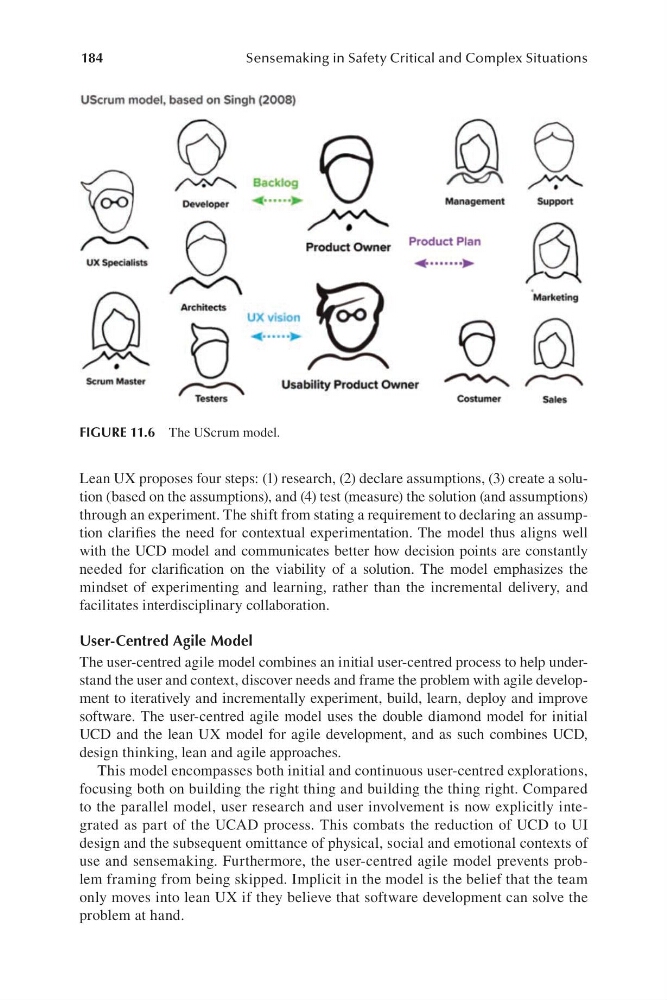
FIGURE 11.6 The UScrum model.
Lean UX proposes four steps: ( 1) research, ( 2) declare assumptions, ( 3) create a solution (b ased on the assumptions), and (4 ) test (me asure) the solution ( and assumptions)
through an experiment. The shift from stating a requirement to declaring an assumption clarifies the need for contextual experimentation. The model thus aligns well
with the UCD model and communicates better how decision points are constantly
needed for clarification on the viability of a solution. The model emphasizes the
mindset of experimenting and learning, rather than the incremental delivery, and
facilitates interdisciplinary collaboration.
User-Centred Agile Model
The user-centred agile model combines an initial us er-centred process to help understand the user and context, discover needs and frame the problem with agile development to iteratively and incrementally experiment, build, learn, deploy and improve
software. The us er-centred agile model uses the double diamond model for initial
UCD and the lean UX model for agile development, and as such combines UCD,
design thinking, lean and agile approaches.
This model encompasses both initial and continuous user-centred explorations,
focusing both on building the right thing and building the thing right. Compared
to the parallel model, user research and user involvement is now explicitly integrated as part of the UCAD process. This combats the reduction of UCD to UI
design and the subsequent omittance of physical, social and emotional contexts of
use and sensemaking. Furthermore, the us er-centred agile model prevents problem framing from being skipped. Implicit in the model is the belief that the team
only moves into lean UX if they believe that software development can solve the
problem at hand.
Sensemaking in Safety Critical and Complex Situations
FIGURE 11.6 The UScrum model.
Lean UX proposes four steps: ( 1) research, ( 2) declare assumptions, ( 3) create a solution (b ased on the assumptions), and (4 ) test (me asure) the solution ( and assumptions)
through an experiment. The shift from stating a requirement to declaring an assumption clarifies the need for contextual experimentation. The model thus aligns well
with the UCD model and communicates better how decision points are constantly
needed for clarification on the viability of a solution. The model emphasizes the
mindset of experimenting and learning, rather than the incremental delivery, and
facilitates interdisciplinary collaboration.
User-Centred Agile Model
The user-centred agile model combines an initial us er-centred process to help understand the user and context, discover needs and frame the problem with agile development to iteratively and incrementally experiment, build, learn, deploy and improve
software. The us er-centred agile model uses the double diamond model for initial
UCD and the lean UX model for agile development, and as such combines UCD,
design thinking, lean and agile approaches.
This model encompasses both initial and continuous user-centred explorations,
focusing both on building the right thing and building the thing right. Compared
to the parallel model, user research and user involvement is now explicitly integrated as part of the UCAD process. This combats the reduction of UCD to UI
design and the subsequent omittance of physical, social and emotional contexts of
use and sensemaking. Furthermore, the us er-centred agile model prevents problem framing from being skipped. Implicit in the model is the belief that the team
only moves into lean UX if they believe that software development can solve the
problem at hand.