

183
User-Centred Agile Development
Satellite Model
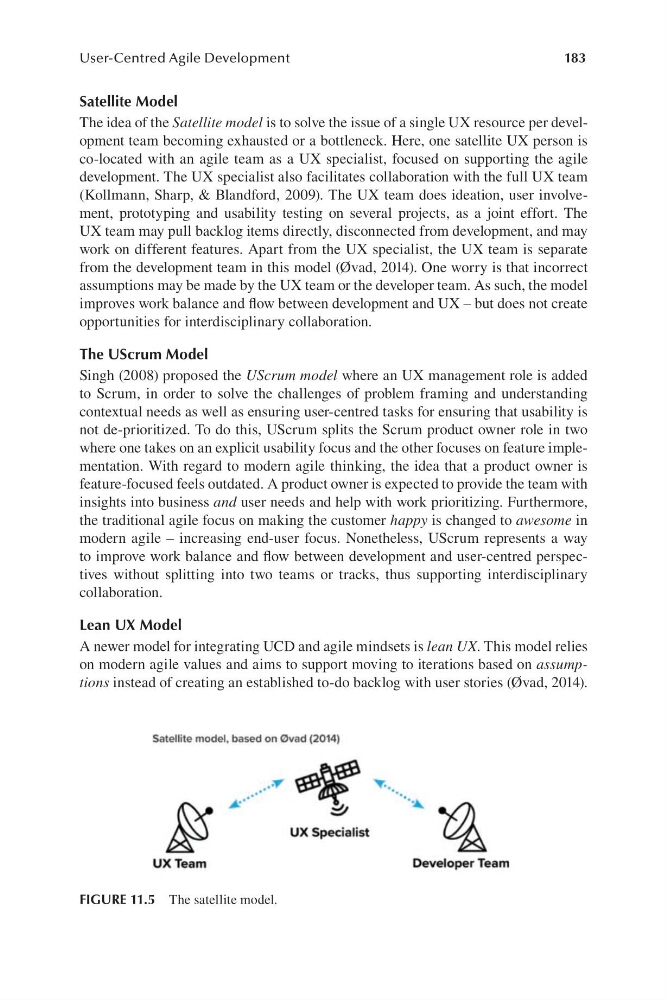
The idea of the Satellite model is to solve the issue of a single UX resource per development team becoming exhausted or a bottleneck. Here, one satellite UX person is
co-located with an agile team as a UX specialist, focused on supporting the agile
development. The UX specialist also facilitates collaboration with the full UX team
( Kollmann, Sharp, & Blandford, 2009). The UX team does ideation, user involvement, prototyping and usability testing on several projects, as a joint effort. The
UX team may pull backlog items directly, disconnected from development, and may
work on different features. Apart from the UX specialist, the UX team is separate
from the development team in this model ( Øvad, 2014). One worry is that incorrect
assumptions may be made by the UX team or the developer team. As such, the model
improves work balance and flow between development and UX – but does not create
opportunities for interdisciplinary collaboration.
The UScrum Model
Singh ( 2008) proposed the UScrum model where an UX management role is added
to Scrum, in order to solve the challenges of problem framing and understanding
contextual needs as well as ensuring user-centred tasks for ensuring that usability is
not de-prioritized. To do this, UScrum splits the Scrum product owner role in two
where one takes on an explicit usability focus and the other focuses on feature implementation. With regard to modern agile thinking, the idea that a product owner is
feature-focused feels outdated. A product owner is expected to provide the team with
insights into business and user needs and help with work prioritizing. Furthermore,
the traditional agile focus on making the customer happy is changed to awesome in
modern agile – increasing end-user focus. Nonetheless, UScrum represents a way
to improve work balance and flow between development and user-centred perspectives without splitting into two teams or tracks, thus supporting interdisciplinary
collaboration.
Lean UX Model
A newer model for integrating UCD and agile mindsets is lean UX. This model relies
on modern agile values and aims to support moving to iterations based on assumptions instead of creating an established to-do backlog with user stories ( Øvad, 2014).
FIGURE 11.5 The satellite model.
User-Centred Agile Development
Satellite Model
The idea of the Satellite model is to solve the issue of a single UX resource per development team becoming exhausted or a bottleneck. Here, one satellite UX person is
co-located with an agile team as a UX specialist, focused on supporting the agile
development. The UX specialist also facilitates collaboration with the full UX team
( Kollmann, Sharp, & Blandford, 2009). The UX team does ideation, user involvement, prototyping and usability testing on several projects, as a joint effort. The
UX team may pull backlog items directly, disconnected from development, and may
work on different features. Apart from the UX specialist, the UX team is separate
from the development team in this model ( Øvad, 2014). One worry is that incorrect
assumptions may be made by the UX team or the developer team. As such, the model
improves work balance and flow between development and UX – but does not create
opportunities for interdisciplinary collaboration.
The UScrum Model
Singh ( 2008) proposed the UScrum model where an UX management role is added
to Scrum, in order to solve the challenges of problem framing and understanding
contextual needs as well as ensuring user-centred tasks for ensuring that usability is
not de-prioritized. To do this, UScrum splits the Scrum product owner role in two
where one takes on an explicit usability focus and the other focuses on feature implementation. With regard to modern agile thinking, the idea that a product owner is
feature-focused feels outdated. A product owner is expected to provide the team with
insights into business and user needs and help with work prioritizing. Furthermore,
the traditional agile focus on making the customer happy is changed to awesome in
modern agile – increasing end-user focus. Nonetheless, UScrum represents a way
to improve work balance and flow between development and user-centred perspectives without splitting into two teams or tracks, thus supporting interdisciplinary
collaboration.
Lean UX Model
A newer model for integrating UCD and agile mindsets is lean UX. This model relies
on modern agile values and aims to support moving to iterations based on assumptions instead of creating an established to-do backlog with user stories ( Øvad, 2014).
FIGURE 11.5 The satellite model.