

182
Sensemaking in Safety Critical and Complex Situations
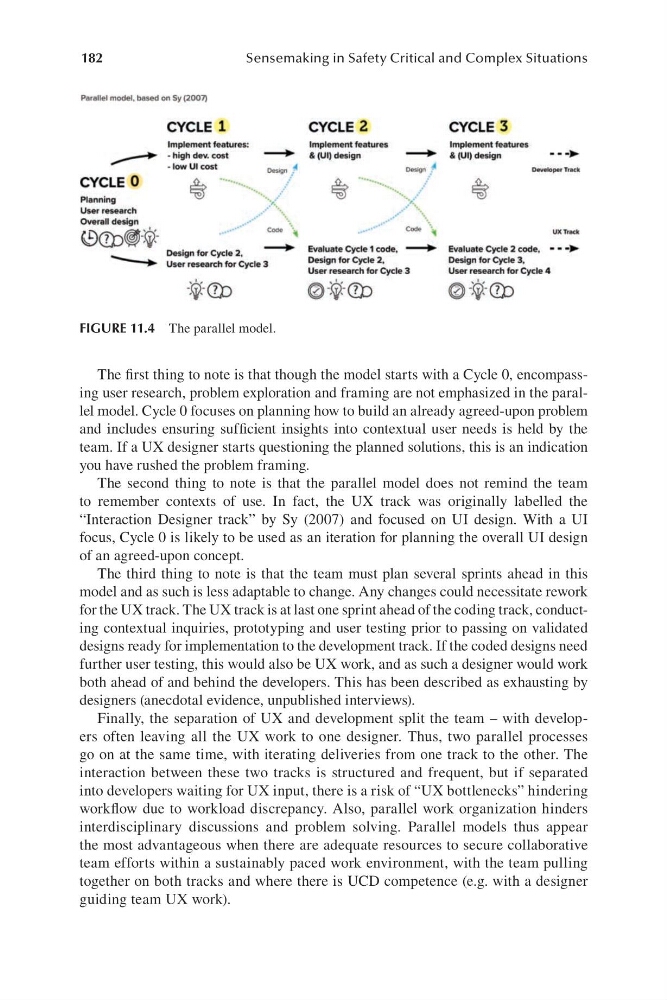
FIGURE 11.4 The parallel model.
The first thing to note is that though the model starts with a Cycle 0, encompassing user research, problem exploration and framing are not emphasized in the parallel model. Cycle 0 focuses on planning how to build an already agreed-upon problem
and includes ensuring sufficient insights into contextual user needs is held by the
team. If a UX designer starts questioning the planned solutions, this is an indication
you have rushed the problem framing.
The second thing to note is that the parallel model does not remind the team
to remember contexts of use. In fact, the UX track was originally labelled the
“ Interaction Designer track” by Sy ( 2007) and focused on UI design. With a UI
focus, Cycle 0 is likely to be used as an iteration for planning the overall UI design
of an agreed-upon concept.
The third thing to note is that the team must plan several sprints ahead in this
model and as such is less adaptable to change. Any changes could necessitate rework
for the UX track. The UX track is at last one sprint ahead of the coding track, conducting contextual inquiries, prototyping and user testing prior to passing on validated
designs ready for implementation to the development track. If the coded designs need
further user testing, this would also be UX work, and as such a designer would work
both ahead of and behind the developers. This has been described as exhausting by
designers ( anecdotal evidence, unpublished interviews).
Finally, the separation of UX and development split the team – with developers often leaving all the UX work to one designer. Thus, two parallel processes
go on at the same time, with iterating deliveries from one track to the other. The
interaction between these two tracks is structured and frequent, but if separated
into developers waiting for UX input, there is a risk of “U X bottlenecks” hindering
workflow due to workload discrepancy. Also, parallel work organization hinders
interdisciplinary discussions and problem solving. Parallel models thus appear
the most advantageous when there are adequate resources to secure collaborative
team efforts within a sustainably paced work environment, with the team pulling
together on both tracks and where there is UCD competence ( e.g. with a designer
guiding team UX work).
Sensemaking in Safety Critical and Complex Situations
FIGURE 11.4 The parallel model.
The first thing to note is that though the model starts with a Cycle 0, encompassing user research, problem exploration and framing are not emphasized in the parallel model. Cycle 0 focuses on planning how to build an already agreed-upon problem
and includes ensuring sufficient insights into contextual user needs is held by the
team. If a UX designer starts questioning the planned solutions, this is an indication
you have rushed the problem framing.
The second thing to note is that the parallel model does not remind the team
to remember contexts of use. In fact, the UX track was originally labelled the
“ Interaction Designer track” by Sy ( 2007) and focused on UI design. With a UI
focus, Cycle 0 is likely to be used as an iteration for planning the overall UI design
of an agreed-upon concept.
The third thing to note is that the team must plan several sprints ahead in this
model and as such is less adaptable to change. Any changes could necessitate rework
for the UX track. The UX track is at last one sprint ahead of the coding track, conducting contextual inquiries, prototyping and user testing prior to passing on validated
designs ready for implementation to the development track. If the coded designs need
further user testing, this would also be UX work, and as such a designer would work
both ahead of and behind the developers. This has been described as exhausting by
designers ( anecdotal evidence, unpublished interviews).
Finally, the separation of UX and development split the team – with developers often leaving all the UX work to one designer. Thus, two parallel processes
go on at the same time, with iterating deliveries from one track to the other. The
interaction between these two tracks is structured and frequent, but if separated
into developers waiting for UX input, there is a risk of “U X bottlenecks” hindering
workflow due to workload discrepancy. Also, parallel work organization hinders
interdisciplinary discussions and problem solving. Parallel models thus appear
the most advantageous when there are adequate resources to secure collaborative
team efforts within a sustainably paced work environment, with the team pulling
together on both tracks and where there is UCD competence ( e.g. with a designer
guiding team UX work).