

166
Sensemaking in Safety Critical and Complex Situations
interfaces, simple components, such as toggle buttons, could have radically different
designs across different equipment (Nordby, Mallam & Lützhöft, 2019). By standardizing a set of common components, it is easier for users to understand key functions. We
argue that an additional effect for improved sensemaking is that more predictable user
interface components allow users to free their cognitive resources on actual maritime
operations rather than in learning and interpreting the operational systems.
generic aPPlicationS Structure
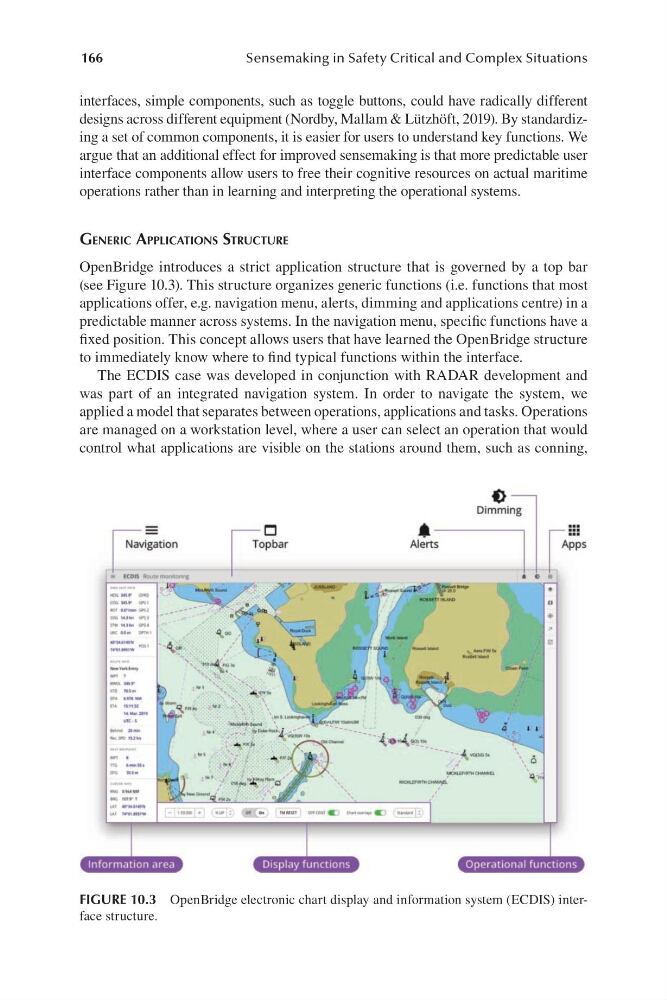
OpenBridge introduces a strict application structure that is governed by a top bar
( see Figure 10.3). This structure organizes generic functions ( i.e. functions that most
applications offer, e.g. navigation menu, alerts, dimming and applications centre) in a
predictable manner across systems. In the navigation menu, specific functions have a
fixed position. This concept allows users that have learned the OpenBridge structure
to immediately know where to find typical functions within the interface.
The ECDIS case was developed in conjunction with RADAR development and
was part of an integrated navigation system. In order to navigate the system, we
applied a model that separates between operations, applications and tasks. Operations
are managed on a workstation level, where a user can select an operation that would
control what applications are visible on the stations around them, such as conning,
FIGURE 10.3 OpenBridge electronic chart display and information system ( ECDIS) interface structure.
Sensemaking in Safety Critical and Complex Situations
interfaces, simple components, such as toggle buttons, could have radically different
designs across different equipment (Nordby, Mallam & Lützhöft, 2019). By standardizing a set of common components, it is easier for users to understand key functions. We
argue that an additional effect for improved sensemaking is that more predictable user
interface components allow users to free their cognitive resources on actual maritime
operations rather than in learning and interpreting the operational systems.
generic aPPlicationS Structure
OpenBridge introduces a strict application structure that is governed by a top bar
( see Figure 10.3). This structure organizes generic functions ( i.e. functions that most
applications offer, e.g. navigation menu, alerts, dimming and applications centre) in a
predictable manner across systems. In the navigation menu, specific functions have a
fixed position. This concept allows users that have learned the OpenBridge structure
to immediately know where to find typical functions within the interface.
The ECDIS case was developed in conjunction with RADAR development and
was part of an integrated navigation system. In order to navigate the system, we
applied a model that separates between operations, applications and tasks. Operations
are managed on a workstation level, where a user can select an operation that would
control what applications are visible on the stations around them, such as conning,
FIGURE 10.3 OpenBridge electronic chart display and information system ( ECDIS) interface structure.