

126
Sensemaking in Safety Critical and Complex Situations
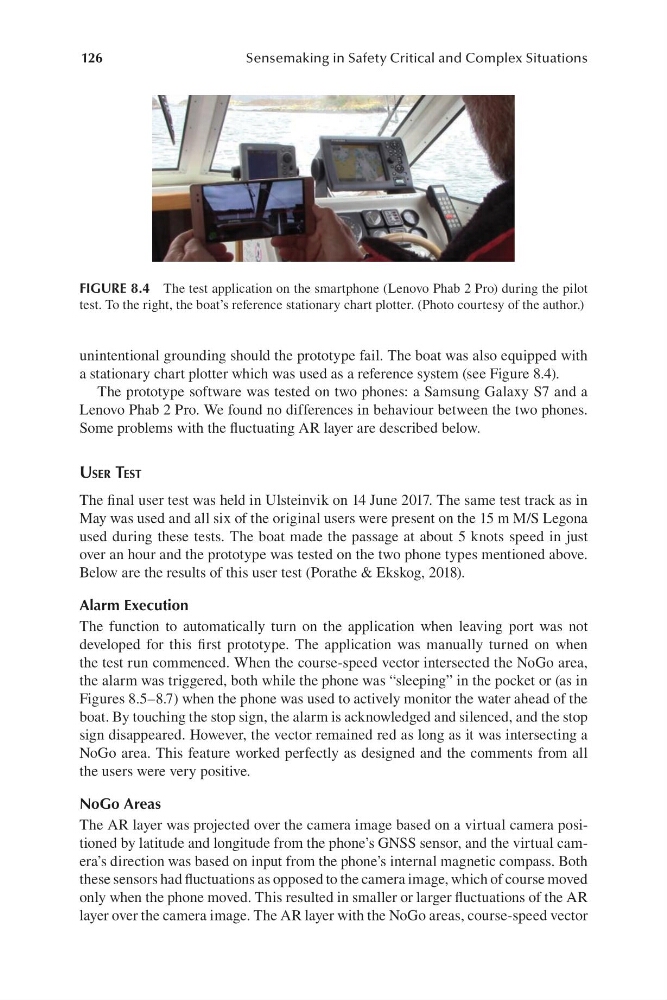
FIGURE 8.4 The test application on the smartphone (L enovo Phab 2 Pro) during the pilot
test. To the right, the boat’s reference stationary chart plotter. ( Photo courtesy of the author.)
unintentional grounding should the prototype fail. The boat was also equipped with
a stationary chart plotter which was used as a reference system (s ee F igure 8.4).
The prototype software was tested on two phones: a Samsung Galaxy S7 and a
Lenovo Phab 2 Pro. We found no differences in behaviour between the two phones.
Some problems with the fluctuating AR layer are described below.
uSer teSt
The final user test was held in Ulsteinvik on 14 June 2017. The same test track as in
May was used and all six of the original users were present on the 15 m M/S L egona
used during these tests. The boat made the passage at about 5 knots speed in just
over an hour and the prototype was tested on the two phone types mentioned above.
Below are the results of this user test (P orathe & Ekskog, 2018).
Alarm Execution
The function to automatically turn on the application when leaving port was not
developed for this first prototype. The application was manually turned on when
the test run commenced. When the course-speed vector intersected the NoGo area,
the alarm was triggered, both while the phone was “s leeping” in the pocket or ( as in
F igures 8. 5–8.7) when the phone was used to actively monitor the water ahead of the
boat. By touching the stop sign, the alarm is acknowledged and silenced, and the stop
sign disappeared. However, the vector remained red as long as it was intersecting a
NoGo area. This feature worked perfectly as designed and the comments from all
the users were very positive.
NoGo Areas
The AR layer was projected over the camera image based on a virtual camera positioned by latitude and longitude from the phone’s GNSS sensor, and the virtual camera’s direction was based on input from the phone’s internal magnetic compass. Both
these sensors had fluctuations as opposed to the camera image, which of course moved
only when the phone moved. This resulted in smaller or larger fluctuations of the AR
layer over the camera image. The AR layer with the NoGo areas, c ourse-speed vector
Sensemaking in Safety Critical and Complex Situations
FIGURE 8.4 The test application on the smartphone (L enovo Phab 2 Pro) during the pilot
test. To the right, the boat’s reference stationary chart plotter. ( Photo courtesy of the author.)
unintentional grounding should the prototype fail. The boat was also equipped with
a stationary chart plotter which was used as a reference system (s ee F igure 8.4).
The prototype software was tested on two phones: a Samsung Galaxy S7 and a
Lenovo Phab 2 Pro. We found no differences in behaviour between the two phones.
Some problems with the fluctuating AR layer are described below.
uSer teSt
The final user test was held in Ulsteinvik on 14 June 2017. The same test track as in
May was used and all six of the original users were present on the 15 m M/S L egona
used during these tests. The boat made the passage at about 5 knots speed in just
over an hour and the prototype was tested on the two phone types mentioned above.
Below are the results of this user test (P orathe & Ekskog, 2018).
Alarm Execution
The function to automatically turn on the application when leaving port was not
developed for this first prototype. The application was manually turned on when
the test run commenced. When the course-speed vector intersected the NoGo area,
the alarm was triggered, both while the phone was “s leeping” in the pocket or ( as in
F igures 8. 5–8.7) when the phone was used to actively monitor the water ahead of the
boat. By touching the stop sign, the alarm is acknowledged and silenced, and the stop
sign disappeared. However, the vector remained red as long as it was intersecting a
NoGo area. This feature worked perfectly as designed and the comments from all
the users were very positive.
NoGo Areas
The AR layer was projected over the camera image based on a virtual camera positioned by latitude and longitude from the phone’s GNSS sensor, and the virtual camera’s direction was based on input from the phone’s internal magnetic compass. Both
these sensors had fluctuations as opposed to the camera image, which of course moved
only when the phone moved. This resulted in smaller or larger fluctuations of the AR
layer over the camera image. The AR layer with the NoGo areas, c ourse-speed vector