

642
The Chemistry and Technology of Petroleum
and Naman, 1989; Clark and Wassink, 1990; Megalofonos and Papayannakos, 1997; Arild, 2000;
Raissi, 2001). In the temperature range of about 800°C–1500°C (1470°F–2730°F), thermolysis of
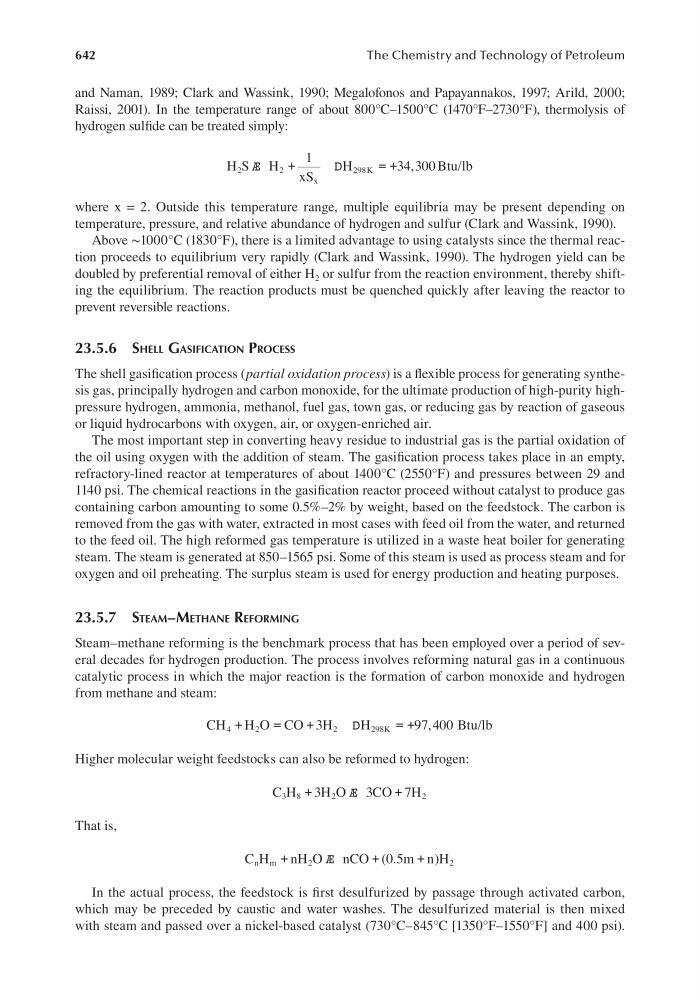
hydrogen sulfide can be treated simply:
H S H
xS
H
3 4 3 Btu/lb
2
2
x
298 K
Æ
+
= +
1
00
D
,
where x = 2. Outside this temperature range, multiple equilibria may be present depending on
temperature, pressure, and relative abundance of hydrogen and sulfur (Clark and Wassink, 1990).
Above ∼1000°C (1830°F), there is a limited advantage to using catalysts since the thermal reaction proceeds to equilibrium very rapidly (Clark and Wassink, 1990). The hydrogen yield can be
doubled by preferential removal of either H 2 or sulfur from the reaction environment, thereby shifting the equilibrium. The reaction products must be quenched quickly after leaving the reactor to
prevent reversible reactions.
23.5.6 sHell gAsIFICAtIon ProCess
The shell gasification process (partial oxidation process) is a flexible process for generating synthesis gas, principally hydrogen and carbon monoxide, for the ultimate production of high-purity highpressure hydrogen, ammonia, methanol, fuel gas, town gas, or reducing gas by reaction of gaseous
or liquid hydrocarbons with oxygen, air, or oxygen-enriched air.
The most important step in converting heavy residue to industrial gas is the partial oxidation of
the oil using oxygen with the addition of steam. The gasification process takes place in an empty,
refractory-lined reactor at temperatures of about 1400°C (2550°F) and pressures between 29 and
1140 psi. The chemical reactions in the gasification reactor proceed without catalyst to produce gas
containing carbon amounting to some 0.5%–2% by weight, based on the feedstock. The carbon is
removed from the gas with water, extracted in most cases with feed oil from the water, and returned
to the feed oil. The high reformed gas temperature is utilized in a waste heat boiler for generating
steam. The steam is generated at 850–1565 psi. Some of this steam is used as process steam and for
oxygen and oil preheating. The surplus steam is used for energy production and heating purposes.
23.5.7 steAm–metHAne reFormIng
Steam–methane reforming is the benchmark process that has been employed over a period of several decades for hydrogen production. The process involves reforming natural gas in a continuous
catalytic process in which the major reaction is the formation of carbon monoxide and hydrogen
from methane and steam:
CH H O CO H
H
Btu/lb
K
4
2
2
298
3
9 7 400
+
=
+
= +
D
,
Higher molecular weight feedstocks can also be reformed to hydrogen:
C H
H O
CO H
3 8
2
2
3
3
7
+
Æ
+
That is,
C H
nH O nCO
m n H
n m +
Æ
+
+
2
2
0 5
( .
)
In the actual process, the feedstock is first desulfurized by passage through activated carbon,
which may be preceded by caustic and water washes. The desulfurized material is then mixed
with steam and passed over a nickel-based catalyst (730°C–845°C [1350°F–1550°F] and 400 psi).