

643
Hydrogen Production
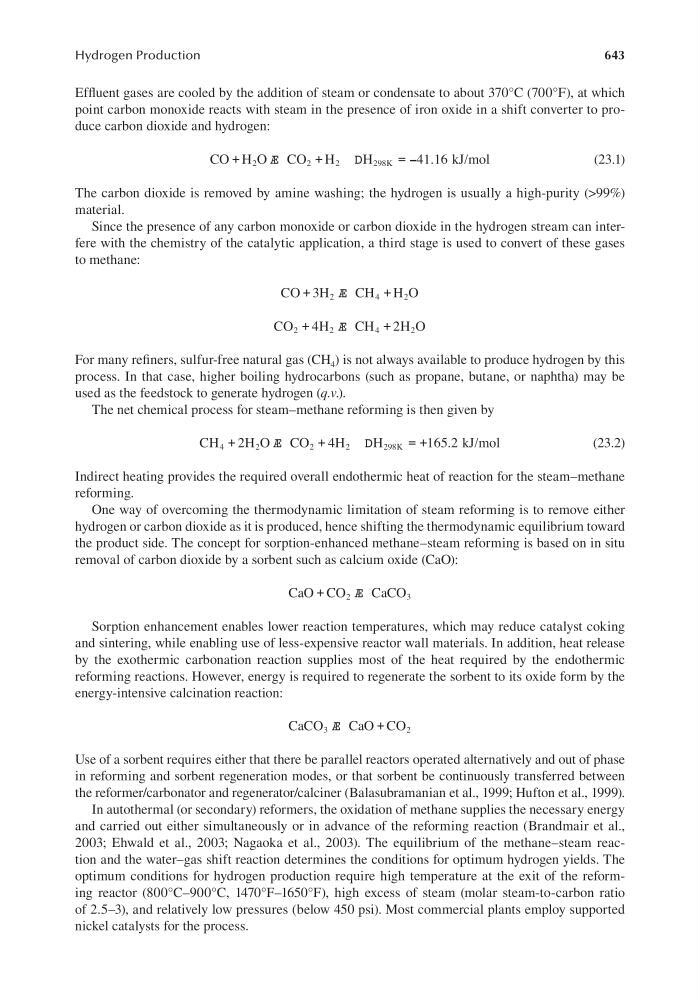
Effluent gases are cooled by the addition of steam or condensate to about 370°C (700°F), at which
point carbon monoxide reacts with steam in the presence of iron oxide in a shift converter to produce carbon dioxide and hydrogen:
CO H O CO H
H
kJ/mol
K
+
Æ
+
= -
2
2
2
298
41 16
D
.
(23.1)
The carbon dioxide is removed by amine washing; the hydrogen is usually a high-purity (>99%)
material.
Since the presence of any carbon monoxide or carbon dioxide in the hydrogen stream can interfere with the chemistry of the catalytic application, a third stage is used to convert of these gases
to methane:
CO H
CH H O
+
Æ
+
3 2
4
2
CO
H
CH
H O
2
2
4
2
4
2
+
Æ
+
For many refiners, sulfur-free natural gas (CH 4 ) is not always available to produce hydrogen by this
process. In that case, higher boiling hydrocarbons (such as propane, butane, or naphtha) may be
used as the feedstock to generate hydrogen (q.v.).
The net chemical process for steam–methane reforming is then given by
CH
H O CO
H
H
kJ/mol
K
4
2
2
2
298
2
4
165 2
+
Æ
+
= +
D
.
(23.2)
Indirect heating provides the required overall endothermic heat of reaction for the steam–methane
reforming.
One way of overcoming the thermodynamic limitation of steam reforming is to remove either
hydrogen or carbon dioxide as it is produced, hence shifting the thermodynamic equilibrium toward
the product side. The concept for sorption-enhanced methane–steam reforming is based on in situ
removal of carbon dioxide by a sorbent such as calcium oxide (CaO):
CaO CO
CaCO
+
Æ
2
3
Sorption enhancement enables lower reaction temperatures, which may reduce catalyst coking
and sintering, while enabling use of less-expensive reactor wall materials. In addition, heat release
by the exothermic carbonation reaction supplies most of the heat required by the endothermic
reforming reactions. However, energy is required to regenerate the sorbent to its oxide form by the
energy-intensive calcination reaction:
CaCO
CaO CO
3
2
Æ
+
Use of a sorbent requires either that there be parallel reactors operated alternatively and out of phase
in reforming and sorbent regeneration modes, or that sorbent be continuously transferred between
the reformer/carbonator and regenerator/calciner (Balasubramanian et al., 1999; Hufton et al., 1999).
In autothermal (or secondary) reformers, the oxidation of methane supplies the necessary energy
and carried out either simultaneously or in advance of the reforming reaction (Brandmair et al.,
2003; Ehwald et al., 2003; Nagaoka et al., 2003). The equilibrium of the methane–steam reaction and the water–gas shift reaction determines the conditions for optimum hydrogen yields. The
optimum conditions for hydrogen production require high temperature at the exit of the reforming reactor (800°C–900°C, 1470°F–1650°F), high excess of steam (molar steam-to-carbon ratio
of 2.5–3), and relatively low pressures (below 450 psi). Most commercial plants employ supported
nickel catalysts for the process.