

641
Hydrogen Production
Hydrogen is recovered by phase separation to yield hydrogen of about 93% purity; the principal
contaminant is methane.
23.5.5 PyrolysIs ProCesses
There has been recent interest in the use of pyrolysis processes to produce hydrogen. Specifically,
the interest has focused on the pyrolysis of methane (natural gas) and hydrogen sulfide.
Natural gas is readily available and offers relatively rich stream of methane with lower amounts
of ethane, propane, and butane also being present. The thermocatalytic decomposition of natural
gas hydrocarbons offers an alternate method for the production of hydrogen (Uemura et al., 1999;
Weimer et al., 2000; Dahl and Weimer, 2001):
C H
nC
m
H
n m
2
Æ
+
Ê
Ë
Á
ˆ
¯
˜
2
If a hydrocarbon fuel such as natural gas (methane) is to be used for hydrogen production by
direct decomposition, then the process that is optimized to yield hydrogen production may not be
suitable for production of high-quality carbon black by-product intended for the industrial rubber market. Moreover, it appears that the carbon produced from high-temperature (850°C–950°C;
1560°F–1740°F) direct thermal decomposition of methane is soot-like material with a high tendency for the catalyst deactivation (Murata et al., 1997). Thus, if the object of methane decomposition is hydrogen production, the carbon by-product may not be marketable as high-quality carbon
black for rubber and tire applications.
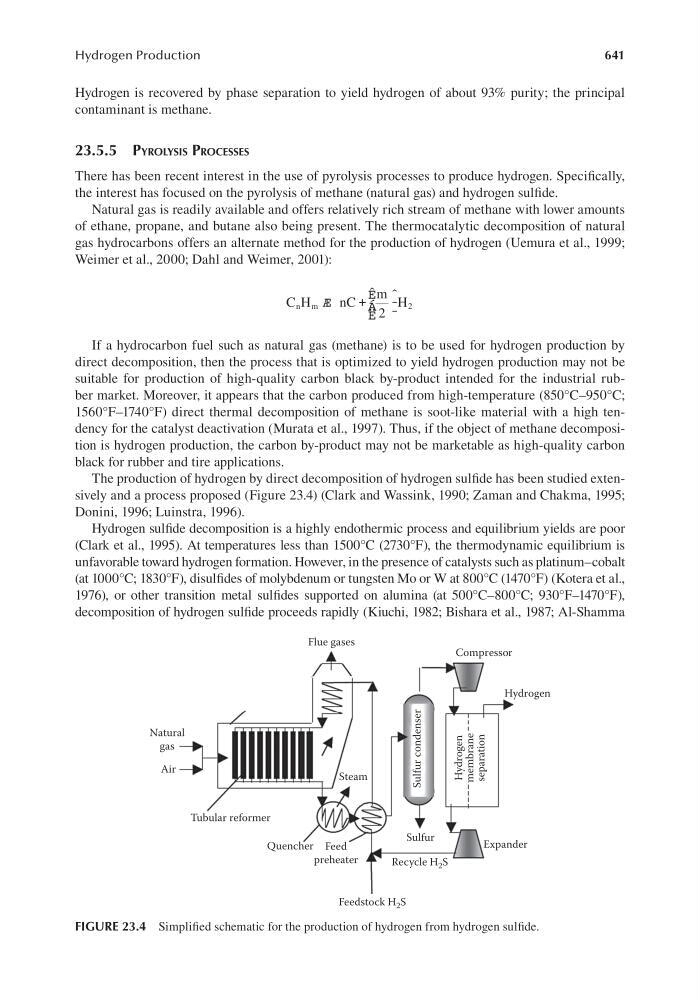
The production of hydrogen by direct decomposition of hydrogen sulfide has been studied extensively and a process proposed (Figure 23.4) (Clark and Wassink, 1990; Zaman and Chakma, 1995;
Donini, 1996; Luinstra, 1996).
Hydrogen sulfide decomposition is a highly endothermic process and equilibrium yields are poor
(Clark et al., 1995). At temperatures less than 1500°C (2730°F), the thermodynamic equilibrium is
unfavorable toward hydrogen formation. However, in the presence of catalysts such as platinum–cobalt
(at 1000°C; 1830°F), disulfides of molybdenum or tungsten Mo or W at 800°C (1470°F) (Kotera et al.,
1976), or other transition metal sulfides supported on alumina (at 500°C–800°C; 930°F–1470°F),
decomposition of hydrogen sulfide proceeds rapidly (Kiuchi, 1982; Bishara et al., 1987; Al-Shamma
Furnace
Flue gases
Compressor
Sulfur condenser
Hydrogen
Expander
Sulfur
Recycle H 2 S
Natural
gas
Air
Tubular reformer
Quencher Feed
preheater
Steam
Feedstock H 2 S
Hydrogen
membrane
separation
FIGURE 23.4 Simplified schematic for the production of hydrogen from hydrogen sulfide.