

613
Hydrocracking
Hydrotreating facilities may be integrated with the hydroconversion section or built on a standalone basis, depending on product quality objectives and owner preference.
22.3.13 mIld HydroCrACkIng ProCess
The mild hydrocracking process uses operating conditions similar to those of a vacuum gas oil
(VGO) desulfurizer to convert vacuum gas oil to significant yields of lighter products. Consequently,
the flow scheme for a mild hydrocracking unit is virtually identical to that of a vacuum gas oil desulfurizer. The process maintains the hydrotreating advantage of sulfur reduction while achieving
significant conversion of the feedstock (Dziabala et al., 2011).
For example, in a simplified process for vacuum gas oil desulfurization, vacuum gas oil feedstock is mixed with hydrogen makeup gas and preheated against reactor effluent. Further preheating
to reaction temperature is accomplished in a fired heater. The hot feed is mixed with recycle gas
before entering the reactor. The temperature rises across the reactor due to the exothermic heat of
reaction. Catalyst bed temperatures are usually controlled by using multiple catalyst beds and by
introducing recycle gas as an inter-bed quench medium. Reactor effluent is cooled against incoming
feed and air or water before entering the high-pressure separator. Vapors from this separator are
scrubbed to remove hydrogen sulfide (H 2 S) before compression return to the reactor as recycle and
quench. A small portion of these gases is purged to fuel gas to prevent buildup of light ends. Liquid
from the high-pressure separator is flashed into the low-pressure separator. Sour flash vapors are
purged from the unit. Liquid is preheated against stripper bottoms and in a feed heater before steam
stripping in a stabilizer tower. Water wash facilities are provided upstream of the last reactor effluent cooler to remove ammonium salts produced by denitrogenation of the vacuum gas oil feedstock.
Variation of this process leads to the hot separator design. The process flow scheme is identical to
that described earlier up to the reactor outlet. After initial reactor effluent cooling against incoming
vacuum gas oil feed and makeup hydrogen, a hot separator is installed. Hot liquid is routed directly
to the product stabilizer. Hot vapors are further cooled by air and/or water before entering the cold
separator. This arrangement reduces the stabilizer feed preheat duty and the effluent cooling duty
by routing hot liquid direct to the stripper tower.
The process operates under temperature conditions of 350°C–440°C (660°F–825°F) and pressures of 450–1500 psi (Scherzer and Gruia, 1996). The hydrogen partial pressure has the greatest effect on the mild hydrocracking process. Higher pressures result in higher reaction rates and
increased catalyst stability. Lower pressures facilitate deactivation of the catalyst due to the fact
that the reactive coke precursors are not hydrogenated quickly enough to prevent coke formation
on the catalyst. Reactor pressure cannot always be controlled, however. Instead, it is dependent on
the available pressure of the hydrogen gas, which would otherwise require installation of costly
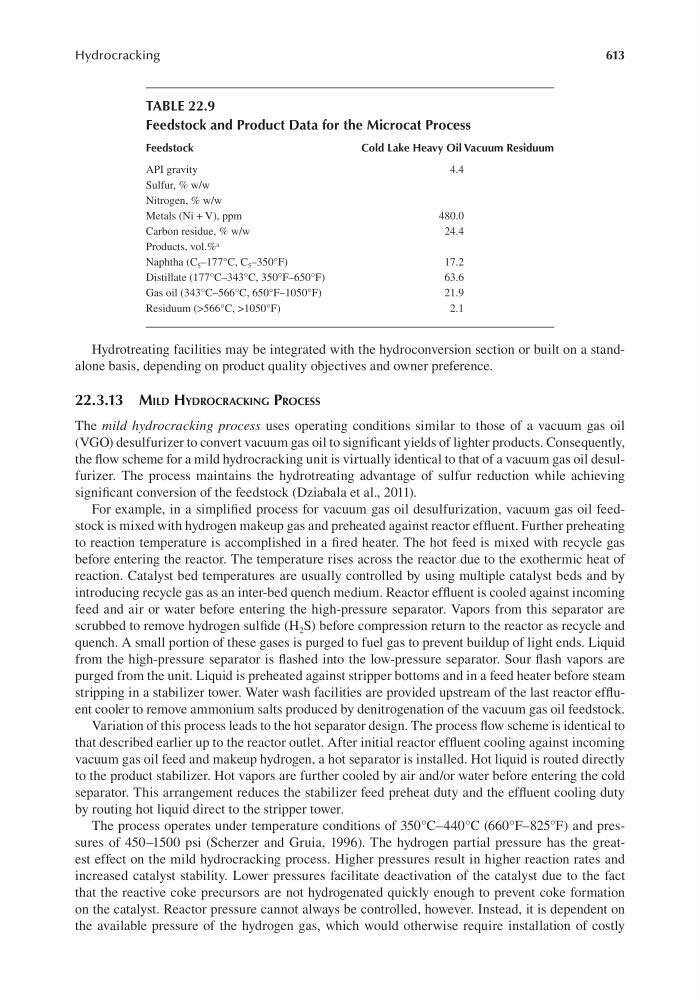
TABLE 22.9
Feedstock and Product Data for the Microcat Process
Feedstock
Cold Lake Heavy Oil Vacuum Residuum
API gravity
4.4
Sulfur, % w/w
Nitrogen, % w/w
Metals (Ni + V), ppm
480.0
Carbon residue, % w/w
24.4
Products, vol.% a
Naphtha (C 5 –177°C, C 5 –350°F)
17.2
Distillate (177°C–343°C, 350°F–650°F)
63.6
Gas oil (343°C–566°C, 650°F–1050°F)
21.9
Residuum (>566°C, >1050°F)
2.1