

614
The Chemistry and Technology of Petroleum
compressors to increase pressure. To compensate for varying pressures, the reactor temperature can
be adjusted to achieve similar results.
The conditions for mild hydrocracking are typical of many low-pressure desulfurization units
that for hydrocracking units, in general, are marginal in pressure and hydrogen oil ratio capabilities.
For hydrocracking, in order to obtain satisfactory run lengths (approximately 11 months), reduction
in feed rate or addition of an extra reactor may be necessary. In most cases, since the product slate
will be lighter than for normal desulfurization service only, changes in the fractionation system may
be necessary. When these limitations can be tolerated, the product value from mild hydrocracking
versus desulfurization can be greatly enhanced.
In summary, the so-called mild hydrocracking process is a simple form of hydrocracking. The
hydrotreaters designed for vacuum gas oil desulfurization and catalytic cracker feed pretreatment
are converted to once-through hydrocracking units and, because existing units are being used, the
hydrocracking is often carried out under nonideal hydrocracking conditions.
22.3.14 mrH ProCess
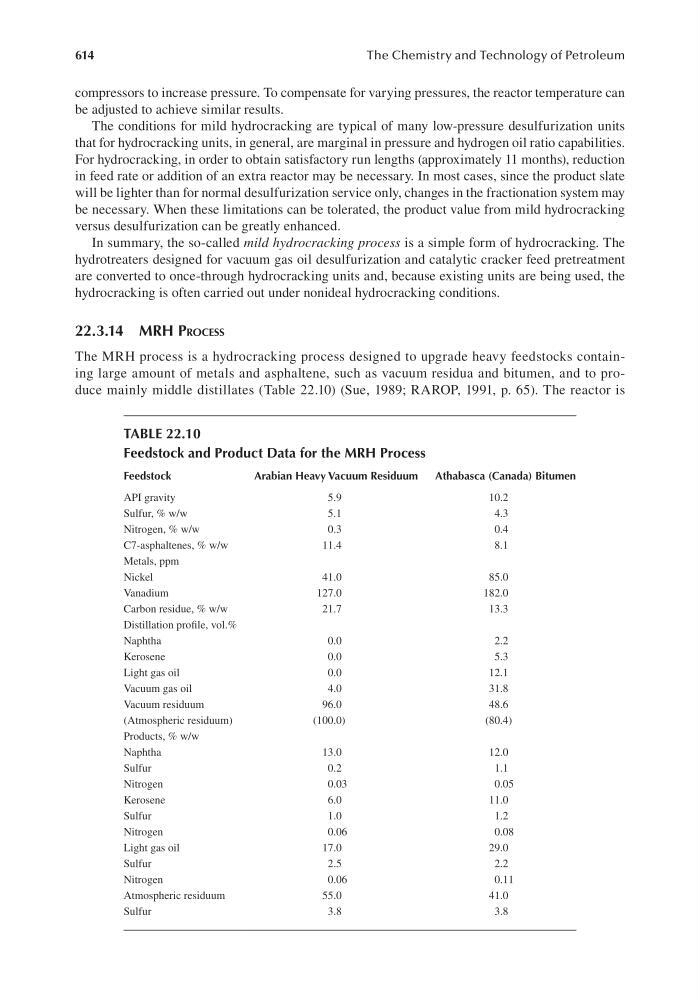
The MRH process is a hydrocracking process designed to upgrade heavy feedstocks containing large amount of metals and asphaltene, such as vacuum residua and bitumen, and to produce mainly middle distillates (Table 22.10) (Sue, 1989; RAROP, 1991, p. 65). The reactor is
TABLE 22.10
Feedstock and Product Data for the MRH Process
Feedstock
Arabian Heavy Vacuum Residuum
Athabasca (Canada) Bitumen
API gravity
5.9
10.2
Sulfur, % w/w
5.1
4.3
Nitrogen, % w/w
0.3
0.4
C7-asphaltenes, % w/w
11.4
8.1
Metals, ppm
Nickel
41.0
85.0
Vanadium
127.0
182.0
Carbon residue, % w/w
21.7
13.3
Distillation profile, vol.%
Naphtha
0.0
2.2
Kerosene
0.0
5.3
Light gas oil
0.0
12.1
Vacuum gas oil
4.0
31.8
Vacuum residuum
96.0
48.6
(Atmospheric residuum)
(100.0)
(80.4)
Products, % w/w
Naphtha
13.0
12.0
Sulfur
0.2
1.1
Nitrogen
0.03
0.05
Kerosene
6.0
11.0
Sulfur
1.0
1.2
Nitrogen
0.06
0.08
Light gas oil
17.0
29.0
Sulfur
2.5
2.2
Nitrogen
0.06
0.11
Atmospheric residuum
55.0
41.0
Sulfur
3.8
3.8