

612
The Chemistry and Technology of Petroleum
(700°F–800°F) (recycle) with pressures of 1000–2000 psi (single-pass) and 1500–3000 psi
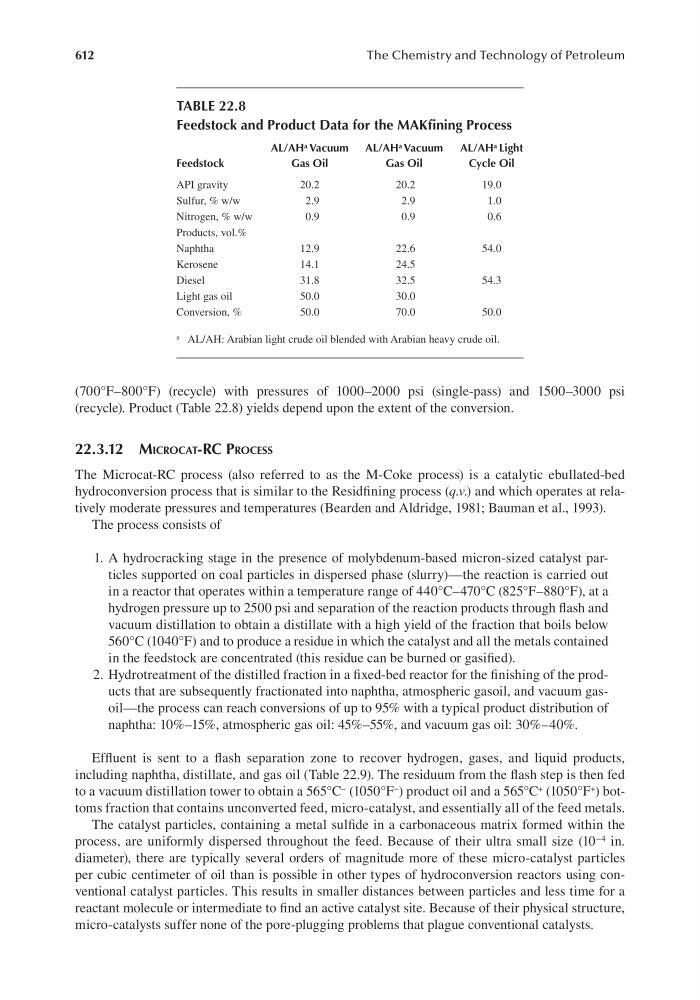
(recycle). Product (Table 22.8) yields depend upon the extent of the conversion.
22.3.12 mICroCAt-rC ProCess
The Microcat-RC process (also referred to as the M-Coke process) is a catalytic ebullated-bed
hydroconversion process that is similar to the Residfining process (q.v.) and which operates at relatively moderate pressures and temperatures (Bearden and Aldridge, 1981; Bauman et al., 1993).
The process consists of
1. A hydrocracking stage in the presence of molybdenum-based micron-sized catalyst particles supported on coal particles in dispersed phase (slurry)—the reaction is carried out
in a reactor that operates within a temperature range of 440°C–470°C (825°F–880°F), at a
hydrogen pressure up to 2500 psi and separation of the reaction products through flash and
vacuum distillation to obtain a distillate with a high yield of the fraction that boils below
560°C (1040°F) and to produce a residue in which the catalyst and all the metals contained
in the feedstock are concentrated (this residue can be burned or gasified).
2. Hydrotreatment of the distilled fraction in a fixed-bed reactor for the finishing of the products that are subsequently fractionated into naphtha, atmospheric gasoil, and vacuum gasoil—the process can reach conversions of up to 95% with a typical product distribution of
naphtha: 10%–15%, atmospheric gas oil: 45%–55%, and vacuum gas oil: 30%–40%.
Effluent is sent to a flash separation zone to recover hydrogen, gases, and liquid products,
including naphtha, distillate, and gas oil (Table 22.9). The residuum from the flash step is then fed
to a vacuum distillation tower to obtain a 565°C − (1050°F − ) product oil and a 565°C + (1050°F + ) bottoms fraction that contains unconverted feed, micro-catalyst, and essentially all of the feed metals.
The catalyst particles, containing a metal sulfide in a carbonaceous matrix formed within the
process, are uniformly dispersed throughout the feed. Because of their ultra small size (10 −4 in.
diameter), there are typically several orders of magnitude more of these micro-catalyst particles
per cubic centimeter of oil than is possible in other types of hydroconversion reactors using conventional catalyst particles. This results in smaller distances between particles and less time for a
reactant molecule or intermediate to find an active catalyst site. Because of their physical structure,
micro-catalysts suffer none of the pore-plugging problems that plague conventional catalysts.
TABLE 22.8
Feedstock and Product Data for the MAKfining Process
Feedstock
AL/AH a Vacuum
Gas Oil
AL/AH a Vacuum
Gas Oil
AL/AH a Light
Cycle Oil
API gravity
20.2
20.2
19.0
Sulfur, % w/w
2.9
2.9
1.0
Nitrogen, % w/w
0.9
0.9
0.6
Products, vol.%
Naphtha
12.9
22.6
54.0
Kerosene
14.1
24.5
Diesel
31.8
32.5
54.3
Light gas oil
50.0
30.0
Conversion, %
50.0
70.0
50.0
a AL/AH: Arabian light crude oil blended with Arabian heavy crude oil.