

608
The Chemistry and Technology of Petroleum
The next processing stage, hydrodesulfurization, is where most of sulfur, some of the nitrogen,
and the residual metals are removed. A limited amount of conversion also takes place. From the
final reactor, the gas phase is separated, hydrogen is recirculated to the reaction section, and the
liquid products are sent to a conventional fractionation section for separation into naphtha, middle
distillates, and heavier streams.
22.3.8 IFP HydroCrACkIng ProCess
The process features a dual catalyst system: The first catalyst is a promoted nickel–molybdenum
amorphous catalyst. It acts to remove sulfur and nitrogen and hydrogenate aromatic rings. The
second catalyst is a zeolite that finishes the hydrogenation and promotes the hydrocracking reaction.
In the two-stage process, feedstock and hydrogen are heated and sent to the first reaction stage where
conversion to products occurs (RAROP, 1991, p. 85). The reactor effluent phases are cooled and separated
and the hydrogen-rich gas is compressed and recycled. The liquid leaving the separator is fractionated,
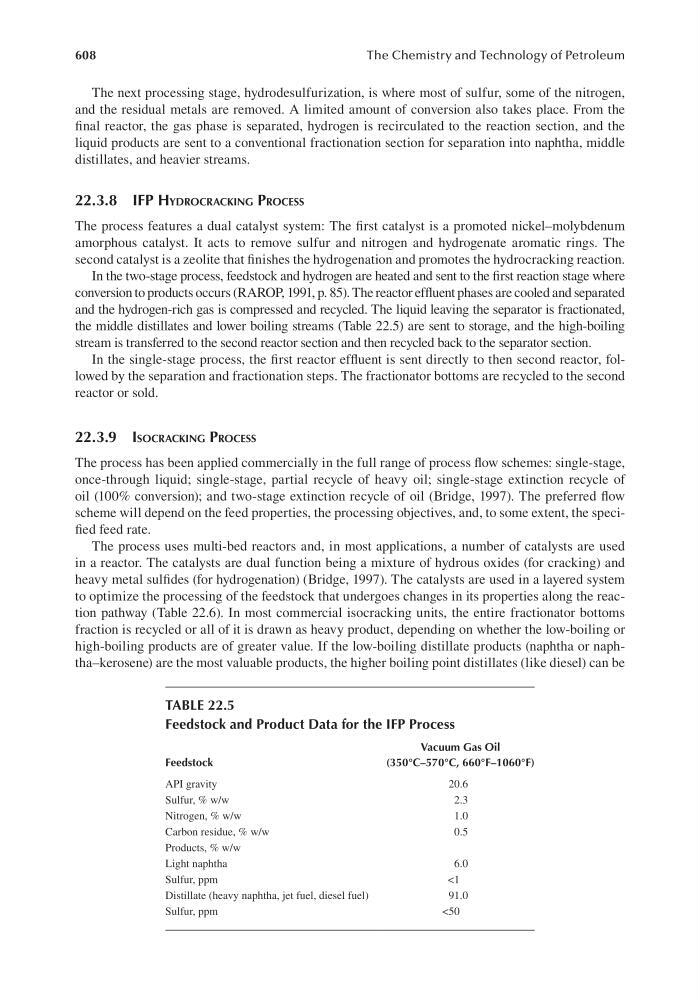
the middle distillates and lower boiling streams (Table 22.5) are sent to storage, and the high-boiling
stream is transferred to the second reactor section and then recycled back to the separator section.
In the single-stage process, the first reactor effluent is sent directly to then second reactor, followed by the separation and fractionation steps. The fractionator bottoms are recycled to the second
reactor or sold.
22.3.9 IsoCrACkIng ProCess
The process has been applied commercially in the full range of process flow schemes: single-stage,
once-through liquid; single-stage, partial recycle of heavy oil; single-stage extinction recycle of
oil (100% conversion); and two-stage extinction recycle of oil (Bridge, 1997). The preferred flow
scheme will depend on the feed properties, the processing objectives, and, to some extent, the specified feed rate.
The process uses multi-bed reactors and, in most applications, a number of catalysts are used
in a reactor. The catalysts are dual function being a mixture of hydrous oxides (for cracking) and
heavy metal sulfides (for hydrogenation) (Bridge, 1997). The catalysts are used in a layered system
to optimize the processing of the feedstock that undergoes changes in its properties along the reaction pathway (Table 22.6). In most commercial isocracking units, the entire fractionator bottoms
fraction is recycled or all of it is drawn as heavy product, depending on whether the low-boiling or
high-boiling products are of greater value. If the low-boiling distillate products (naphtha or naphtha–kerosene) are the most valuable products, the higher boiling point distillates (like diesel) can be
TABLE 22.5
Feedstock and Product Data for the IFP Process
Feedstock
Vacuum Gas Oil
(350°C–570°C, 660°F–1060°F)
API gravity
20.6
Sulfur, % w/w
2.3
Nitrogen, % w/w
1.0
Carbon residue, % w/w
0.5
Products, % w/w
Light naphtha
6.0
Sulfur, ppm
<1
Distillate (heavy naphtha, jet fuel, diesel fuel)
91.0
Sulfur, ppm
<50