

609
Hydrocracking
recycled to the reactor for conversion rather than drawn as a product (RAROP, 1991, p. 83). Product
distribution depends upon the mode of operation.
Heavy feedstocks have been used in the process, and the product yield is very much dependent
upon the catalyst and the process parameters (Bridge, 1997).
22.3.10 lC-FInIng ProCess
The LC-Fining process is a hydrocracking process capable of desulfurizing, demetallizing, and
upgrading a wide spectrum of heavy feedstocks by means of an expanded bed reactor (Van Driesen
et al., 1979; Bishop, 1990; RAROP, 1991, p. 61; Reich et al., 1993; Gupta, 2004). Operating with
the expanded bed allows the processing of heavy feedstocks, such as atmospheric residua, vacuum
residua, and oil sand bitumen. The catalyst in the reactor behaves like fluid that enables the catalyst
to be added to and withdrawn from the reactor during operation. The reactor conditions are near
isothermal because the heat of reaction is absorbed by the cold fresh feed immediately owing to
thorough mixing of reactors.
In the process (Figure 22.7), the feedstock and hydrogen are heated separately and then pass
upward in the hydrocracking reactor through an expanded bed of catalyst (Figure 22.8). Reactor
products flow to the high-pressure and high-temperature separator. Vapor effluent from the separator is let down in pressure, and then goes to the heat exchange and thence to a section for the removal
of condensable products, and purification (Table 22.7).
Liquid is let down in pressure and passes to the recycle stripper. This is a most important part of
the high conversion process. The liquid recycle is prepared to the proper boiling range for return to
the reactor. In this way, the concentration of bottoms in the reactor, and therefore, the distribution of
products can be controlled. After the stripping, the recycle liquid is then pumped through the coke precursor removal step where high-molecular-weight constituents are removed. The clean liquid recycle
then passes to the suction drum of the feed pump. The product from the top of the recycle stripper
goes to fractionation, and any heavy oil product is directed from the stripper bottoms pump discharge.
The residence time in the reactor is adjusted to provide the desired conversion levels. Catalyst
particles are continuously withdrawn from the reactor, regenerated and recycled back into the reactor, which provides the flexibility to process a wide range of heavy feedstock such as atmospheric
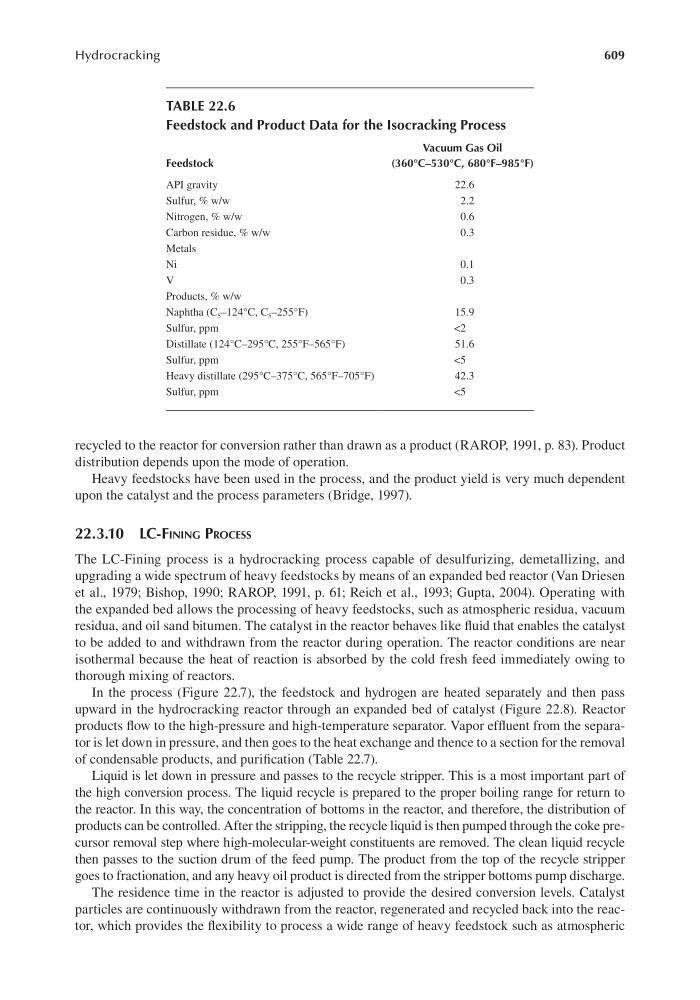
TABLE 22.6
Feedstock and Product Data for the Isocracking Process
Feedstock
Vacuum Gas Oil
(360°C–530°C, 680°F–985°F)
API gravity
22.6
Sulfur, % w/w
2.2
Nitrogen, % w/w
0.6
Carbon residue, % w/w
0.3
Metals
Ni
0.1
V
0.3
Products, % w/w
Naphtha (C 5 –124°C, C 5 –255°F)
15.9
Sulfur, ppm
<2
Distillate (124°C–295°C, 255°F–565°F)
51.6
Sulfur, ppm
<5
Heavy distillate (295°C–375°C, 565°F–705°F)
42.3
Sulfur, ppm
<5