

607
Hydrocracking
of hydrogen leads to more stable products (lower flocculation threshold) than can be obtained with
straight visbreaking, which means that higher conversions can be achieved, producing a lower
viscosity product.
The hydrovisbreaking process (HYCAR process) is composed fundamentally of three parts:
(1) visbreaking, (2) hydrodemetallization, and (3) hydrocracking. In the visbreaking section, the
heavy feedstock (e.g., vacuum residuum or bitumen) is subjected to moderate thermal cracking while
no coke formation is induced. The visbroken oil is fed to the demetallization reactor in the presence
of catalysts, which provides sufficient pore for diffusion and adsorption of high-molecular-weight
constituents. The product from this second stage proceeds to the hydrocracking reactor, where desulfurization and denitrogenation take place along with hydrocracking.
22.3.7 HyvAHl F ProCess
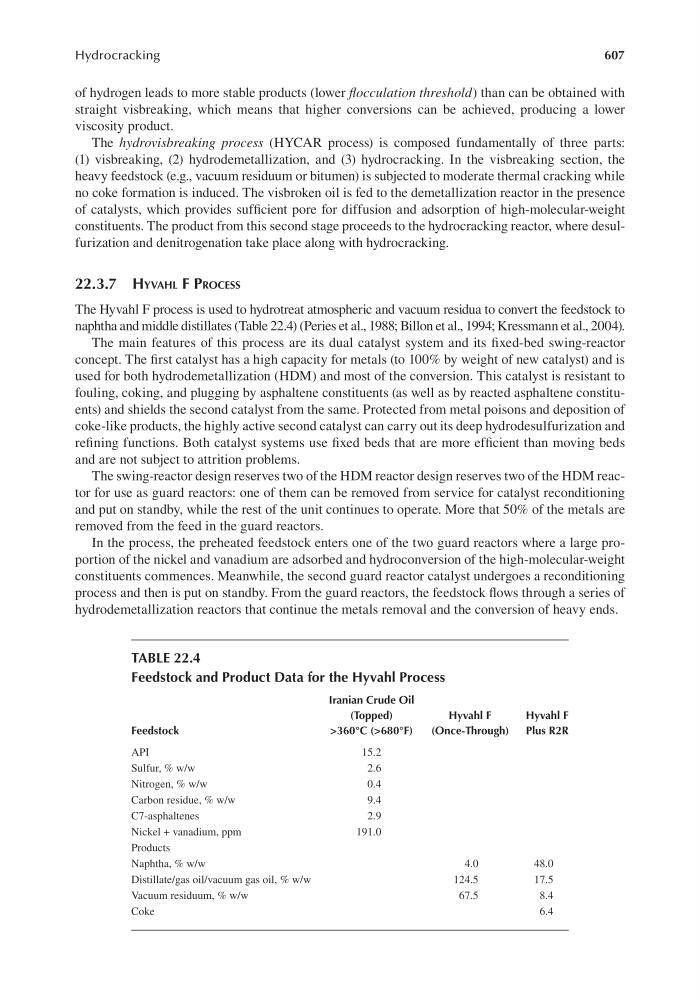
The Hyvahl F process is used to hydrotreat atmospheric and vacuum residua to convert the feedstock to
naphtha and middle distillates (Table 22.4) (Peries et al., 1988; Billon et al., 1994; Kressmann et al., 2004).
The main features of this process are its dual catalyst system and its fixed-bed swing-reactor
concept. The first catalyst has a high capacity for metals (to 100% by weight of new catalyst) and is
used for both hydrodemetallization (HDM) and most of the conversion. This catalyst is resistant to
fouling, coking, and plugging by asphaltene constituents (as well as by reacted asphaltene constituents) and shields the second catalyst from the same. Protected from metal poisons and deposition of
coke-like products, the highly active second catalyst can carry out its deep hydrodesulfurization and
refining functions. Both catalyst systems use fixed beds that are more efficient than moving beds
and are not subject to attrition problems.
The swing-reactor design reserves two of the HDM reactor design reserves two of the HDM reactor for use as guard reactors: one of them can be removed from service for catalyst reconditioning
and put on standby, while the rest of the unit continues to operate. More that 50% of the metals are
removed from the feed in the guard reactors.
In the process, the preheated feedstock enters one of the two guard reactors where a large proportion of the nickel and vanadium are adsorbed and hydroconversion of the high-molecular-weight
constituents commences. Meanwhile, the second guard reactor catalyst undergoes a reconditioning
process and then is put on standby. From the guard reactors, the feedstock flows through a series of
hydrodemetallization reactors that continue the metals removal and the conversion of heavy ends.
TABLE 22.4
Feedstock and Product Data for the Hyvahl Process
Feedstock
Iranian Crude Oil
(Topped)
>360°C (>680°F)
Hyvahl F
(Once-Through)
Hyvahl F
Plus R2R
API
15.2
Sulfur, % w/w
2.6
Nitrogen, % w/w
0.4
Carbon residue, % w/w
9.4
C7-asphaltenes
2.9
Nickel + vanadium, ppm
191.0
Products
Naphtha, % w/w
4.0
48.0
Distillate/gas oil/vacuum gas oil, % w/w
124.5
17.5
Vacuum residuum, % w/w
67.5
8.4
Coke
6.4