

597
Hydrocracking
Upgrading processes are evaluated on the basis of liquid yield (i.e., naphtha, distillate, and gas oil),
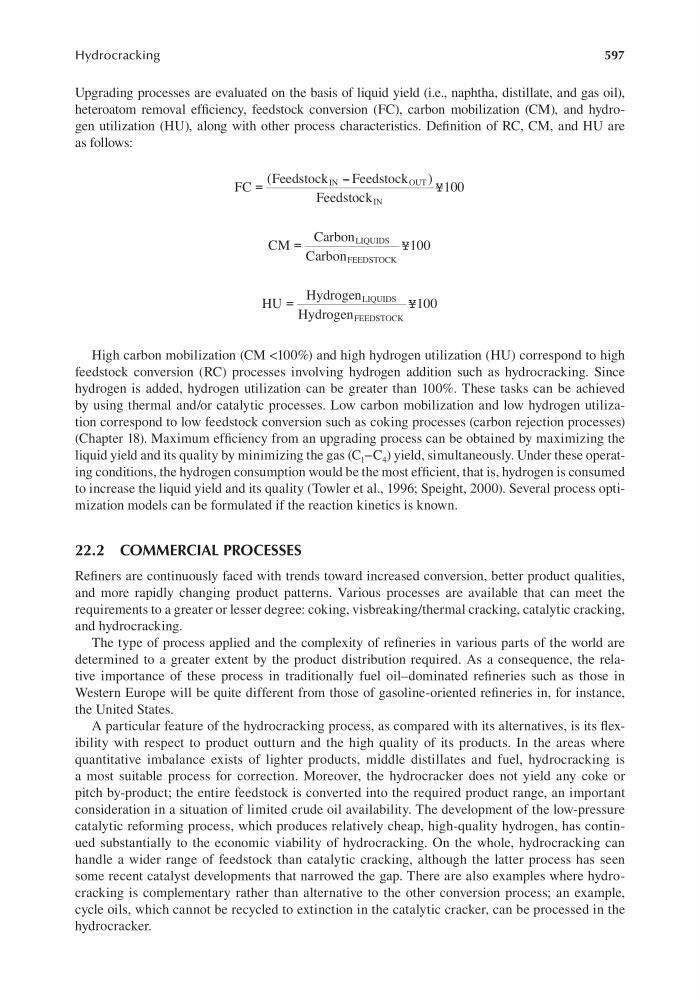
heteroatom removal efficiency, feedstock conversion (FC), carbon mobilization (CM), and hydrogen utilization (HU), along with other process characteristics. Definition of RC, CM, and HU are
as follows:
FC
Feedstock
Feedstock
Feedstock
IN
OUT
IN
=
-
¥
(
)
100
CM
Carbon
Carbon
LIQUIDS
FEEDSTOCK
=
¥ 100
HU
Hydrogen
Hydrogen
LIQUIDS
FEEDSTOCK
=
¥ 100
High carbon mobilization (CM <100%) and high hydrogen utilization (HU) correspond to high
feedstock conversion (RC) processes involving hydrogen addition such as hydrocracking. Since
hydrogen is added, hydrogen utilization can be greater than 100%. These tasks can be achieved
by using thermal and/or catalytic processes. Low carbon mobilization and low hydrogen utilization correspond to low feedstock conversion such as coking processes (carbon rejection processes)
(Chapter 18). Maximum efficiency from an upgrading process can be obtained by maximizing the
liquid yield and its quality by minimizing the gas (C 1 −C 4 ) yield, simultaneously. Under these operating conditions, the hydrogen consumption would be the most efficient, that is, hydrogen is consumed
to increase the liquid yield and its quality (Towler et al., 1996; Speight, 2000). Several process optimization models can be formulated if the reaction kinetics is known.
22.2 COMMERCIAL PROCESSES
Refiners are continuously faced with trends toward increased conversion, better product qualities,
and more rapidly changing product patterns. Various processes are available that can meet the
requirements to a greater or lesser degree: coking, visbreaking/thermal cracking, catalytic cracking,
and hydrocracking.
The type of process applied and the complexity of refineries in various parts of the world are
determined to a greater extent by the product distribution required. As a consequence, the relative importance of these process in traditionally fuel oil–dominated refineries such as those in
Western Europe will be quite different from those of gasoline-oriented refineries in, for instance,
the United States.
A particular feature of the hydrocracking process, as compared with its alternatives, is its flexibility with respect to product outturn and the high quality of its products. In the areas where
quantitative imbalance exists of lighter products, middle distillates and fuel, hydrocracking is
a most suitable process for correction. Moreover, the hydrocracker does not yield any coke or
pitch by-product; the entire feedstock is converted into the required product range, an important
consideration in a situation of limited crude oil availability. The development of the low-pressure
catalytic reforming process, which produces relatively cheap, high-quality hydrogen, has continued substantially to the economic viability of hydrocracking. On the whole, hydrocracking can
handle a wider range of feedstock than catalytic cracking, although the latter process has seen
some recent catalyst developments that narrowed the gap. There are also examples where hydrocracking is complementary rather than alternative to the other conversion process; an example,
cycle oils, which cannot be recycled to extinction in the catalytic cracker, can be processed in the
hydrocracker.