

596
The Chemistry and Technology of Petroleum
upgrade low-value distillate feedstocks, such as cycle oils (highly aromatic products from a catalytic
cracker that usually are not recycled to extinction for economic reasons), thermal and coker gas
oils, and heavy-cracked and straight-run naphtha. These feedstocks are difficult to process by either
catalytic cracking or reforming, since they are usually characterized by a high polycyclic aromatic
content and/or by high concentrations of the two principal catalyst poisons, sulfur and nitrogen
compounds (Bland and Davidson, 1967).
While whole families of catalysts are required depending on feed available and the desired product slate or product character, the number of process stages is also important to catalysts choice.
Generally, the refinery utilizes one of three options. Thus, depending on the feedstock being processed and the type of plant design employed (single-stage or two-stage), flexibility can be provided
to vary product distribution among the following principal end products:
Fundamentally, the trend toward lower API gravity feedstocks is related to an increase in the
hydrogen/carbon atomic ratio of crude oils because of higher content of residuum. This can be overcome by upgrading methods that lower this ratio by adding hydrogen, rejecting carbon, or using a
combination of both methods.
Though several technologies exist to upgrade heavy feedstocks, selection of the optimum process
units is very much dependent on each refiner’s needs and goals, with the market pull being the prime
motivator. Furthermore, processing options systems to dig deeper into the barrel by converting
more of the higher boiling materials to distillable products should not only be cost effective and
reliable, but also flexible.
Hydrocracking adds that flexibility and offers the refiner a process that can handle varying feeds
and operate under diverse process conditions. Utilizing different types of catalysts can modify the
product slate produced. Reactor design and number of processing stages play a role in this flexibility.
Finally, a word about conversion measures for upgrading processes. Such measures are necessary for any conversion process but more particularly for hydrocracking processes where hydrogen
management is an integral, and essential, part of process design.
The objective of any upgrading process is to convert heavy feedstock into marketable products by
reducing their heteroatom (nitrogen, oxygen, and sulfur) and metal contents, modifying the structures
of the asphaltene constituents (reducing coke precursors), and converting the high-molecular-weight
polar species large molecules into lower molecular weight and lower boiling hydrocarbon products.
Some asphaltene
sulfur removed
Complete
sulfur
removed
Nonasphaltene
sulfur
removed
Nonasphaltene
sulfur
Asphaltene
sulfur
Sulfur in oil
Removal of
nonasphaltene
sulfur
0
2 5
5 0
7 5
100
Asphaltene
sulfur intact
% Desulfurization
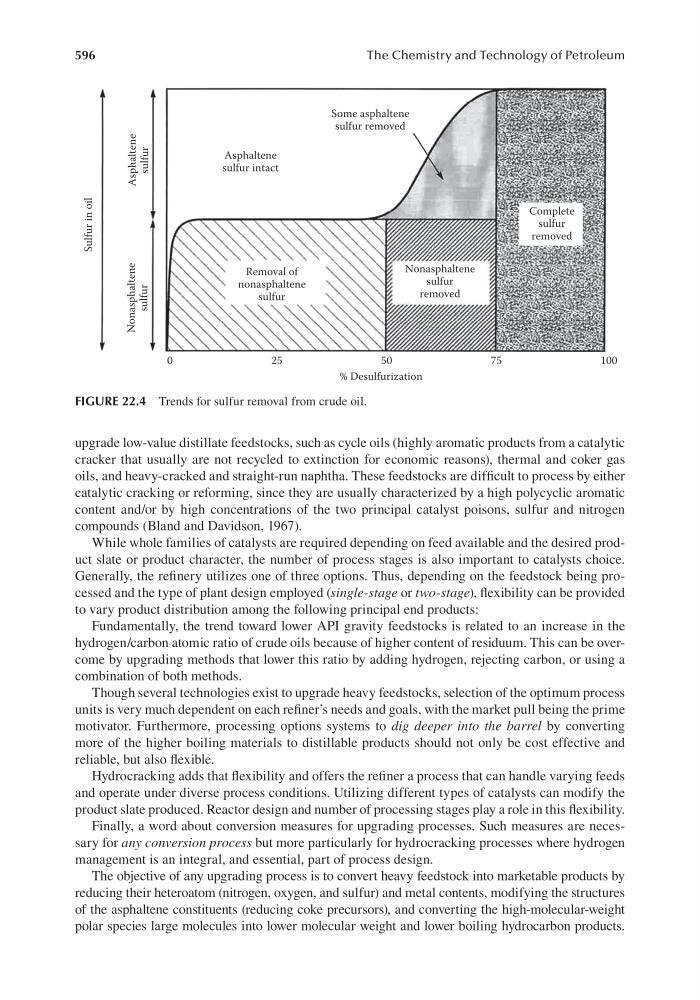
FIGURE 22.4 Trends for sulfur removal from crude oil.