

595
Hydrocracking
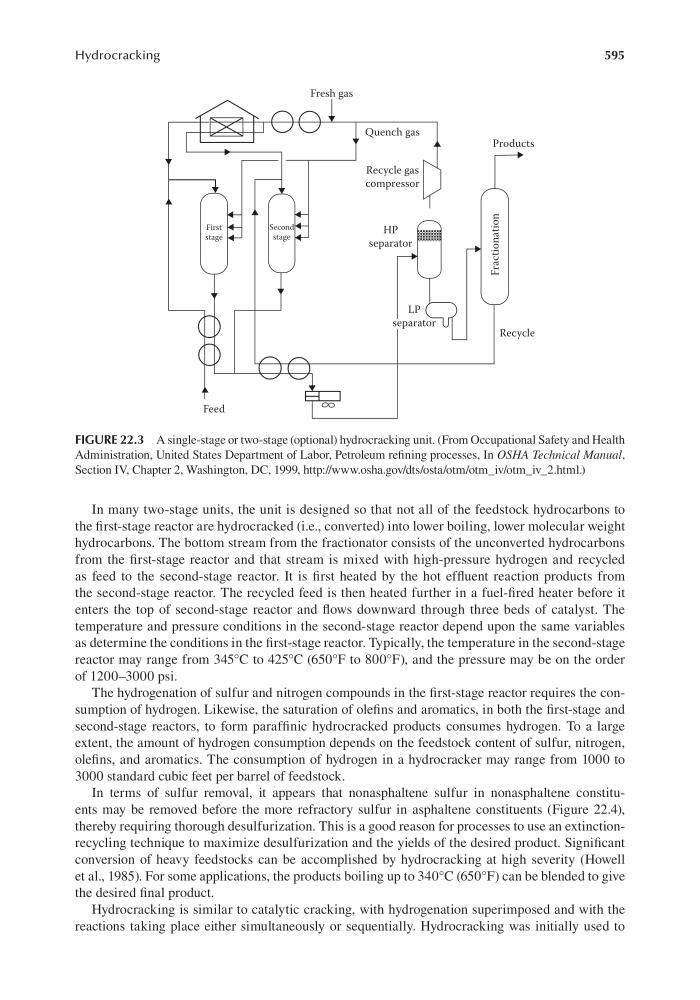
In many two-stage units, the unit is designed so that not all of the feedstock hydrocarbons to
the first-stage reactor are hydrocracked (i.e., converted) into lower boiling, lower molecular weight
hydrocarbons. The bottom stream from the fractionator consists of the unconverted hydrocarbons
from the first-stage reactor and that stream is mixed with high-pressure hydrogen and recycled
as feed to the second-stage reactor. It is first heated by the hot effluent reaction products from
the second-stage reactor. The recycled feed is then heated further in a fuel-fired heater before it
enters the top of second-stage reactor and flows downward through three beds of catalyst. The
temperature and pressure conditions in the second-stage reactor depend upon the same variables
as determine the conditions in the first-stage reactor. Typically, the temperature in the second-stage
reactor may range from 345°C to 425°C (650°F to 800°F), and the pressure may be on the order
of 1200–3000 psi.
The hydrogenation of sulfur and nitrogen compounds in the first-stage reactor requires the consumption of hydrogen. Likewise, the saturation of olefins and aromatics, in both the first-stage and
second-stage reactors, to form paraffinic hydrocracked products consumes hydrogen. To a large
extent, the amount of hydrogen consumption depends on the feedstock content of sulfur, nitrogen,
olefins, and aromatics. The consumption of hydrogen in a hydrocracker may range from 1000 to
3000 standard cubic feet per barrel of feedstock.
In terms of sulfur removal, it appears that nonasphaltene sulfur in nonasphaltene constituents may be removed before the more refractory sulfur in asphaltene constituents (Figure 22.4),
thereby requiring thorough desulfurization. This is a good reason for processes to use an extinctionrecycling technique to maximize desulfurization and the yields of the desired product. Significant
conversion of heavy feedstocks can be accomplished by hydrocracking at high severity (Howell
et al., 1985). For some applications, the products boiling up to 340°C (650°F) can be blended to give
the desired final product.
Hydrocracking is similar to catalytic cracking, with hydrogenation superimposed and with the
reactions taking place either simultaneously or sequentially. Hydrocracking was initially used to
Fresh gas
First
stage
Second
stage
Products
Recycle
Fractionation
Quench gas
Recycle gas
compressor
HP
separator
LP
separator
Feed
FIGURE 22.3 A single-stage or two-stage (optional) hydrocracking unit. (From Occupational Safety and Health
Administration, United States Department of Labor, Petroleum refining processes, In OSHA Technical Manual,
Section IV, Chapter 2, Washington, DC, 1999, http://www.osha.gov/dts/osta/otm/otm_iv/otm_iv_2.html.)