

598
The Chemistry and Technology of Petroleum
22.2.1 ProCess desIgn
All hydrocracking processes are characterized by the fact that in a catalytic operation under relatively
high hydrogen pressure a heavy oil fraction is treated to give products of lower molecular weight.
Most hydrocracking units use fixed beds of catalyst with downflow of reactants. The H-Oil process developed by Hydrocarbon Research Corp and Cities Service R & D employs an ebullient-bed
reactor in which the beds of particulate catalyst are maintained in an ebullient or fluidized condition
with up-flowing reactants.
When the processing severity in a hydrocracker is increased, the first reaction is the saturation of
olefins present in feedstock. Next, desulfurization, denitrogenation, and de-oxygenation reactions
occur. These reactions constitute treating steps during which in most cases, only limited cracking takes place. When the severity is increased further, hydrocracking reaction is initiated. They
proceed at various rates with the formation of intermediate products (e.g., saturation of aromatics),
which are subsequently cracked into lighter products.
The most common form of hydrocracking process is a two-stage operation (Figure 22.3). This
flow scheme has been very popular, since it can be used to maximize the yield of transportation
fuels and has the flexibility to produce gasoline, naphtha, jet fuel, or diesel fuel to meet seasonal
swings in product demand.
When the treating step is combined with the cracking reaction to occur in one reactor, the process is called a single-stage process. In this simplest of the hydrocracker configuration, the layout
of the reactor section generally resembles that of hydrotreating unit. This configuration will find
application in cases where only moderate degree of conversion (say 60% or less) is required. It may
also be considered if full conversion, but with a limited reduction in molecular weight, is aimed at.
An example is the production of middle distillates from heavy distillate oils. The catalyst used in
a single-stage process comprises a hydrogenation function in combination with a strong cracking
function. Sulfided metals such as cobalt, molybdenum, and nickel provide the hydrogenation function. An acidic support, usually alumina, attends to the cracking function. Nitrogen compounds and
ammonia produced by hydrogenation interfere with acidic activity of the catalyst. In the cases of
high/full conversion is required, the reaction temperatures and run lengths of interest in commercial
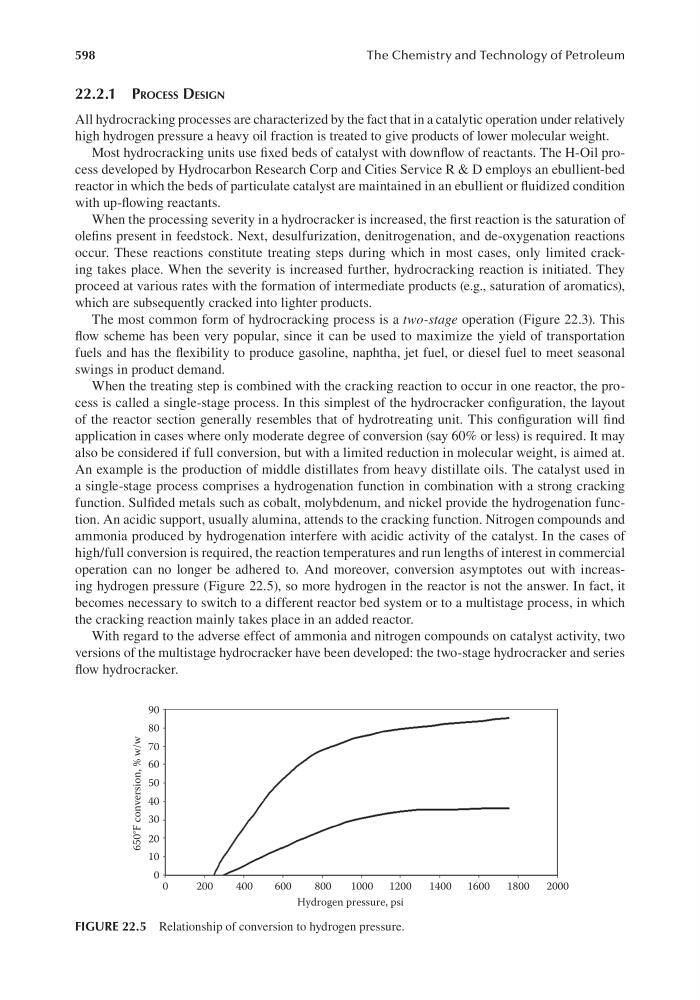
operation can no longer be adhered to. And moreover, conversion asymptotes out with increasing hydrogen pressure (Figure 22.5), so more hydrogen in the reactor is not the answer. In fact, it
becomes necessary to switch to a different reactor bed system or to a multistage process, in which
the cracking reaction mainly takes place in an added reactor.
With regard to the adverse effect of ammonia and nitrogen compounds on catalyst activity, two
versions of the multistage hydrocracker have been developed: the two-stage hydrocracker and series
flow hydrocracker.
200
0
400
600
800
1000 1200
1400 1600
1800
2000
Hydrogen pressure, psi
0
650°F conversion, % w/w
10
20
30
40
50
60
70
80
90
FIGURE 22.5 Relationship of conversion to hydrogen pressure.