

553
Solvent Processes
and the resulting vaporized solvent from the strippers is condensed and returned to the process.
Product oil is cooled by heat exchange before being pumped to storage or further processing.
The deasphalting efficiency in processes using propane is of the order of 75%–83%, with an
overall DAO recovery yield of the order of 50%.
20.2.2.5 Solvahl Process
The Solvahl process is a SDA process for application to vacuum residua (Table 20.6; RAROP, 1991,
p. 9; Billon et al., 1994).
The process was developed to give maximum yields of DAO while eliminating asphaltenes
and reducing metals content to a level compatible with the reliable operation of downstream units
(Peries et al., 1995).
20.2.2.6 Lube Deasphalting
Other facilities incorporate lube deasphalting to process vacuum residuum into lube oil base stocks.
Propane deasphalting is most commonly used to remove asphaltene constituents and resins that contribute an undesirable dark color to the lube base stocks. This process typically uses baffle towers
or rotating disk contactors to mix the propane with the feed. Solvent recovery is accomplished with
evaporators, and supercritical solvent recovery processes are also used in some deasphalting units.
The Duo-Sol process is used to deasphalt and extract lubricating oil feedstocks. Propane is used
as the deasphalting solvent and a mixture of phenol and cresylic acids (cresols, hydroxytoluenes) are
used as the extraction solvent. The extraction is conducted in a series of batch extractors followed
by solvent recovery in multistage flash distillation and stripping towers.
20.3 DEWAXING PROCESSES
Paraffinic crude oils often contain microcrystalline or paraffin waxes. The crude oil may be treated
with a solvent such as methyl-ethyl-ketone (MEK) to remove this wax before it is processed. However,
this is not a common practice, and solvent dewaxing processes are designed to remove wax from
lubricating oils to give the product good fluidity characteristics at low temperatures (e.g., low pour
points) rather than from the whole crude oil. The mechanism of solvent dewaxing involves either
the separation of wax as a solid that crystallizes from the oil solution at low temperature or the
Resins
Oils
STR
SEP
SEP
T 1
T 2
T 3
SEP
STR
STR
Mix
Vacuum
residue
Solvent
Solvent
Asphaltenes
(200°F–360°F SP)
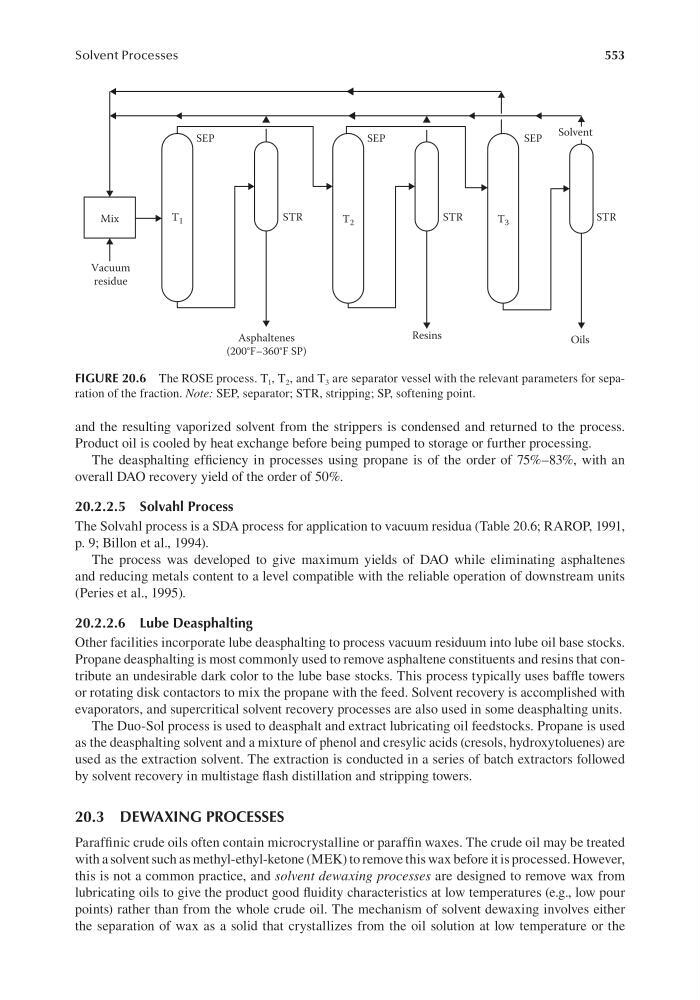
FIGURE 20.6 The ROSE process. T 1 , T 2 , and T 3 are separator vessel with the relevant parameters for separation of the fraction. Note: SEP, separator; STR, stripping; SP, softening point.