

552
The Chemistry and Technology of Petroleum
20.2.2.4 Residuum Oil Supercritical Extraction Process
The ROSE process is a SDA process with minimum energy consumption using supercritical solvent recovery system, and the process is of value in obtaining oils for further processing (Gearhart and Garwin, 1976; Gearhart, 1980; RAROP, 1991, p. 97; Northrup and
Sloan, 1996).
The process used supercritical solvents and is a natural progression from propane deasphalting and allows the separation of residua into their base components (Asphaltene constituents,
resin constituents, and oil constituents) for recombination to optimum properties. Propane,
butane, and pentane may be used as the solvent depending on the feedstock and the desired
compositions. A mixer is used to blend residue with liquefied solvent at elevated temperature
and pressure. The blend is pumped into the first-stage separator where, through counter current flow of solvent, the asphaltene constituents are precipitated, separated, and stripped of
solvent by steam. The overhead solution from the first tower is taken to a second stage where
it is heated to a higher temperature. This causes the resin constituents to separate. The final
material is taken to a third stage and heated to a supercritical temperature. This makes the oils
insoluble and separation occurs. This process is very flexible and allows precise blending to
required compositions.
In the process (Figure 20.6), the residuum is mixed with several-fold volume of a low-boiling
hydrocarbon solvent and passed into the asphaltene separator vessel. Asphaltenes rejected by the
solvent are separated from the bottom of the vessel and are further processed by heating and steam
stripping to remove a small quantity of dissolved solvent. The solvent-free asphaltenes are sent to a
section of the refinery for further processing. The main flow, solvent and extracted oil, passes overhead from the asphaltene separator through a heat exchanger and heater into the oil separator where
the extracted oil is separated without solvent vaporization. The solvent, after heat exchange, is recycled to the process. The small amount of solvent contained in the oil is removed by steam stripping,
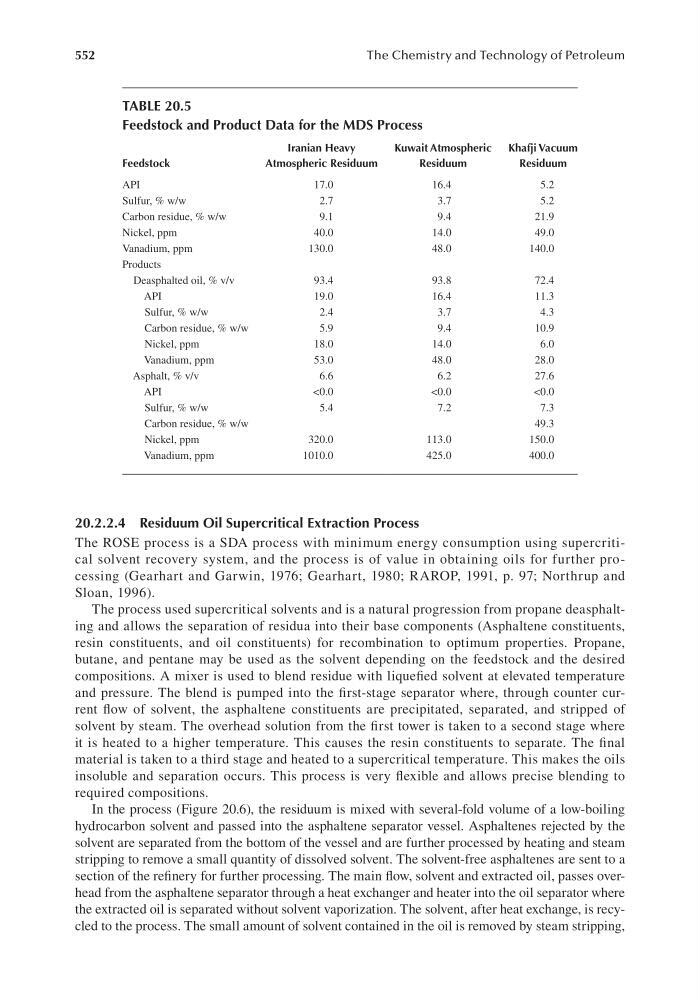
TABLE 20.5
Feedstock and Product Data for the MDS Process
Feedstock
Iranian Heavy
Atmospheric Residuum
Kuwait Atmospheric
Residuum
Khafji Vacuum
Residuum
API
17.0
16.4
5.2
Sulfur, % w/w
2.7
3.7
5.2
Carbon residue, % w/w
9.1
9.4
21.9
Nickel, ppm
40.0
14.0
49.0
Vanadium, ppm
130.0
48.0
140.0
Products
Deasphalted oil, % v/v
93.4
93.8
72.4
API
19.0
16.4
11.3
Sulfur, % w/w
2.4
3.7
4.3
Carbon residue, % w/w
5.9
9.4
10.9
Nickel, ppm
18.0
14.0
6.0
Vanadium, ppm
53.0
48.0
28.0
Asphalt, % v/v
6.6
6.2
27.6
API
<0.0
<0.0
<0.0
Sulfur, % w/w
5.4
7.2
7.3
Carbon residue, % w/w
49.3
Nickel, ppm
320.0
113.0
150.0
Vanadium, ppm
1010.0
425.0
400.0