

542
The Chemistry and Technology of Petroleum
vapors flow directly through the condenser into the solvent accumulator. Hot asphalt, with a small
quantity of solvent flows, from the asphalt flash drum bottom to the asphalt stripper, which is operated at near atmospheric pressure. Superheated steam is introduced into the bottom of the stripper.
The steam and solvent vapors pass overhead, join the DAO stripper overhead, and flow through the
condenser into the compressor suction drum. The asphalt is pumped from the bottom of the stripper
under level control to storage.
The propane deasphalting process is similar to solvent extraction in that a packed or baffled
extraction tower or RDC is used to mix the oil feed stocks with the solvent. In the tower method,
four to eight volumes of propane are fed to the bottom of the tower for every volume of feed flowing
down from the top of the tower. The oil, which is more soluble in the propane, dissolves and flows
to the top. The asphaltene and resins flow to the bottom of the tower where they are removed in a
propane mix. Propane is recovered from the two streams through two-stage flash systems followed
by steam stripping in which propane is condensed and removed by cooling at high pressure in the
first stage and at low pressure in the second stage. The asphalt recovered can be blended with other
asphalts or heavy fuels or can be used as feed to the coker.
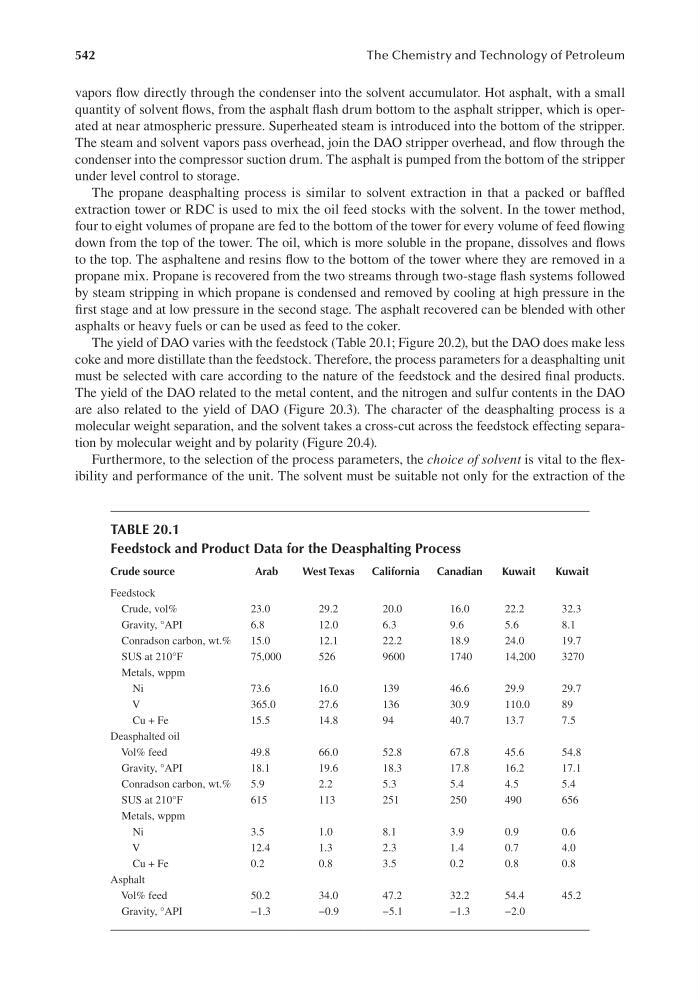
The yield of DAO varies with the feedstock (Table 20.1; Figure 20.2), but the DAO does make less
coke and more distillate than the feedstock. Therefore, the process parameters for a deasphalting unit
must be selected with care according to the nature of the feedstock and the desired final products.
The yield of the DAO related to the metal content, and the nitrogen and sulfur contents in the DAO
are also related to the yield of DAO (Figure 20.3). The character of the deasphalting process is a
molecular weight separation, and the solvent takes a cross-cut across the feedstock effecting separation by molecular weight and by polarity (Figure 20.4).
Furthermore, to the selection of the process parameters, the choice of solvent is vital to the flexibility and performance of the unit. The solvent must be suitable not only for the extraction of the
TABLE 20.1
Feedstock and Product Data for the Deasphalting Process
Crude source
Arab
West Texas
California
Canadian
Kuwait
Kuwait
Feedstock
Crude, vol%
23.0
29.2
20.0
16.0
22.2
32.3
Gravity, °API
6.8
12.0
6.3
9.6
5.6
8.1
Conradson carbon, wt.%
15.0
12.1
22.2
18.9
24.0
19.7
SUS at 210°F
75,000
526
9600
1740
14,200
3270
Metals, wppm
Ni
73.6
16.0
139
46.6
29.9
29.7
V
365.0
27.6
136
30.9
110.0
89
Cu + Fe
15.5
14.8
94
40.7
13.7
7.5
Deasphalted oil
Vol% feed
49.8
66.0
52.8
67.8
45.6
54.8
Gravity, °API
18.1
19.6
18.3
17.8
16.2
17.1
Conradson carbon, wt.%
5.9
2.2
5.3
5.4
4.5
5.4
SUS at 210°F
615
113
251
250
490
656
Metals, wppm
Ni
3.5
1.0
8.1
3.9
0.9
0.6
V
12.4
1.3
2.3
1.4
0.7
4.0
Cu + Fe
0.2
0.8
3.5
0.2
0.8
0.8
Asphalt
Vol% feed
50.2
34.0
47.2
32.2
54.4
45.2
Gravity, °API
−1.3
−0.9
−5.1
−1.3
−2.0