

541
Solvent Processes
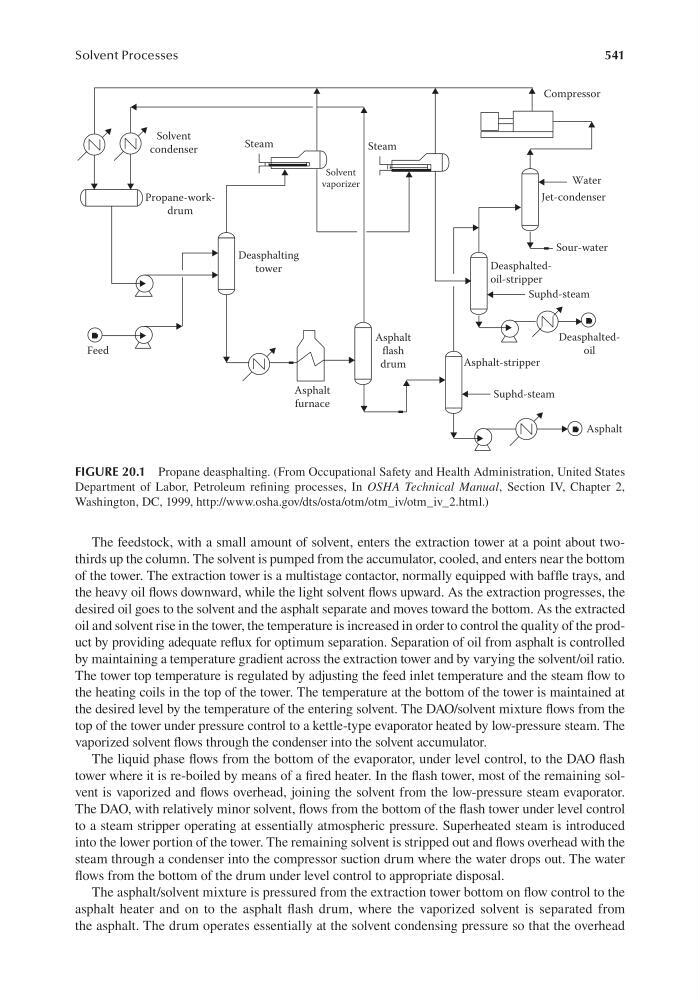
The feedstock, with a small amount of solvent, enters the extraction tower at a point about twothirds up the column. The solvent is pumped from the accumulator, cooled, and enters near the bottom
of the tower. The extraction tower is a multistage contactor, normally equipped with baffle trays, and
the heavy oil flows downward, while the light solvent flows upward. As the extraction progresses, the
desired oil goes to the solvent and the asphalt separate and moves toward the bottom. As the extracted
oil and solvent rise in the tower, the temperature is increased in order to control the quality of the product by providing adequate reflux for optimum separation. Separation of oil from asphalt is controlled
by maintaining a temperature gradient across the extraction tower and by varying the solvent/oil ratio.
The tower top temperature is regulated by adjusting the feed inlet temperature and the steam flow to
the heating coils in the top of the tower. The temperature at the bottom of the tower is maintained at
the desired level by the temperature of the entering solvent. The DAO/solvent mixture flows from the
top of the tower under pressure control to a kettle-type evaporator heated by low-pressure steam. The
vaporized solvent flows through the condenser into the solvent accumulator.
The liquid phase flows from the bottom of the evaporator, under level control, to the DAO flash
tower where it is re-boiled by means of a fired heater. In the flash tower, most of the remaining solvent is vaporized and flows overhead, joining the solvent from the low-pressure steam evaporator.
The DAO, with relatively minor solvent, flows from the bottom of the flash tower under level control
to a steam stripper operating at essentially atmospheric pressure. Superheated steam is introduced
into the lower portion of the tower. The remaining solvent is stripped out and flows overhead with the
steam through a condenser into the compressor suction drum where the water drops out. The water
flows from the bottom of the drum under level control to appropriate disposal.
The asphalt/solvent mixture is pressured from the extraction tower bottom on flow control to the
asphalt heater and on to the asphalt flash drum, where the vaporized solvent is separated from
the asphalt. The drum operates essentially at the solvent condensing pressure so that the overhead
Compressor
Water
Jet-condenser
Sour-water
Deasphaltedoil-stripper
Suphd-steam
Deasphaltedoil
Asphalt
Asphalt-stripper
Suphd-steam
Asphalt
furnace
Deasphalting
tower
Propane-workdrum
Steam
Feed
Solvent
vaporizer
Solvent
condenser
Steam
Asphalt
flash
drum
FIGURE 20.1 Propane deasphalting. (From Occupational Safety and Health Administration, United States
Department of Labor, Petroleum refining processes, In OSHA Technical Manual, Section IV, Chapter 2,
Washington, DC, 1999, http://www.osha.gov/dts/osta/otm/otm_iv/otm_iv_2.html.)