

515
Catalytic Cracking
options that are generating the most interest are (1) hydrotreat the feedstock to the catalytic cracking
unit; and (2) hydrotreat the naphtha from the catalytic cracker.
Hydrotreating the fluid catalytic cracker feed improves naphtha yield (Table 19.3) and quality
and reduces the sulfur oxide (SO x ) emissions from the catalytic cracker unit, but it is typically a
high-pressure process, and, furthermore, manipulation of feedstock sulfur alone may not be sufficient to meet future gasoline performance standards. Refineries wishing to process heavier crude oil
may only have the option to desulfurize the resulting higher-sulfur naphtha. Hydrodesulfurization
(HDS) of catalytic cracker naphtha is a low-pressure process. Obviously, the selection of an optimum
hydrotreating process option for reducing sulfur content in catalytic cracker naphtha is determined
by economic factors specific to a refinery and to the feedstock. Hydrotreating catalytic cracker
feedstock process can be very profitable for a refiner despite its large capital investment. By taking
advantage of feedstock hydrotreating process, margins can be optimized by considering the feedstock hydrotreater unit, the fluid catalytic cracker, and any postcatalytic cracker hydrotreaters as one
integrated upgrading step.
Catalytic cracking in the usual commercial process involves contacting a feedstock (usually a
gas oil fraction) with a catalyst under suitable conditions of temperature, pressure, and residence
time. By this means, a substantial part (>50%) of the feedstock is converted into gasoline and lower
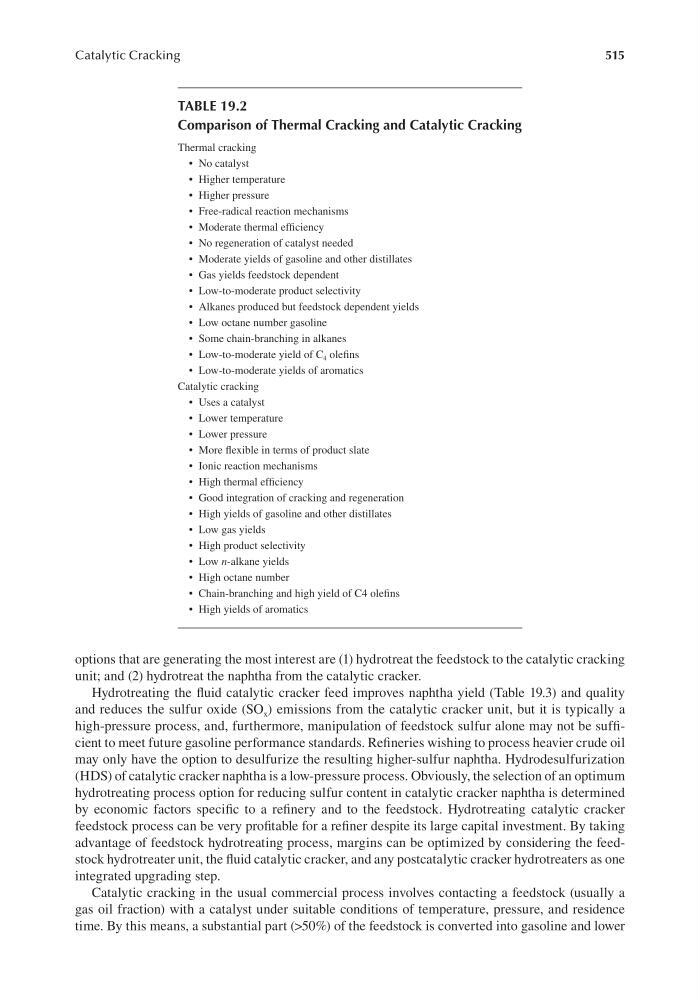
TABLE 19.2
Comparison of Thermal Cracking and Catalytic Cracking
Thermal cracking
• No catalyst
• Higher temperature
• Higher pressure
• Free-radical reaction mechanisms
• Moderate thermal efficiency
• No regeneration of catalyst needed
• Moderate yields of gasoline and other distillates
• Gas yields feedstock dependent
• Low-to-moderate product selectivity
• Alkanes produced but feedstock dependent yields
• Low octane number gasoline
• Some chain-branching in alkanes
• Low-to-moderate yield of C 4 olefins
• Low-to-moderate yields of aromatics
Catalytic cracking
• Uses a catalyst
• Lower temperature
• Lower pressure
• More flexible in terms of product slate
• Ionic reaction mechanisms
• High thermal efficiency
• Good integration of cracking and regeneration
• High yields of gasoline and other distillates
• Low gas yields
• High product selectivity
• Low n-alkane yields
• High octane number
• Chain-branching and high yield of C4 olefins
• High yields of aromatics