

516
The Chemistry and Technology of Petroleum
boiling products, usually in a single-pass operation (Bland and Davidson, 1967). However, during
the cracking reaction, carbonaceous material is deposited on the catalyst, which markedly reduces
its activity, and the removal of the deposit is very necessary. The carbonaceous deposit arises from
the thermal decomposition of high molecular weight polar species (Chapters 12 and 16) in the
feedstock. The removal of the deposit from the catalyst is usually accomplished by burning in the
presence of air until catalyst activity is reestablished.
The reactions that occur during catalytic cracking are complex (Germain, 1969), but there is a
measure of predictability now that catalyst activity is better understood. The major catalytic cracking reaction exhibited by paraffins is carbon–carbon bond scission into a lighter paraffin and olefin.
Bond rupture occurs at certain definite locations on the paraffin molecule, rather than randomly
as in thermal cracking. For example, paraffins tend to crack toward the center of the molecule, the
long chains cracking in several places simultaneously (Chapter 16). Normal paraffins usually crack
at (carbon–carbon bonds) or still nearer the center of the molecule. On the other hand, iso-paraffins
tend to rupture between carbon atoms that are α and β, respectively, and to a tertiary carbon. In
either case, catalytic cracking tends to yield products containing three or four carbon atoms rather
than the one- or two-carbon atom molecules produced in thermal cracking.
As in thermal cracking (Chapters 16 and 18), in any homologous series, higher molecular weight
species usually crack more readily than lower molecular weight species. However, paraffins with
more than six carbon atoms may also undergo rearrangement of their carbon skeletons before cracking, and a minor amount of dehydrocyclization also occurs, yielding aromatics and hydrogen.
Olefins are the most reactive class of hydrocarbons in catalytic cracking and tend to crack from
1,000 to 10,000 times faster than in thermal processes. Severe cracking conditions destroy olefins
almost completely, except for those in the low-boiling gasoline and gaseous hydrocarbon range and,
as in the catalytic cracking of paraffins, iso-olefins crack more readily than n-olefins.
Olefins also tend to undergo rapid isomerization and yield mixtures with an equilibrium distribution of double-bond positions. In addition, the chain-branching isomerization of olefins is fairly rapid
and often reaches equilibrium. These branched-chain olefins can then undergo hydrogen transfer reactions with naphthenes and other hydrocarbons. Other olefin reactions include polymerization as well
as condensation to yield aromatic molecules, which in turn may be the precursors of coke formation.
Cycloparaffins (naphthenes) catalytically crack more readily than paraffins but not as readily as
olefins. Naphthene cracking occurs by both ring and chain rupture and yields olefins and paraffins,
but the formation of methane and the C 2 hydrocarbons (ethane, CH 3 CH 3 , ethylene, CH 2 =CH 2 , and
acetylene, CH≡CH) is relatively minor if present at all.
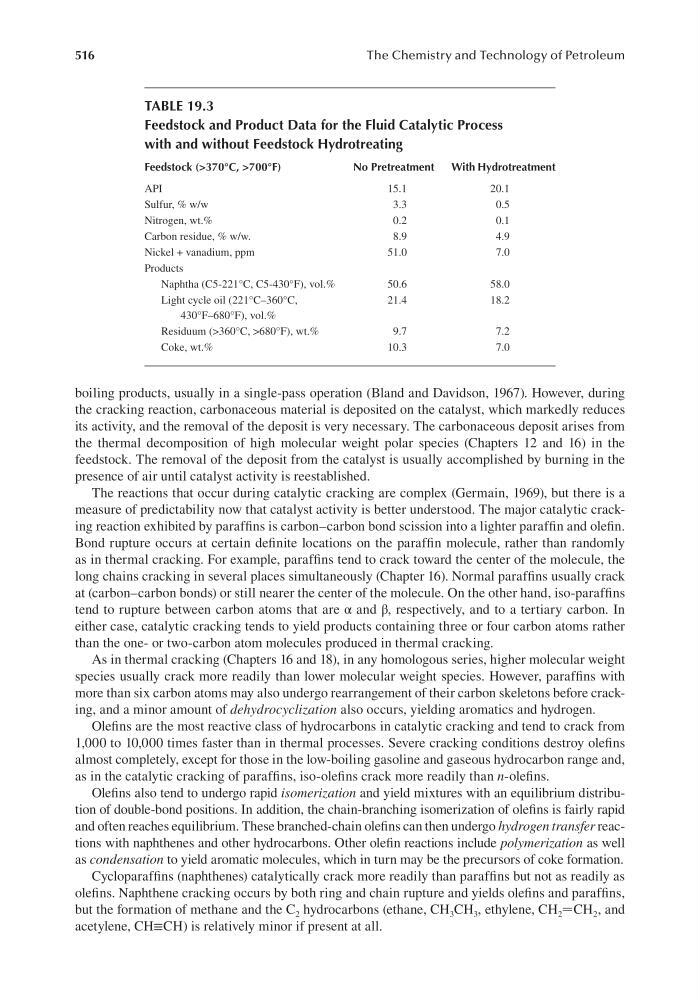
TABLE 19.3
Feedstock and Product Data for the Fluid Catalytic Process
with and without Feedstock Hydrotreating
Feedstock (>370°C, >700°F)
No Pretreatment
With Hydrotreatment
API
15.1
20.1
Sulfur, % w/w
3.3
0.5
Nitrogen, wt.%
0.2
0.1
Carbon residue, % w/w.
8.9
4.9
Nickel + vanadium, ppm
51.0
7.0
Products
Naphtha (C5-221°C, C5-430°F), vol.%
50.6
58.0
Light cycle oil (221°C–360°C,
430°F–680°F), vol.%
21.4
18.2
Residuum (>360°C, >680°F), wt.%
9.7
7.2
Coke, wt.%
10.3
7.0