

503
Thermal Cracking
the presence of superheated steam that is injected to strip the cracked products out of the reactor and
supply a part of heat required for cracking reaction. At the end of the reaction, the bottom product
is quenched. The oil and gas products (and steam) pass from the top of the reactor to the lower section of the fractionator, where a small amount of entrained material is removed by a wash operation.
The upper section is an ordinary fractionator, where the heavier fraction of cracked oil is drawn as a
side stream. The process bottoms (pitch) can be used as boiler fuel, as partial oxidation feedstock for
producing hydrogen and carbon monoxide, and as binder pitch for manufacturing metallurgical coke.
The process reactions proceed at lower cracked oil partial pressure by injecting steam into the
reactor, keeping petroleum pitch in a homogeneous liquid state and, unlike a conventional delayed
coker, a higher cracked oil yield can be obtained. A wide range of residua can be used as feedstock,
such as atmospheric and vacuum residue of petroleum crude oils, various cracked residues, asphalt
products from solvent deasphalting and native asphalt. After hydrotreating, the cracked oil is used
as feedstock for a fluid catalytic cracker or hydrocracker.
The original Eureka process uses two batch reactors, while the newer ET-II (q.v.) and the HSC
process (q.v.) both employ continuous reactors (Ohba et al., 2008).
18.4.6 FluId tHermAl CrACkIng ProCess
The fluid thermal cracking process (FTC process) is a heavy oil and residuum upgrading process
in which the feedstock is thermally cracked to produce distillate and coke (Table 18.10); the coke is
gasified to fuel gas.
The feedstock, mixed with recycle stock from the fractionator, is injected into the cracker is immediately absorbed into the pores of the particles by capillary force and is subjected to thermal cracking.
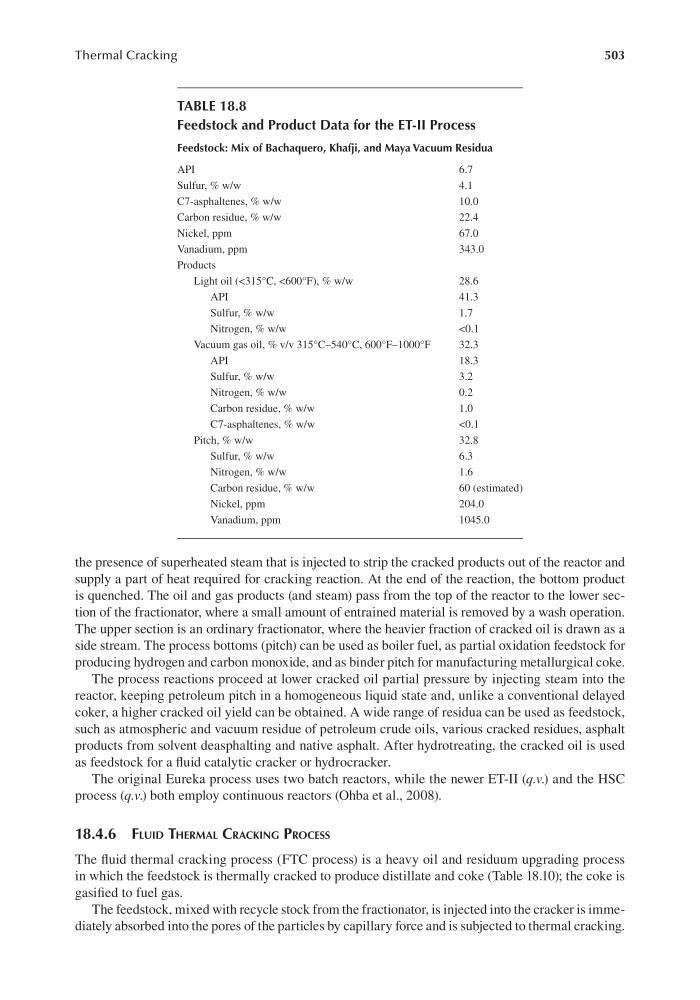
TABLE 18.8
Feedstock and Product Data for the ET-II Process
Feedstock: Mix of Bachaquero, Khafji, and Maya Vacuum Residua
API
6.7
Sulfur, % w/w
4.1
C7-asphaltenes, % w/w
10.0
Carbon residue, % w/w
22.4
Nickel, ppm
67.0
Vanadium, ppm
343.0
Products
Light oil (<315°C, <600°F), % w/w
28.6
API
41.3
Sulfur, % w/w
1.7
Nitrogen, % w/w
<0.1
Vacuum gas oil, % v/v 315°C–540°C, 600°F–1000°F
32.3
API
18.3
Sulfur, % w/w
3.2
Nitrogen, % w/w
0.2
Carbon residue, % w/w
1.0
C7-asphaltenes, % w/w
<0.1
Pitch, % w/w
32.8
Sulfur, % w/w
6.3
Nitrogen, % w/w
1.6
Carbon residue, % w/w
60 (estimated)
Nickel, ppm
204.0
Vanadium, ppm
1045.0