

502
The Chemistry and Technology of Petroleum
In the process, the feedstock is heated up to 350°C (660°F) by passage through the preheater
and fed into the bottom of the fractionator, where it is mixed with recycle oil, and the high-boiling
fraction of the cracked oil. The ratio of recycle oil to feedstock is within the range 0.1%–0.3% by
weight. The feedstock mixed with recycle oil is then pumped out and fed into the cracking heater,
where the temperature is raised to approximately 490°C–495°C (915°F–925°F), and the outflow is
fed to the stirred-tank reactor where it is subjected to further thermal cracking. Both cracking and
condensation reactions take place in the reactor.
The heat required for the cracking reaction is brought in by the effluent itself from the cracking
heater, as well as by the superheated steam, which is heated in the convection section of the cracking
heater and blown into the reactor bottom. The superheated steam reduces the partial pressure of the
hydrocarbons in the reactor and accelerates the stripping of volatile components from the cracked
residuum. This residual product is discharged through a transfer pump and transferred to a cooling
drum, where the thermal cracking reaction is terminated by quenching with a water spray after
which it is sent to the pitch water slurry preparation unit.
The cracked oil and gas products, together with steam from the top of the reactor, are introduced
into the fractionator where the oil is separated into the products: (1) cracked light oil, (2) vacuum
gas oil, and (3) pitch (Table 18.8).
18.4.5 eurekA ProCess
The Eureka process is a thermal cracking process to produce a cracked oil and aromatic residuum
from heavy residual feedstocks (Table 18.9; Aiba et al., 1981). In this process (Figure 18.7), the
feedstock, usually a vacuum residuum, is fed to the preheater and then enters the bottom of the
fractionator, where it is mixed with the recycle oil. The mixture is then fed to the reactor system that
consists of a pair of reactors operating alternately. In the reactor, thermal cracking reaction occurs in
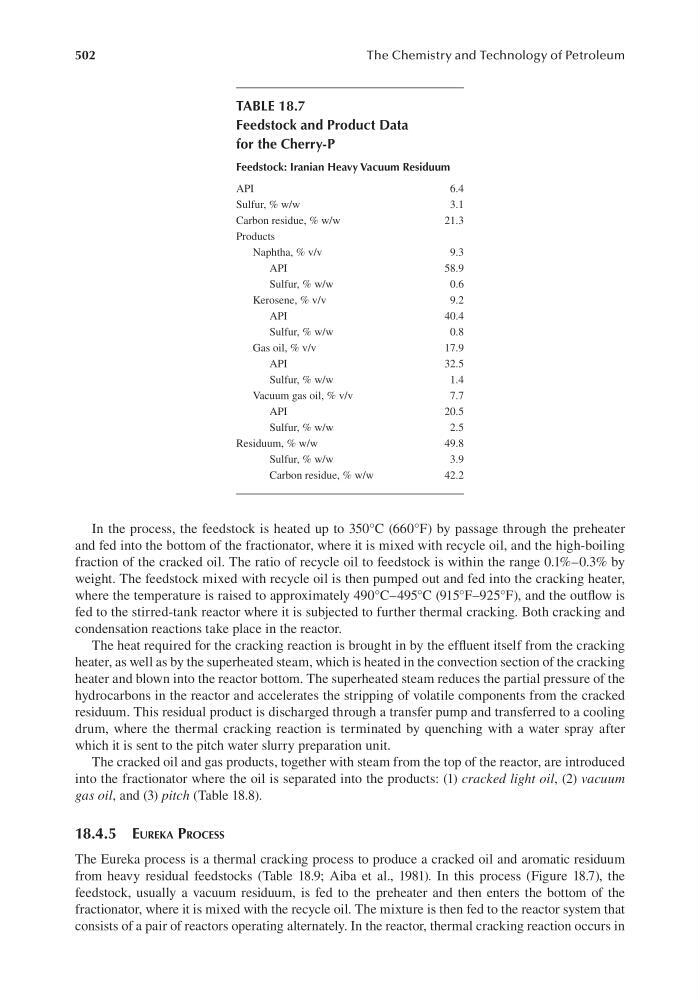
TABLE 18.7
Feedstock and Product Data
for the Cherry-P
Feedstock: Iranian Heavy Vacuum Residuum
API
6.4
Sulfur, % w/w
3.1
Carbon residue, % w/w
21.3
Products
Naphtha, % v/v
9.3
API
58.9
Sulfur, % w/w
0.6
Kerosene, % v/v
9.2
API
40.4
Sulfur, % w/w
0.8
Gas oil, % v/v
17.9
API
32.5
Sulfur, % w/w
1.4
Vacuum gas oil, % v/v
7.7
API
20.5
Sulfur, % w/w
2.5
Residuum, % w/w
49.8
Sulfur, % w/w
3.9
Carbon residue, % w/w
42.2