

501
Thermal Cracking
18.4.3 deCArBonIzIng
The decarbonizing thermal process is designed to minimize coke and gasoline yields but, at the
same time, to produce maximum yields of gas oil. Decarbonizing in this sense of the term should
not be confused with propane decarbonizing, which is essentially a solvent deasphalting process
(Chapter 20).
Thermal decarbonizing is essentially the same as the delayed coking process, but lower temperatures and pressures are employed. For example, pressures range from 10 to 25 psi, heater
outlet temperatures may be 485°C (905°F) and coke drum temperatures may be of the order of
415°C (780°F).
18.4.4 et-II ProCess
The ET-II process is a thermal cracking process for the production of distillates and cracked residuum for use as metallurgical coke and is designed to accommodate feedstocks such as heavy oils,
atmospheric residua, and vacuum residua (Kuwahara, 1987; Speight and Ozum, 2002). The distillate (referred to in the process as cracked oil) is suitable as a feedstock to hydrocracker and fluid
catalytic cracking. The basic technology of the ET-II process is derived from that of the original
Eureka process (q.v.).
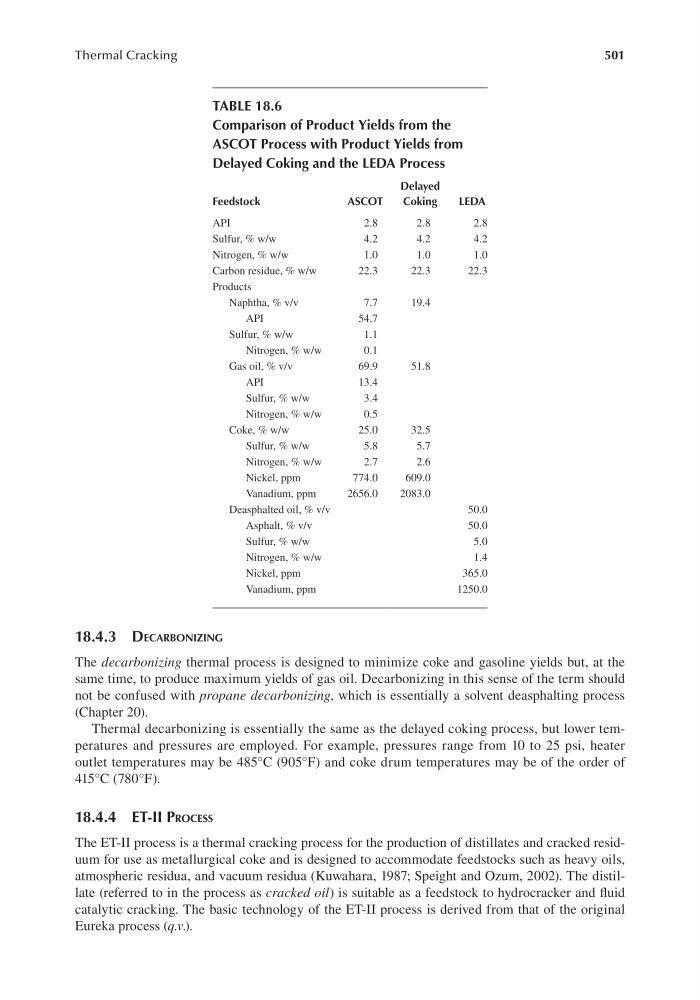
TABLE 18.6
Comparison of Product Yields from the
ASCOT Process with Product Yields from
Delayed Coking and the LEDA Process
Feedstock
ASCOT
Delayed
Coking
LEDA
API
2.8
2.8
2.8
Sulfur, % w/w
4.2
4.2
4.2
Nitrogen, % w/w
1.0
1.0
1.0
Carbon residue, % w/w
22.3
22.3
22.3
Products
Naphtha, % v/v
7.7
19.4
API
54.7
Sulfur, % w/w
1.1
Nitrogen, % w/w
0.1
Gas oil, % v/v
69.9
51.8
API
13.4
Sulfur, % w/w
3.4
Nitrogen, % w/w
0.5
Coke, % w/w
25.0
32.5
Sulfur, % w/w
5.8
5.7
Nitrogen, % w/w
2.7
2.6
Nickel, ppm
774.0
609.0
Vanadium, ppm
2656.0
2083.0
Deasphalted oil, % v/v
50.0
Asphalt, % v/v
50.0
Sulfur, % w/w
5.0
Nitrogen, % w/w
1.4
Nickel, ppm
365.0
Vanadium, ppm
1250.0